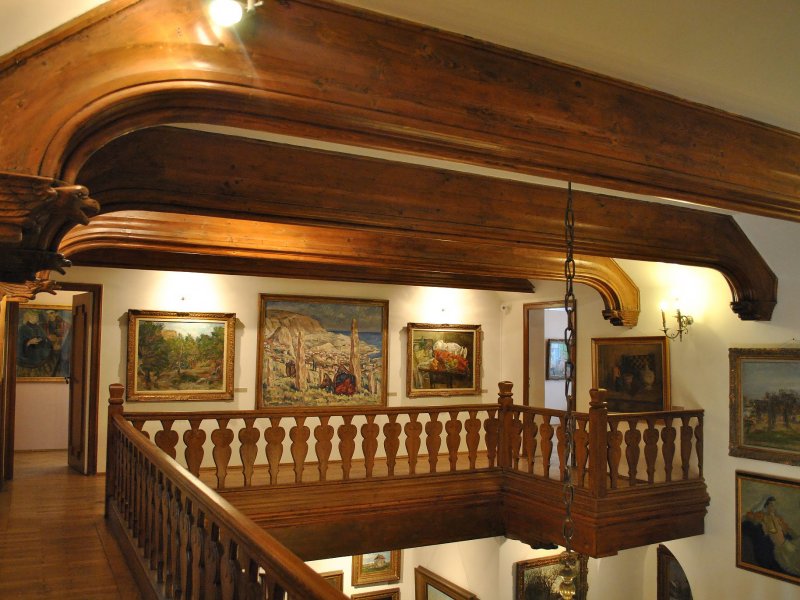
The Zambaccian Museum is one of those places Bucharest keeps quietly to itself, far from the busier tourist trails. Tucked into a calm corner of the Dorobanți neighborhood, it makes no grand announcement from the outside — and that's precisely what amplifies the effect once you step in.
The house was built specifically in the 1940s to hold the collection, conceived from the very beginning not as a home but as a space for display. Krikor H. Zambaccian — an Armenian-born businessman, art critic and collector whose eye was shaped by years in Paris — lived surrounded by the works he had gathered over half a century, opening the house to the public one day a week from the moment it was completed. In 1947 he donated to the Romanian state 205 paintings, 38 sculptures, 8 pieces of furniture and the building itself, with one implicit condition: the collection stays home.
And it does. The Romanian works trace an arc from Theodor Aman, Nicolae Grigorescu and Ioan Andreescu, through Ștefan Luchian, Nicolae Tonitza, Theodor Pallady and Gheorghe Petrașcu, all the way to Corneliu Baba and Horia Damian. Alongside them, a handful of canvases by masters such as Cézanne, Picasso, Matisse, Bonnard and Utrillo — unique in Romania — complete a collection that reads as a living conversation between modern Romanian art and the French tradition that shaped it so deeply.
The pace of the visit is that of a house, not a conventional museum. Outside, three sculptures by Oscar Han — "The Kiss," "Elegy," and "Nude" — greet you in the courtyard, while inside the atmosphere is intimate rather than solemn. You move through rooms, not halls. You look at works hung the way they would be in a beloved home, not labels on a white wall.
🕒 Hours: Wednesday – Friday: 10:00 – 18:00 | Saturday – Sunday: 11:00 – 19:00 | Monday & Tuesday: closed
📅 Free entry: first Wednesday of the month
📍 Address: Str. Muzeul Zambaccian nr. 21A, Sector 1
🎟️ Tickets: approx. 15–20 lei – adults / discounts available for pupils, students and pensioners