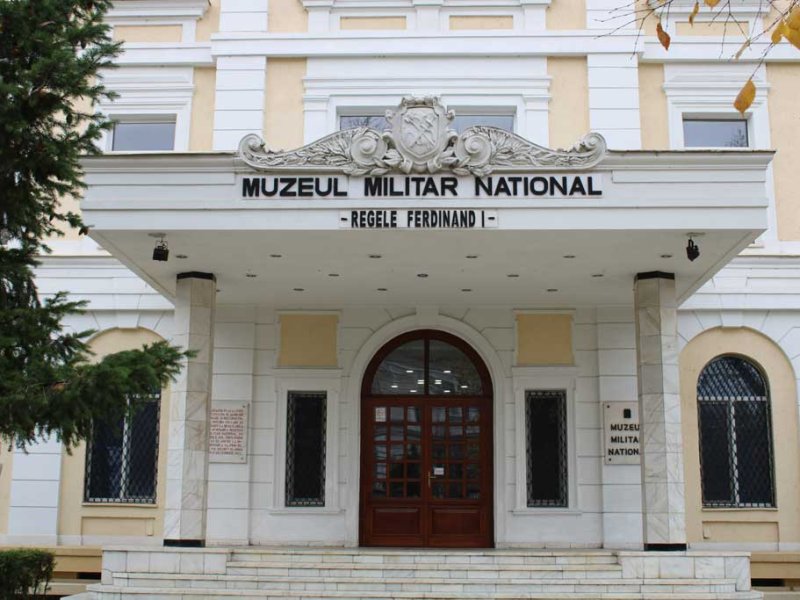
The museum was founded on 18 December 1923, by Royal Decree no. 6064, signed by King Ferdinand I himself — after whom it is named to this day. The founding purpose was clear: to preserve and pass on Romania's military memory at a time when the country had just emerged from the First World War with reunited territories, but also with deep wounds.
Over the decades, the collections grew steadily, and in 1985 the museum relocated to its current home on Strada Mircea Vulcănescu — a former barracks of the 4th Ilfov Infantry Regiment, later the headquarters of the Border Troops Command. The imposing building, with its interwar character and distinctly military architecture, perfectly complements the atmosphere you discover inside.
Today, more than 100 years after its founding, the museum houses a patrimony of approximately 1,280,000 items, organised across 27 thematic collections.
What You Can See
The museum spans 22,150 square metres, spread across several pavilions and an outdoor park of military hardware — one of the most spectacular spaces in the entire complex.
The general military history pavilion traces the evolution of the Romanian army from Antiquity and the Middle Ages through to the present day. You move through epochs and conflicts: from medieval helmets and armour, to the uniforms of the First and Second World Wars, to documents and objects from the December 1989 Revolution.
Among the most prized exhibits are the swords of Alexandru Ioan Cuza, Carol I, Ferdinand I, and King Michael I, uniforms worn by Queen Marie and other members of the royal family, the personal effects of Romania's greatest military commanders — Eremia Grigorescu, Alexandru Averescu, Ion Dragalina — and an exceptional collection of rare military orders and medals.
The thematic collections include:
- Edged weapons and firearms (over 11,700 objects)
- Romanian and foreign military uniforms (18,000 objects)
- Orders, medals, and badges (10,000 objects)
- Flags and standards (2,600 pieces)
- Paintings, sculptures, and drawings with military themes (3,200 works)
- Royal carriages and harnesses (1,150 objects)
- Ancient and medieval military archaeology (5,000 objects)
The aviation section is one of the museum's great surprises. Here you can see the replica of the "Coandă 1910" aircraft — considered by many to be the world's first jet-powered plane — and the re-entry module of the space capsule aboard which Romanian cosmonaut Dumitru Prunariu returned to Earth in 1981. These are exhibits you will not find anywhere else.
The outdoor military hardware park — when open — brings together tanks, artillery pieces, armoured vehicles, and fighter aircraft in the open air, including MiG jets and Renault tanks from the First World War. A genuine history lesson you can walk up to and touch.
Important notice (2026): The artillery and armoured vehicle park, along with the Aviation, Armament, and Royal Carriages pavilions, are temporarily closed due to ongoing works to roof over the inner courtyard. It is strongly recommended to check the museum's official website for updates before your visit.
Opening Hours
1 May – 31 October: Monday and Tuesday — CLOSED Wednesday – Sunday: 10:00 – 18:00 (last entry at 17:00)
1 November – 30 April: Monday and Tuesday — CLOSED Wednesday – Sunday: 09:00 – 17:00 (last entry at 16:00)
Admission Prices
CategoryPriceAdults | 10 lei
Children (over 5), pupils, students, pensioners | 3 lei
Children under 6, military pupils and students, war veterans, institutionalised children, people with disabilities | Free
Guide for groups of 5–15 people (by appointment) | 30 lei
Guide for groups of over 15 people (by appointment) | Free
Guide for groups of over 15 people, in foreign languages (by appointment) | 50 lei
Prices are indicative. Please check the official website for the most up-to-date information.
Getting There
Address: Strada Mircea Vulcănescu nr. 125–127, Sector 1, Bucharest
Metro:
- Eroilor station (lines M1 and M3) — approximately 10 minutes on foot
- Gara de Nord station (line M1)
Bus:
- Berzei stop: lines 168, 268, 368, 226, 12, 122
- Macedoniei stop: line 178
- Dinicu Golescu stop: lines 123, 305
Trolleybus: Dinicu Golescu stop — lines 62, 71, 85, 93, 96
Tram: Virgiliu stop — lines 20, 35, 44