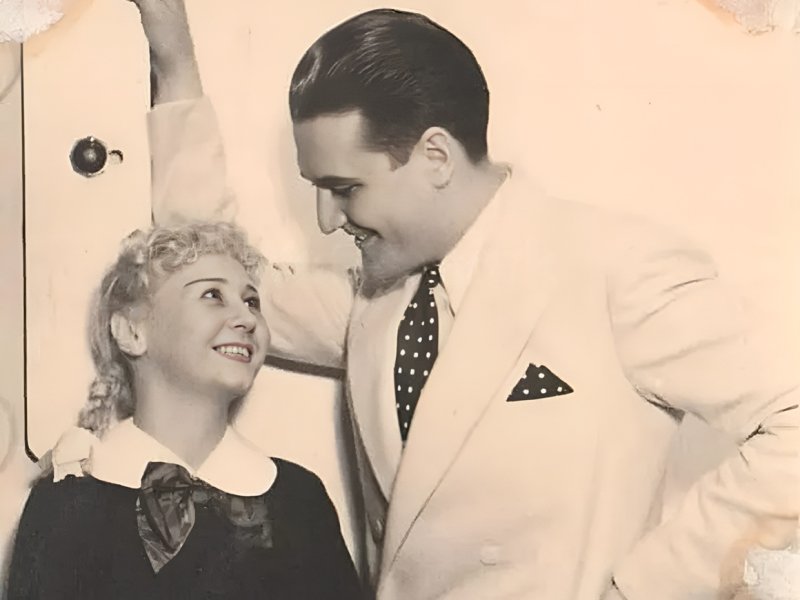
The stars of interwar Bucharest: The actress Nora Piacentini, a student of the great Nottara, ended her life at the age of 40
By Bucharest Team
- Articles
Interwar Bucharest was a city of strong contrasts, of cultural effervescence and of personal dramas hidden behind the spotlights. Among the emblematic figures of that era was Nora Piacentini, one of the most talented and charismatic theater actresses of the time.
A star of the interwar stage, extinguished too early
Cheerful, full of energy, and endowed with a stage charm that was hard to match, she managed to bring smiles to the faces of tens of thousands of spectators, even though, beyond the applause, her own life was marked by profound inner turmoil.
Born in 1905, in Galați, Nora Piacentini had a spectacular but short artistic path. At only 40 years old, her destiny was tragically cut short, leaving behind not only a remarkable career, but also numerous unanswered questions. Her death has remained one of the mysteries of the Romanian theatrical world, and her name continues to be associated with the charm, talent, and fragility of a generation of artists.
The call of theater and training under Nottara’s guidance
Nora Piacentini’s life initially seemed an ordinary one, without clear signs of an extraordinary destiny. Everything changed, however, in a decisive moment, when she attended the performance of the play “Moartea civilă” (“Civil Death”), starring the great Ion Manolescu. The emotional impact was so strong that the young woman decided to run away from home in order to follow her artistic dream.
Arriving in Bucharest, she enrolled at the Conservatory of Dramatic Art, where she had the rare chance to study under the guidance of the legendary Constantin Nottara. The master quickly sensed his student’s potential, noticing not only her innate talent, but also her explosive temperament, perfectly suited to the stage. Training under Nottara’s mentorship was essential in shaping her acting style, based on spontaneity, expressiveness, and an energy difficult to contain.
Her official debut took place on the stage of the Teatrul Popular, in the play “Școala femeilor” (“The School for Wives”) by Molière. It was the moment that opened the doors to Bucharest’s major stages and confirmed the emergence of a truly special actress.
Ascension on the great stages and unmistakable charm
After her debut, Nora Piacentini’s career experienced a rapid rise. She was cast successively at the Regina Maria Theatre, the Vesel Theatre, and the Comedia Theatre, where the public discovered an actress with a unique magnetism.
Critics and spectators alike were fascinated by her stage presence, her bodily expressiveness, and the unique way in which she combined comedy with a subtle note of melancholy.
The theater scholar F.O. Fosian memorably described her as a combination of Betty Boop and a “mischievous little devil,” a formula that perfectly captures her playful and unpredictable spirit. Nora Piacentini excelled in comic roles, but she was not limited to them.
From the delightful cocottes in productions at the Vesel Theatre, to the unconventional teacher in “Ionescu G. Maria,” or Luca, the vagabond in “Domnișoara Nastasia” by G.M. Zamfirescu, the actress demonstrated a versatility rarely encountered.
Legendary collaborations and resounding successes
Throughout her career, Nora Piacentini worked alongside some of the greatest actors of the era. She had important collaborations with Nicolae Stroe, who was also her husband at one point, as well as with the famous duo Stroe and Vasilache, extremely popular in those years. During the 1941–1942 period, she was part of the troupe led by Sică Alexandrescu, where she performed alongside legendary names such as Ion Iancovescu, Jules Cazaban, Radu Beligan, and Grigore Vasiliu-Birlic.
Her success was confirmed by productions such as “Kiki” (1939), “Mărgeluș” (1942), and “Pensiunea dragostei” (“The Boarding House of Love”, 1943), all received with enthusiasm by the public. Packed halls and thunderous applause consolidated Nora Piacentini’s status as one of the stars of Romanian interwar theater.
“Steaua fără nume” and a tense historical context
One of the most important roles of her career was Miss Cucu in the play “Steaua fără nume” (“The Star Without a Name”), written by Mihail Sebastian. The premiere took place on March 1, 1944, at the Alhambra Theatre, in an extremely delicate political context. Because of the author’s Jewish origin, he was forbidden to sign his creation, his name being replaced with that of the lawyer Ștefan Enescu.
The performance was staged under the supervision of agents of the state security, and the tension in the hall was palpable. Despite these conditions, the play enjoyed considerable success, and Nora Piacentini’s performance was highly praised. Nevertheless, this episode would remain linked to a series of shattered destinies and to the oppressive atmosphere of the final years of the war.
The Atlantic Theatre and a project of the heart
Another essential moment in the actress’s career was the founding of the Atlantic Theatre, on October 1, 1944. The project was carried out together with her husband at the time, the actor Mircea Șeptilici, and with their colleagues Nicolae Stroe and Elly Roman. The theatre operated on Academiei Street, in the space where the Intim Theatre had functioned briefly.
After the tragic death of Nora Piacentini, Nicolae Stroe decided that the theatre should bear her name, becoming the Nora Piacentini Theatre. For four years, until nationalization, performances were staged there to full houses, in a period marked by uncertainty and dramatic change. The theatre set out to offer the public joy and artistic quality, remaining a symbol of cultural resistance.
Love, fragility, and a mysterious ending
Her marriage to Mircea Șeptilici represented an important stage in the actress’s life. Although few details about their relationship have been preserved, it is known that the two shared a common passion for theatre and supported each other in their careers. However, the difficult context of the war, social pressures, and inner struggles seem to have profoundly affected Nora Piacentini’s emotional balance.
On January 15, 1945, the actress died under unclear circumstances. Officially, her death was classified as a suicide, and one hypothesis suggests that she ingested a large quantity of apricot or almond kernels, leading to cyanide poisoning. The announcement published by Mircea Șeptilici in the newspaper “Universul” was brief and painful, reflecting the shock of the loss.
Nora Piacentini’s death remains a mystery to this day. Beyond hypotheses and rumors, there remains the image of a brilliant artist who burned intensely on the stage of Romanian theatre and was extinguished far too early, leaving behind a legend of interwar Bucharest.
We also recommend: Stroe and Vasilache elevated humor to the rank of art in interwar Bucharest theater. The story of those nicknamed the Stan and Bran of Romania