Radu Calomfirescu, the “Dragon of Wallachia”, captain in the army of Michael the Brave, has a street bearing his name in Bucharest
By Bucharest Team
- Articles
The history of the Romanian Lands is full of heroic figures, and around the great rulers there gathered, over time, captains and boyars who contributed decisively to major military victories. In the era of Michael the Brave, the anti-Ottoman struggle generated a true gallery of heroes, some well known to the general public, others remaining rather in the shadow of official history, yet present in chronicles, ballads, and legends.
A name from the shadow of the great epics of Romanian history
Among them is Radu Calomfirescu, a great captain and Wallachian boyar, whose life and feats of arms have been passed down both through historical documents and through popular creations.
Radu Calomfirescu was one of Michael the Brave’s trusted men, involved from the very beginning in the anti-Ottoman war. Alongside other famous captains of the time, such as Deli Marcu or the priest Stoica from Fărcașele of Romanați, he contributed to the defense of Wallachia and of Christianity during an extremely turbulent period in the history of southeastern Europe.
A great Wallachian boyar and captain of chosen troops
Radu Calomfirescu came from the ranks of the great Wallachian boyar class and was related to the influential Buzești brothers, one of the most powerful political and military families of the era. This bond of blood and political alliance placed him within the narrow circle of Michael the Brave’s close collaborators, who relied on the loyalty and experience of these men in decisive moments.
The Chronicle of the Buzești mentions Radu Calomfirescu as an active participant in military campaigns from the very outbreak of the anti-Ottoman conflict. At the ruler’s command, he departed from the camp at Hulubești together with the Buzești brothers, having under his command “a number of chosen troops,” meaning elite forces, well trained and prepared for direct confrontation with the enemy. This trust granted by Michael the Brave speaks volumes about the captain’s status and military competence.
The victories at Putinei and Stănești
Among Radu Calomfirescu’s most important feats of arms is his participation in the battles of Putinei and Stănești, fought in January 1595. At Putinei, on January 4/14, and at Stănești, on January 6/16, the troops led by him and by the Buzești brothers achieved significant victories against Ottoman and Tatar forces.
The chronicle of the land also confirms his active role in these confrontations, recording that Michael the Voivode “sent guards against the Tatars” under the command of Radu Buzescu, his brothers, Preda and Stroe the Postelnic, and Radu Calomfirescu. These battles had a major impact on the course of the war, demonstrating the organizational and command capabilities of the Wallachian boyars in the face of a numerous and experienced adversary.
A diplomat in the service of Michael the Brave
Beyond his military role, Radu Calomfirescu also carried out important diplomatic missions. In May 1595, he and Radu Buzescu represented Michael the Brave at Alba Iulia, on the occasion of the wedding of Prince Sigismund Báthory with Maria Christina. This diplomatic mission underscores his position of trust within the Wallachian political and military elite.
Attendance at such an event was not merely ceremonial, but aimed to strengthen political alliances in an extremely tense regional context. Radu Calomfirescu was therefore not only a man of the sword, but also a boyar capable of representing the interests of Wallachia on the political stage of the time.
The controversies of Călugăreni and historical truth
Over time, numerous confusions and legends have arisen around Radu Calomfirescu. One of them claims, erroneously, that after the battle of Călugăreni he would have plotted against Michael the Brave and that he was killed on the ruler’s orders. Historians have shown, however, that this version does not correspond to reality.
On the contrary, a few years later, in the spring of 1600, Radu Calomfirescu is mentioned again as a participant in the Moldavian campaign, which confirms that he was still in the service of Michael the Brave. These clarifications are essential for separating documented truth from the fiction later created by popular tradition.
From chronicles to ballads and theatre
Radu Calomfirescu’s feats of bravery survived the centuries not only through documents, but also through popular literature. Over time, his image was transformed into a legendary one, and the captain became a character of ballads and historical epic songs. Popular imagination took his name and enriched it with fantastic elements, specific to legendary heroes.
The folk poem “Radu Calomfirescu,” collected by Vasile Alecsandri, mistakenly places him in the time of Mircea the Voivode and suggests a tragic destiny marked by boyar rivalries. Although the historical facts are distorted, the popular creation preserves what is essential: the image of a fearless fighter who confronted the Tatars and other dangers of the age.
The “Dragon of Wallachia” in the collective imagination
The epithet that has remained most strongly associated with his name is that of the “Dragon of Wallachia.” Popular verses call him “Radu of Calomfirești / the Dragon of the Romanian land,” turning him into a symbol of strength and courage. Even though these creations mix reality with fiction, they demonstrate the impact his personality had on collective memory.
In the second half of the nineteenth century, the playwright Ion Dumitrescu chose to turn Radu Calomfirescu into the main character of a historical drama bearing his name. This work, like the ballads, contains numerous inaccuracies, especially regarding his end, but it confirms the enduring interest of Romanian culture in this character.
The legacy of a forgotten captain, symbolically recovered
Radu Calomfirescu remains an eloquent example of the way history and legend intertwine. Although he does not enjoy the same notoriety as Michael the Brave or the Buzești brothers, his role in the great confrontations of the late sixteenth century is undeniable.
He was a captain of chosen troops, a skilled diplomat, and a loyal boyar, who bound his destiny to one of the most important epics in Romanian history.
Today, his name is symbolically recovered not only through historical studies and cultural creations, but also through the urban toponymy of the capital.
Where Radu Calomfirescu Street is located in Bucharest
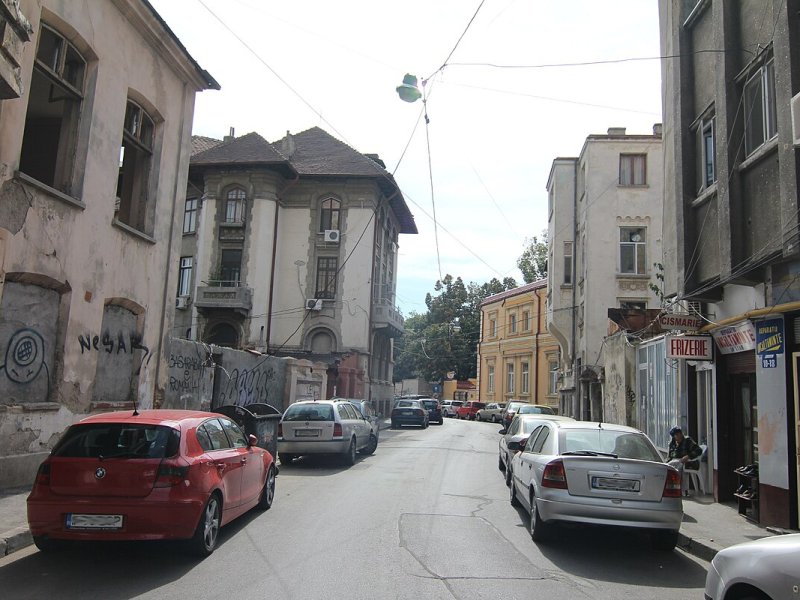
Radu Calomfirescu Street is located in the municipality of Bucharest, in Sector 1, in a central-northern area of the city. It is situated in the Dorobanți neighborhood, an area known for its residential character and for streets bearing the names of historical and cultural personalities.
Located within an elegant perimeter and well connected to the main arteries of the capital, Radu Calomfirescu Street represents a discreet tribute to this legendary captain, the “Dragon of Wallachia,” who fought for the defense of Wallachia in the time of Michael the Brave.
We also recommend: Who was Voivode Alexandru Moruzi and why a street in Bucharest bears his name