Why Bucharest Looks Cheap Only in Excel: The Gap Between Prices and Real Life
By Bucharest Team
- Articles
- 04 FEB 26
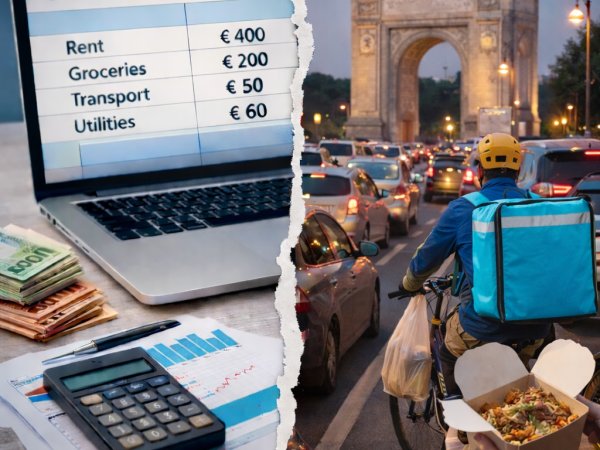
In international cost of living rankings, Bucharest is often listed among the most affordable capitals in the European Union. Rents are lower than in Prague or Warsaw, services are cheaper than in Western Europe, and the consumer basket remains, statistically, below the regional average. Seen from the outside—or through a spreadsheet—the city appears competitive and budget-friendly.
Daily life, however, tells a different story. Bucharest is not expensive because of its listed prices, but because of a series of recurring, hard-to-measure costs that never appear in Excel, yet are paid every day.
The cost of time: an expense that appears nowhere
Traffic is one of Bucharest’s largest invisible costs. Hours lost daily in commuting are not just an inconvenience; they represent a real economic loss. In practice, wasted time quickly turns into money spent on compensatory solutions:
- frequent use of ride-sharing instead of public transport,
- food delivery replacing home cooking due to lack of time,
- paid services for routine tasks, simply to reclaim functional hours.
Excel does not charge for time. The city does.
Housing: rent is only the entry price
Relatively low rents are often cited as Bucharest’s main affordability advantage. The problem is that rent alone does not reflect the true cost of housing. Older apartment blocks bring constant and unpredictable expenses, while basic comfort often requires additional investments.
In practice, housing frequently involves:
- high maintenance costs,
- recurring repairs,
- alternative solutions for hot water, heating, or cooling.
These expenses are not exceptions—they are part of everyday urban life—yet they are almost never included in international comparisons.
Paying for normality: when private services become necessary
One of the key ways Bucharest becomes more expensive than it looks is through the transfer of system failures to the individual. To achieve predictability and efficiency, many residents end up paying extra for services that, in other cities, are provided reliably by the public system.
The most common examples include:
- education (afterschool programs, private kindergartens and schools),
- private healthcare, chosen for access and time efficiency,
- alternative transport, used to compensate for unreliable infrastructure.
This is not about luxury, but about purchasing basic functionality.
Utilities: cheap on paper, unstable in reality
Regulated or subsidized utility prices create the impression of low living costs. In reality, service instability changes the equation entirely. Hot water and district heating are often unpredictable, making redundancy unavoidable.
As a result, residents pay not only for consumption, but for the assurance of access, through backup solutions that require both investment and ongoing costs.
The mental cost of the city
There is also a harder-to-measure dimension with clear economic consequences: urban stress. A fragmented, noisy, and unpredictable city generates cognitive fatigue, which directly shapes spending behavior. People tend to spend more on fast, convenient solutions meant to reduce friction and regain time.
Stress does not appear in household budgets, but it strongly influences how money is spent.
Why cost-of-living rankings miss the full picture
Most international cost of living rankings compare:
- rent,
- food prices,
- public transport,
- basic utilities.
They do not include:
- the cost of avoiding system dysfunctions,
- private substitute services,
- time and energy losses,
- infrastructural instability.
This is why Bucharest performs well on nominal prices, but poorly on what could be called the total cost of urban functioning.
Conclusion
Bucharest looks cheap when reduced to numbers. In reality, the cost of living is fragmented, diffuse, and constant. The city does not demand large sums all at once; instead, it forces residents to pay continuously to compensate for what does not work well enough.
The difference between a cheap city and an accessible one lies not in prices, but in how much extra you must pay to live a normal life.
Also recommended How to save money in Bucharest when you have a family – without drastic changes