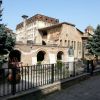
Who was the politician Anastasie Panu and why does he have a street named after him in Bucharest

- Articles
- 26 JAN 26
The name Anastasie Panu is today known mainly through a street in Bucharest, yet few passers-by know the story of the man behind this name. Anastasie Panu was one of the key figures of the 1848 generation in Moldavia, a respected jurist, a courageous politician, and a firm supporter of the Union of the Romanian Principalities. His activity unfolded during an extremely turbulent period, marked by political conflicts, revolutions, and major transformations, and his role was essential in the consolidation of the modern Romanian state.
The origins and professional training of Anastasie Panu
Anastasie Panu was born in 1810, in Iași, a city that was to play a decisive role in the political history of Moldavia and of the future Romanian state. Here he pursued his legal studies, choosing a career in the magistracy, a field in which he quickly distinguished himself through competence and firmness. His legal education offered him not only a profession, but also an important instrument for involvement in public life and for defending the principles of legality and justice.
At the beginning of his career, Anastasie Panu lived for a period in Huși, where from 1845 he served as a member of the Tribunal, and later became president of this institution. This position consolidated his reputation as an upright magistrate and allowed him to come into direct contact with the social and administrative problems of the time, experience that proved extremely useful in his later political activity.
The conflict with Mihail Sturdza and the first political reprisals
The rise of Anastasie Panu was not without obstacles. A decisive moment in his life was the conflict with Prince Mihail Sturdza, who ruled Moldavia between April 1843 and June 1849. Panu supported the candidacy of Lascăr Rosetti for the position of deputy, a gesture considered a direct challenge to princely authority.
As a result of this political stance, Anastasie Panu was dismissed from office and imprisoned for three months in Galați. This experience did not discourage him; on the contrary, it strengthened his political convictions and brought him closer to the reformist and revolutionary circles that opposed the authoritarian regime of the time.
Involvement in the 1848 Revolution in Moldavia
The year 1848 represented a turning point for the whole of Europe, and Moldavia was no exception. Anastasie Panu was among the active participants in the Moldavian revolutionary movement of March 1848. He was one of the members of the assembly organized at the Sankt Petersburg Hotel in Iași, a place that became a symbol of the attempt to reform Moldavian society.
This revolutionary movement was, however, quickly repressed, and the authorities ordered the arrest of the participants. Even though the revolution did not achieve its immediate goals, Panu’s involvement established him as a supporter of change and modernization, willing to assume personal risks for his ideals.
Return to administration and political ascent
After the end of this period of instability, during the reign of Grigore Alexandru Ghica, Anastasie Panu settled again in Iași. In 1852, he obtained a position as director within the Ministry of Justice, and later he was appointed ad-interim minister in the same ministry. This return to administrative structures demonstrated the recognition of his professional competence, as well as the need for experienced people in a period of reforms.
In the following years, Panu became one of the central figures of Moldavian political life. He was a deputy in the Princely Divan in 1856 and a founding member of the Central Electoral Committee in Iași, in February 1857. His activity increasingly focused on supporting the Union of the Principalities, an objective he considered vital for the future of the nation.
Anastasie Panu and the road toward the Union of the Principalities
In 1857, Anastasie Panu was elected a unionist deputy in the ad-hoc Divan of Moldavia, a political body essential to the process of unification. He was a declared supporter of the candidacy of Colonel Alexandru Ioan Cuza, seeing in him the leader capable of materializing the ideal of union.
In the tense context of the years 1858–1859, Panu was appointed, together with Ștefan Catargiu and Vasile Sturdza, to form the princely Lieutenancy, also known as the three-man Caimacamate. This provisional governing body ruled Moldavia between October 1858 and January 5, 1859. Following political divergences, Ștefan Catargiu was removed, and Anastasie Panu, allied with Vasile Sturdza, firmly supported Cuza’s candidacy to the throne of Moldavia.
Recognition of merits and role in the united state
After the election of Alexandru Ioan Cuza as ruler of Moldavia on January 5, 1859, and later of Wallachia on January 24, Anastasie Panu received official recognition for his merits. In the session of January 20, 1859, the Elective Assembly of Moldavia issued a motion of thanks addressed to the former caimacams Vasile Sturdza and Anastasie Panu, for the patriotism and courage with which they defended national autonomy and dignity.
The motion, read by Mihail Kogălniceanu, even proposed the creation of a commemorative medal, at the expense of the state, to publicly consecrate the role of the two in national history. After the Union, Anastasie Panu was appointed president of the Elective Assembly, a position he held during the first part of Cuza’s reign.
Government activity and the final years
Between January 17 and September 23, 1861, Anastasie Panu was appointed by Alexandru Ioan Cuza to lead the Council of Ministers in Iași, at the same time holding the position of Minister of the Interior. He thus contributed directly to the administration and consolidation of the new structures of the united Romanian state.
With the establishment of the single Assembly on January 24, 1862, Panu became a deputy, being elected in several legislatures. His parliamentary activity was, however, affected by health problems. In 1867, being ill, he died on the road to Vienna, at the age of 57.
The legacy of Anastasie Panu remains significant. The street that bears his name in Bucharest is a discreet tribute to a politician who placed principles, courage, and national interest above personal ambitions, contributing decisively to the birth of modern Romania.
We also recommend: Who Radu of Afumați Was and Why a Street in Bucharest Bears His Name