Who was the painter Ion Negulici and why is there a street named after him in Bucharest?
- Articles
- 30 SEP 26
In Bucharest, there are numerous streets that bear the names of politicians, writers, architects or artists who contributed to the transformation of Romanian society. Among them is Pictor Ion Negulici Street, in Sector 1, a name that refers to one of the complex personalities of the 1848 generation. Ion D. Negulici was not merely a painter. He was also a draftsman, lithographer, translator, journalist and an active participant in the 1848 Revolution in Wallachia. At a time when Romanian art was gradually emerging from the miniature tradition and from portraiture of Oriental type, Negulici tried to bring to the Principalities modern artistic models that he had encountered during his studies abroad. Museums and specialized works today include him among the important representatives of Romanian art from the first half of the 19th century. His destiny was, however, much shorter than the breadth of his interests might have suggested. Ill with tuberculosis, involved in the revolutionary movement of 1848 and later forced to go into exile, Negulici died in Constantinople in 1851, at only 39 years of age.
The child from Câmpulung who reached Saint Sava
Ion D. Negulici was born in 1812, in Câmpulung Muscel, into a priest's family, his father being Dimitrie Negulici. He learned his first notions of drawing and painting in the local environment, at a school where icon painting was practiced. This initial training would later be surpassed through contact with Western art, but it represents the starting point of one of the artists who would contribute to the modernization of Romanian painting.
The young Negulici then arrived in Bucharest, where he studied at Saint Sava College. The institution was one of the important educational centers of the generation that would play a major role in the political and cultural transformations of the middle of the 19th century. Biographical sources place him here among young people such as Vasile Alecsandri and Alexandru Ioan Cuza, and contact with the Bucharest intellectual environment brought him closer to the reformist ideas circulating at the time. Saint Sava College, in fact, includes Ioan D. Negulici among the personalities associated with the institution.
In Bucharest, Negulici also attended the School of Decorative Arts founded by Ana Rosetti. In 1830, he left for Iași, where for approximately four years he studied painting with Niccolò Livaditti, one of the important artists of the Moldavian cultural environment of that period.
His training did not stop in the Principalities. Although he was already suffering from tuberculosis, Negulici went abroad for studies, receiving support from the Eforia Școalelor. He reached Athens and Paris, and in Paris he worked in the academic environment of painters Léon Cogniet and Michel Martin Drolling. Because of financial difficulties, he did not remain long in the French capital and headed for Vienna, where he specialized in lithography.
In Vienna, he met Constantin Daniel Rosenthal, the painter who would himself become one of the artistic figures associated with the 1848 Revolution. Negulici persuaded him to come to Wallachia, thus contributing to the connection between the generation of artists trained in the West and the cultural and revolutionary environment of the Principalities.
A painter who went beyond the portrait tradition
Ion Negulici is important in the history of Romanian art also because of the variety of his interests. In the first half of the 19th century, portraiture occupied an important place in the activity of artists in the Principalities, but Negulici tried to broaden this perspective. He created portraits, drawings, lithographs, watercolors and landscapes, contributing to the detachment of Romanian painting from traditional formulas.
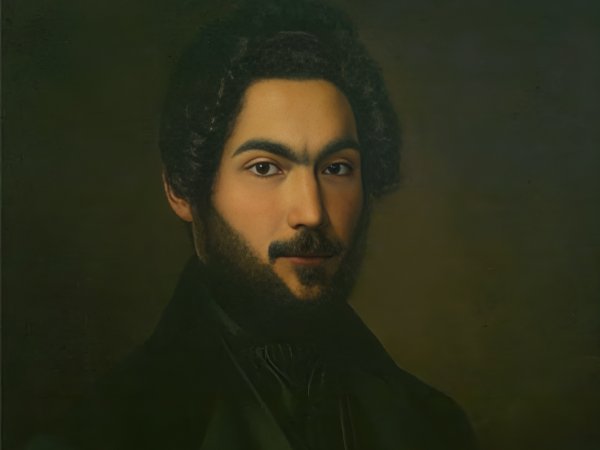
Among the personalities he portrayed were Nicolae Bălcescu, C.A. Rosetti, Ion Heliade Rădulescu, Cristian Tell, Cezar Bolliac, Dimitrie C. Brătianu, Alexandru Zanne and Constantin Daniel Rosenthal. His portraits today also have important documentary value, because they preserve the image of people who played an essential role in the political and cultural life of the 1848 generation. The National Museum of Romanian History preserves, among other works, a self-portrait of the artist, a work classified as part of the National Cultural Heritage as a treasure in 2019.
Negulici also painted landscapes, a genre that did not yet have an established tradition in Romanian art of the time. One of his known works is Landscape from Câmpulung (The Birthplace and Negru-Vodă Monastery), preserved at the National Museum of Art of Romania. The painting, made in oil on canvas, was classified as part of the National Cultural Heritage as a treasure in 2014.
He also created works in watercolor, including Woman in Blue, noted for the transparency of its tones. The diversity of the techniques he used shows that Negulici cannot be reduced to the image of a simple portraitist of the political figures of his time.
Painter, translator and collaborator of Heliade Rădulescu
Ion Negulici's activity was not limited to the painting studio. After returning to the country, the artist became involved in the cultural projects associated with Ion Heliade Rădulescu and the publication Curierul Românesc. He created drawings and lithographs, translated texts and wrote, contributing to the effort to educate and culturally enlighten the public.
Biographical sources present him as one of Heliade Rădulescu's important collaborators, being involved even in editorial activity when Heliade was absent. Negulici wrote prose and theatre, made translations and concerned himself with issues of the Romanian language. He compiled a Romanian Vocabulary, intended to explain neologisms, and worked on editorial projects through which he sought to give as broad a public as possible access to literature and culture.
An interesting example of this activity is his translation of Gulliver's Travels from a French version, for which Negulici also created illustrations inspired by Grandville's engravings. Thus, the painter simultaneously became a translator, illustrator and journalist, which says much about the role that artists and cultural figures could play in the intellectual modernization of Romanian society.
The revolutionary who became prefect of Prahova
In 1848, Negulici's artistic and cultural path was interrupted by the revolutionary events. A member of the “Frăția” society, he became actively involved in the 1848 movement and placed his talent as an artist and journalist at the service of the revolutionary cause.
In June 1848, Negulici was appointed administrator of Prahova County, a position equivalent to that of a prefect in the modern administration. Historical documents and research record his appointment in the context of the reorganization of the administration by the revolutionary government. In Ploiești, his activity was connected with the organization of the new administration and with the consolidation of the revolutionary structures.
The period during which he led the administration of Prahova was, however, very short. The 1848 Revolution in Wallachia was defeated, and the intervention of Ottoman and Russian troops radically changed the political situation. Negulici was forced to leave the country, taking refuge first in Transylvania and then in the Ottoman Empire.
In Ploiești, the memory of his activity as prefect is also preserved through a bust placed near the “Toma Caragiu” Municipal Theatre. The bust replaced a memorial plaque installed in 1968 on the theatre wall, which recalled the position held by the painter during the 1848 Revolution.
The final years in exile and his death in Constantinople
Exile represented the final stage of a life already marked by illness. After leaving Wallachia, Negulici reached Brașov and later the Ottoman Empire. In Bursa, where he was sent into exile, he continued to work, creating mainly drawings and portraits. Historical sources also mention the appreciation he received from Sultan Abdul-Medjid.
The tuberculosis from which he suffered, however, worsened. Ion Negulici died in Constantinople on April 5, 1851. This date is confirmed by research published by the National Museum of Romanian History and by works dedicated to his biography, although some secondary sources indicate other dates in April. Historical research published by the National Museum of Romanian History explicitly mentions that the artist died on April 5, 1851, and records information about his funeral in Constantinople.
His death, at only 39 years of age, brought an end to an activity that had encompassed painting, lithography, literature, journalism and politics. Precisely this combination makes him representative of the 1848 generation, in which the boundaries between artist, writer, journalist and political activist were often very fluid.
Why there is a Pictor Ion Negulici Street in Bucharest
Today, the memory of Ion Negulici is also present in Bucharest through Pictor Ion Negulici Street, located in Sector 1. The street is officially recorded in the list of streets of Sector 1 under this name.
The street is part of an area where several roads bear the names of artists and cultural figures, and its name places Negulici within the same urban memory of Bucharest as other important painters. Sources dedicated to the history of the capital's streets include him among the visual artists who have had a street named after them, alongside Barbu Iscovescu, Constantin Daniel Rosenthal, Gheorghe Tattarescu, Theodor Aman, Nicolae Grigorescu and others.
More than just a name on a street sign, the street recalls a figure who simultaneously belonged to several worlds. Negulici was the artist who contributed to the modernization of Romanian painting, the cultural figure involved in spreading books and modern ideas, and the revolutionary who accepted to temporarily abandon his studio for the administration of a province in the midst of intense political turmoil.
At a time when modern Romania was only beginning to take shape, Ion Negulici tried to participate in the transformation of society through every means available to him. He painted the faces of a generation, drew the landscapes of a country discovering its modern identity, translated and wrote for the general public, and in 1848 entered directly into the center of political events. The fact that a street in Bucharest bears his name today is therefore connected not only to his artistic value, but also to the place he occupied in the generation that prepared modern Romania.
We also recommend: Who was George Missail and why does a street in Bucharest bear his name?