Who Was the Architect Louis Pierre Blanc and Why Does a Street in Bucharest Bear His Name?
- Articles
- 08 JUN 26
Bucharest is a city where history and architecture meet at every step. From the grand boulevards to the hidden streets of the city center, numerous buildings preserve the imprint of architects who played a decisive role in transforming the city into a European metropolis. Among them is Louis Pierre Blanc, one of the most important architects who worked in Romania at the end of the 19th century and the beginning of the 20th century. Although his name is not as widely known to the general public as that of Ion Mincu, his works are still present today in some of the most important areas of Bucharest. Many of the buildings designed by him continue to house prestigious institutions, and their architectural value has earned them the status of historical monuments. His contribution to the development of the Capital was so significant that a street in Bucharest bears his name, as a sign of recognition for the legacy he left to the city.
The Swiss architect who contributed to the modernization of Bucharest
Louis Pierre Blanc was born in Switzerland and arrived in Romania in 1884, during a period when Bucharest was undergoing an extensive process of modernization. His arrival in the country was facilitated by the close relationship he had with the famous Romanian architect Ion Mincu, one of the promoters of the Romanian Revival style.
At that time, the Romanian Capital was experiencing rapid development, and the demand for public buildings and elegant residences was constantly increasing. Louis Pierre Blanc’s talent was quickly recognized, and his projects soon became sought after by both state institutions and members of the political and economic elite.
The architect integrated easily into Romanian society, including through his two marriages to women from influential families: Elena Șuțu and later Irina Berindei. These connections gave him access to the aristocratic circles of the time and strengthened his professional reputation.
His architectural style was strongly influenced by the European movements of the era, especially Neo-Renaissance architecture and the Beaux-Arts style, which was highly appreciated in the great Western capitals.
Maurice Blank Palace, one of his most famous creations
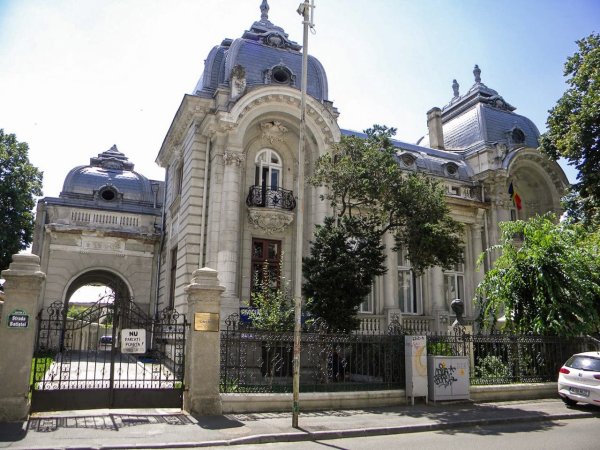
Probably the most famous building designed by Louis Pierre Blanc is Maurice Blank Palace, located on Batiștei Street, near University Square. For approximately seven decades, the building was known as the headquarters of the Embassy of the United States of America in Bucharest.
Originally built as a private residence for the family of banker Maurice Blank, the palace quickly became one of the most elegant homes in the Capital. Its architecture impresses through its generous proportions, ornamental details, and French neoclassical influences.
The building has nearly 50 rooms and a usable area of more than 2,000 square meters. Surrounding it is a spacious garden, complemented by a fountain, an element that enhanced the aristocratic character of the property.
Even after the U.S. Embassy moved to a new headquarters, the building remained one of the most valuable historic properties in Bucharest and a landmark of early 20th-century architecture.
Representative buildings that bear the signature of Louis Pierre Blanc
The legacy left by the Swiss architect is far broader than the famous palace on Batiștei Street. In fact, a walk through central Bucharest allows visitors to discover several constructions created according to his plans.
On Calea Dorobanților stands Maria Lahovary House, one of the most elegant historic residences in the Capital. Built in the style of the French Renaissance, the building impresses through the symmetry of its façade and the refinement of its architectural details. Today, the property houses Cambridge School of Bucharest.
Also on Batiștei Street, one can admire H. Spayer Palace, built for the industrialist Herman Spayer. During the interwar period, the building was so highly regarded that it frequently appeared on postcards, illustrated cards, and tourist materials dedicated to Bucharest.
In the same area stands the house of Nicolae Filipescu, former mayor of the Capital and one of the important personalities of Romanian political life at the beginning of the 20th century. Unfortunately, the building is now in an advanced state of deterioration.
Louis Pierre Blanc also designed the residence of Take Ionescu, an important politician and former President of the Council of Ministers. At the time of its construction, his house was considered one of the most elegant private residences in Bucharest.
Public institutions that bear his imprint
Louis Pierre Blanc’s contribution was not limited to private residences. Some of the most important public institutions in Romania still operate today in buildings designed by him.
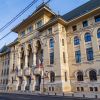
A remarkable example is the current headquarters of the Ministry of Agriculture. Inaugurated in 1895, the palace was built in the French Renaissance style and has preserved its original appearance almost intact. The façade is decorated with numerous sculptural elements, while the main entrance is flanked by two monumental statues representing Hercules.
Another important work is the Palace of the Faculty of Medicine in Bucharest, today’s “Carol Davila” University of Medicine and Pharmacy. The building was inaugurated in 1903 and represents one of the most valuable architectural achievements in the Cotroceni area.
Its monumental façades, domes, and symmetrical organization of volumes reflect the French academic influences that defined Blanc’s work. In front of the building stands the famous statue of Doctor Carol Davila, created by sculptor Carol Storck.
Louis Pierre Blanc was also the architect of the “Alexandru Ioan Cuza” University Palace in Iași, one of the most important university buildings in Romania.
Victor Babeș Institute and his contribution to medical architecture
Among his landmark projects is the current headquarters of the National Institute for Research and Development in Pathology and Biomedical Sciences “Victor Babeș,” located on Splaiul Independenței.
The institute was conceived following the model of the great medical research centers of Western Europe and began operating in its current building in 1899. The architectural project was praised even by the scientist Victor Babeș, who highlighted the originality and functionality of the construction.
The building remains one of the most important architectural achievements dedicated to medical research in Romania and demonstrates Louis Pierre Blanc’s ability to combine monumental aesthetics with the practical requirements of a modern institution.
Why does Louis Pierre Blanc have a street in Bucharest?
Few foreign architects have had such a strong impact on the image of Bucharest as Louis Pierre Blanc. For decades, his projects contributed to transforming the Capital into a city comparable to the great urban centers of Europe.
Numerous buildings designed by him are still in use today, and their historical and architectural value is undeniable. From public institutions and universities to aristocratic residences, his creations shaped the appearance of modern Bucharest.
For this reason, the authorities of the Capital decided to honor his memory by assigning his name to a street. It is a symbolic gesture through which the city recognizes the contribution of an architect who profoundly influenced the urban development and built heritage of Bucharest.
Where is Louis Blanc Street located in Bucharest?
Louis Blanc Street is located in the central area of Bucharest, in the Dorobanți neighborhood, one of the most elegant and highly regarded districts of the Capital. From an administrative point of view, the street is situated in Sector 1 of Bucharest, close to important thoroughfares such as Calea Dorobanților and Dacia Boulevard.
We also recommend: Stories of Bucharest: Henrieta Delavrancea knew she would become one of the greatest Romanian architects from the age of just 6