Who was Barbu Văcărescu and why does a street in Bucharest bear his name
By Bucharest Team
- Articles
- 14 OCT 26
Bucharest is home to numerous streets named after rulers, writers, artists, politicians and military figures. Some of these names are very well known, while others have remained largely hidden behind the city map. One of them is Barbu Văcărescu Street, today one of Bucharest’s important thoroughfares, running through an area that has undergone a spectacular transformation in recent decades. The name of the street, however, refers to a figure who belonged to a world very different from present-day Bucharest. Barbu Văcărescu was a prominent Wallachian boyar and held one of the highest offices in Wallachia, that of Great Ban of Craiova. He died in 1832, during a period of major political and administrative changes, when the old system of great boyar offices was beginning to be transformed. His importance is not limited to the office he held. Barbu Văcărescu belonged to an old and powerful boyar family, and through his daughter, Stanca Văcărescu, he became the maternal grandfather of Barbu Catargiu, the first president of the Council of Ministers of Romania after the establishment of the modern Romanian state. His name therefore connects two important periods in Romanian history: the world of the great boyars of Wallachia and the beginnings of modern Romania.
Barbu Văcărescu and the family he came from
To understand who Barbu Văcărescu was, it is first necessary to look at the family to which he belonged. The Văcărescu family was one of the great boyar families of Wallachia, with a long-standing presence in the country’s political, administrative and cultural life. The family produced numerous officials, as well as important figures in Romanian culture, including the Văcărescu poets.
Barbu Văcărescu lived in a society in which noble rank, landed wealth and the holding of high offices were the main ways in which the elites exercised authority. The great boyar families owned extensive estates, strengthened their positions through marriages and repeatedly occupied important positions in the princely administration.
Historical sources mention Barbu Văcărescu as Great Ban of Craiova, one of the highest offices in the hierarchy of Wallachia. Neagu Djuvara identifies him as the last Great Ban of Craiova, who died in 1832, at a time when the traditional structure of the boyar institutions was already undergoing significant changes.
Therefore, when Bucharest residents encounter the name Barbu Văcărescu today on an important avenue, it is not simply a name chosen at random for the city’s street directory. It refers to a representative of a family that played a considerable role in the political and social history of Wallachia.
What did the office of Great Ban of Craiova mean?
The title of Great Ban of Craiova was one of the most important offices in Wallachia. The Great Ban was associated with the administration of Oltenia and occupied a very high position in the hierarchy of officials. The influence attached to this office was considerable, and the person holding it belonged to the country’s political elite.
Barbu Văcărescu appears in historical documents in his capacity as Great Ban and in contexts that demonstrate his authority. An inventory of documents held by the National Archives, for example, records documents and legal disputes in which the “late Ban Văcărescu” is mentioned, including matters concerning properties and disputes over estates.
The office was not merely honorary. Great officials participated in the administration of the country and in resolving important matters, while their authority was closely linked to the political system of the period. A document concerning the events of 1821 mentions Barbu Văcărescu as Great Ban of Craiova during the unrest caused by Tudor Vladimirescu’s movement. The text lists him among the boyars consulted regarding the extremely tense political situation of the time.
His death in 1832 therefore marked the end of an era. It is no coincidence that Romanian historiography associates him with the expression “the last Great Ban of Craiova”, a phrase emphasizing the gradual disappearance of the old system of great princely offices.
The connection between Barbu Văcărescu and Barbu Catargiu
One of the most important connections that brings Barbu Văcărescu back into the history of modern Romania is his family relationship with Barbu Catargiu. Barbu Văcărescu’s daughter, Stanca, also known as Țița Văcărescu, married Grand Vornic Ștefan Catargiu. Their son, Barbu Catargiu, was born in 1807.
Barbu Catargiu would become one of the important political figures of 19th-century Romania. He studied in Paris, where he attended courses in literature, law, history, philosophy and political economy. After returning to Romania, he became involved in public life and emerged as one of the leading representatives of the conservative movement.
His political career was directly connected with the formation of modern Romania. Following the Union of the Principalities and the establishment of a unified government, Barbu Catargiu became, on January 22, 1862, the first president of the Council of Ministers of Romania. His term was extremely short, however: on June 8, 1862, he was assassinated in Bucharest.
Barbu Văcărescu was therefore not merely a name in the genealogy of an old boyar family. He was the maternal grandfather of a man who occupied a fundamental position in the newly formed Romanian state. This family connection creates an interesting link between the political world of Wallachia before 1848 and the institutions of Romania after the Union of 1859.
Where does the name Barbu Văcărescu Street come from?
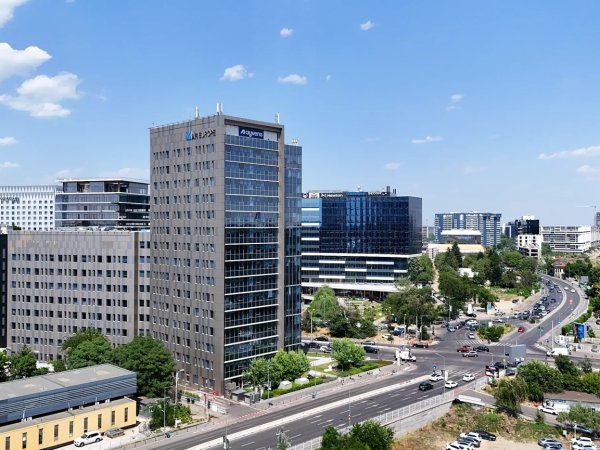
The street that bears his name is today one of the best-known thoroughfares in Bucharest and runs through an area that has changed dramatically compared with the way it looked a century ago. Its present-day importance is primarily economic and urban, as the street has become part of a rapidly developing area in the northern part of the capital.
The history of the name, however, is connected with Barbu Văcărescu’s position as Great Ban of Craiova. Historian Alexandru Popescu, in a study dedicated to Bucharest’s streets and the old princely offices, lists Barbu Văcărescu Street among the capital’s thoroughfares that preserve the names of great officials. He explicitly identifies Barbu Văcărescu as the last Great Ban of Craiova, who died in 1832.
This is not the only example in Bucharest where the memory of a medieval and pre-modern princely office has survived through the city’s street names. In the same area and nearby neighbourhoods, there are streets recalling other Great Bans of Craiova, including Banul Antonache, Banul Costache, Banul Dumitrache and Banul Scarlat.
Thus, Bucharest’s map preserves, sometimes without residents even knowing the meaning behind the names, a genuine gallery of the old officials of Wallachia.
How the Barbu Văcărescu Street area has changed
If in the past the name Barbu Văcărescu evoked the world of large estates and boyar families, today the street is associated primarily with modern Bucharest. The thoroughfare lies in an area where real-estate development and the construction of office buildings have radically transformed the urban landscape.
This transformation is all the more interesting because the street has retained, in its name, the memory of a vanished world. On one side are office towers, commercial spaces and the heavy traffic of the contemporary capital. On the other, the name displayed on the street sign recalls a great boyar who died almost two centuries ago.
Other names associated with old princely officials have also been preserved in the vicinity. According to historians of Bucharest’s streets, the choice of such names contributes to preserving a historical memory that would otherwise have become increasingly difficult to notice within the modern city.
Barbu Văcărescu Street is therefore an excellent example of the way in which Bucharest superimposes different historical periods. The present-day city, with its company headquarters and high-rise buildings, symbolically coexists with the memory of the old boyar families.
Why Barbu Văcărescu matters to the history of Bucharest
Barbu Văcărescu did not remain in the collective memory because of a literary work, a spectacular monument or a major military event. His importance derives primarily from the position he held within the political structure of Wallachia and from his membership in one of the great boyar families of the period.
He was one of the representatives of an aristocracy that dominated Wallachia’s administration and politics before modern Romania took shape. His career must be viewed in the context of a transitional period, when the old institutions and privileges of the boyars were gradually being replaced by modern administrative structures.
At the same time, his family lineage connects him directly to Barbu Catargiu, a political figure at the heart of the first years of modern Romania. The fact that the first prime minister of united Romania was Barbu Văcărescu’s grandson illustrates both the continuity and the transformation of the Romanian elites within a single generation.
For this reason, Barbu Văcărescu Street is more than just a busy thoroughfare in northern Bucharest and more than the name of a business district. It is a fragment of history preserved in the everyday landscape of the capital. Its name evokes an old boyar family, one of the most important offices in Wallachia and a figure who lived at a time when the old Romanian political order stood on the threshold of profound change.
Seen in this light, the street becomes a genuine lesson in urban history. While Bucharest continues to change, the name Barbu Văcărescu still recalls the era of the Great Bans, the boyars and the princely offices. And through his family connection with Barbu Catargiu, the memory of this great Wallachian boyar extends into the period when Romania was beginning to build the institutions of its modern state.
We also recommend: Who killed Barbu Catargiu? The story of the first political assassination in our country's history