Where Romanians had fun in interwar Bucharest: the most famous bars and restaurants from a century ago
By Bucharest Team
- Articles
- 17 JUN 26
Interwar Bucharest was a city of contrasts, of spectacular changes, and of a nightlife that rivaled that of the great European capitals. During the period between the two World Wars, Romania’s capital was going through an accelerated process of modernization: new buildings appeared from one year to another, boulevards became increasingly lively, electric lighting transformed the city’s nights, and new technologies gave residents the feeling that they were living in a Western metropolis in full ascension. For many Bucharest residents, the day was not enough for all the activities and pleasures that the city had to offer. After the end of the working program, especially on weekend evenings, the central streets became real stages of spectacle. People went to the cinema, had dinner in elegant restaurants, listened to music in bars and summer gardens, or partied until morning in venues where all social categories met.
Bucharest of lights and new entertainment
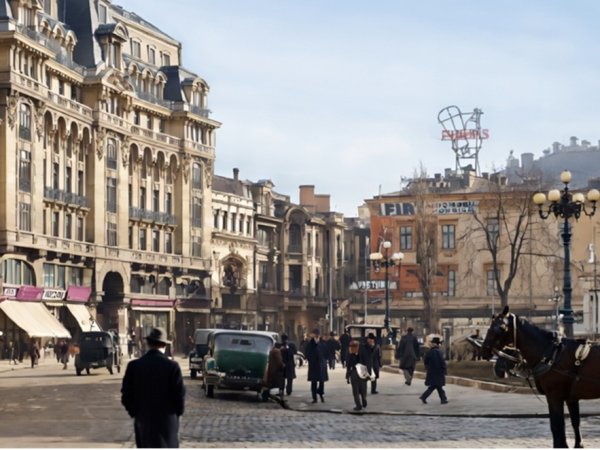
The central area of the Capital represented the heart of interwar entertainment. Important boulevards, such as Take Ionescu and Brătianu, were decorated with illuminated advertisements and modern buildings, which gave the city a Western appearance. One of the symbols of this era was the huge Antinevralgic advertisement placed on the “Jawol” building, a structure known today as Magheru One. It dominated the area and became a landmark of modern Bucharest.
Cinemas, restaurants, and shops also used illuminated advertisements to attract passersby. Electric trams crossed the boulevards, and the streets lit at night offered a spectacular image for that period. All these elements made Bucharest considered one of the most advanced European cities from the point of view of infrastructure and urban life.
One of the main attraction points was Elisabeta Boulevard, nicknamed by many the “Bucharest Hollywood” due to the large number of cinemas located here. Entire families, groups of friends, and couples came to watch the newest cinematographic productions, and the evening often continued with a meal at a restaurant or a few hours spent in a venue with music.
The Automat buffet and the appearance of modernity in Bucharest gastronomy
Immediately after leaving the movie theater, many Bucharest residents stopped at the famous “Automat” buffet, one of the most modern venues of the time. With an impressive illuminated advertisement and an innovative serving system, the venue brought to the Capital a Western concept almost unknown until then.
The mechanism was simple: customers inserted tokens into special machines and received food or drinks without interacting with a waiter. For some people, this experience seemed like a demonstration of the future and technological progress. For others, however, the lack of human contact turned the venue into a space that was too cold and impersonal.
The press of the time described the buffet as a “silent and mechanical” venue, in which the service was fast and efficient, but lacking the charm of conversations between customer and waiter. In a city where meals often represented an opportunity for socializing and endless stories, this change was viewed with admiration, but also with skepticism.
The elegance of jazz and the sophisticated venues of the Capital
Interwar Bucharest also had venues dedicated to those who preferred elegance, modern music, and a Western atmosphere. One of the most appreciated was “Colos”, an impressive venue created in the art-deco style, with furniture inspired by the Bauhaus movement and designed by Jean Monda.
The interior was dominated by simple shapes, smooth surfaces, and an aesthetic specific to interwar modernism. Jazz was frequently played here, a musical genre that was at that time in full rise in major European and American cities. For the Bucharest public, an evening spent at Colos represented a cosmopolitan experience, close to the atmosphere of the great Western capitals.
Alongside Colos, other well-known venues of the period were “Chat Noir”, “Zissu”, “Alcazar”, “Carlton”, and “Melody”, the latter being located in the basement of the Patria building. Each had its own audience, its own atmosphere, and its own musical style, from jazz orchestras to light music or variety performances.
Simplon, the place where the aristocracy and the underworld met at the same table
One of the most interesting examples of the contrasts of interwar Bucharest was the “Simplon” venue, located on Câmpineanu Street. Although it was not considered the most refined venue in the city, it had a special fame due to its extremely diverse clientele.
Here, one could meet companions for hire, figures from high society, artists, adventurers, but also individuals involved in illegal activities. At night, social differences seemed to disappear, and people from completely opposite environments ended up partying together under the dim lights of the venue.
The entrance was hidden behind a thick red plush curtain, where the cloakroom attendant watched over the customers, bellboys delivered love letters, flower sellers made their calculations, and the artists prepared their appearances. It was a world apart, where the show did not take place only on stage, but also among the tables occupied by the most different kinds of characters.
Calea Griviței and the parties that lasted until dawn
If the Calea Victoriei area represented the elegant and luxurious side of Bucharest, Calea Griviței had a more modest, more popular, and much less regulated image. Here, at number 347, operated the famous “Nae Florian’s Family Variety Theatre”, a venue where parties often lasted until the first hours of the morning.
Under the same roof operated a restaurant, a tavern, and a variety entertainment space, and the customers came from all corners of society. Young people eager for adventure, partygoers, drug-dependent individuals, companions for hire, merchants, or simple travelers coming from the provinces met in the same place.
The grilled minced meat rolls and roasted dishes were prepared continuously, accompanied by generous glasses of dark wine and uncensored jokes. The atmosphere was noisy, free, and often unpredictable, turning the venue into a symbol of the crazy nights of old Bucharest.
The obscure taverns and the hidden world of the Capital
Not all entertainment places of interwar Bucharest were elegant or respectable. Neighborhood taverns often attracted characters living on the edge of the law, being regarded as dangerous spaces where honest people had to watch their pockets, and policemen entered prepared for possible conflicts.
One of the most famous such places was “At the Small Café”, located on Cantemir Street in the Dudești neighborhood. The venue became famous because it was frequented by some of the most well-known criminals of the time, such as Chocolate, Ambassador, Nae Velvet, Costache Seven Fingers, or Nae Doctor.
These individuals operated in numerous illegal activities, from rigging card games and scams to stealing watches in the crowded trams of the Capital. Nevertheless, their presence was part of the dark charm of a Bucharest in which luxury and poverty, elegance and danger, coexisted only a few streets away.
Interwar Bucharest remained in collective memory as a city of contrasts, where each neighborhood had its own personality and where a simple crossing of the street could completely change the scenery: from jazz and elegant lights to folk musicians, noisy taverns, and stories from the underworld.
This diversity made the Capital’s nightlife one of the most fascinating chapters in the history of the city, a period in which modernity, eccentricity, and freedom met under the same light of Bucharest’s street lamps.
We also recommend: How the bourgeoisie's life unfolded in Bucharest between the two World Wars