Where Romanians had fun in Bucharest in the 1930s: Sandwiches and spritzers by token at the Automat Buffet, the American bar of Little Paris
- Articles
- 14 JAN 26
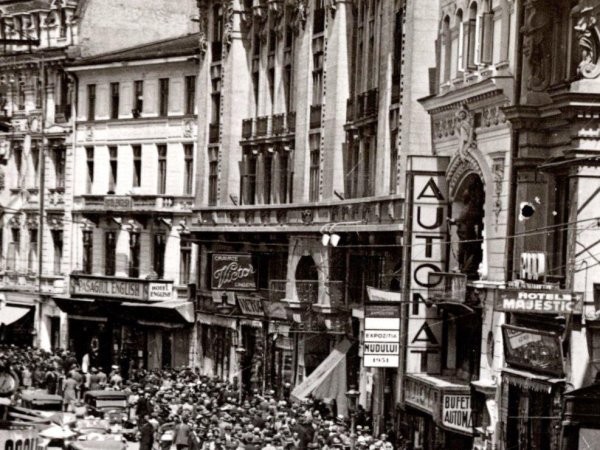
Bucharest in the 1930s was a city under the sign of change, enthusiasm, and modernity imported from the West. Already nicknamed “Little Paris,” the city was beginning to look more and more insistently across the Ocean, fascinated by the rhythm, technology, and American lifestyle. On the central boulevards, among new buildings, illuminated advertisements, and elegant cinemas, entertainment took on forms never seen before. Jazz, modern bars, and vending machines became symbols of an era that wanted to leave behind the patriarchal atmosphere once and for all.
Bucharest seduced by American fashion
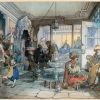
In this context, the Automat Buffet appeared, a venue that stirred amazement, curiosity, and admiration. Here, Bucharest residents could experience something considered revolutionary: food and drinks were no longer brought by waiters, but obtained by inserting a token into a machine. Sandwiches, spritzers, whisky, or cigarettes appeared as if by magic, in a setting that rivaled the great cities of America.
The 1930s represented the moment when American influence became visible in the everyday life of the Capital. On the major boulevards, collective housing buildings rose vertically, true blockhouses with ten floors, built on Brătianu and Take Ionescu boulevards, known today as Nicolae Bălcescu and Gheorghe Magheru. These modern constructions radically changed the city’s silhouette and announced a new urban vision.
At the same time, Ford automobiles could be seen on the streets, symbols of progress and industrialization. Illuminated advertisements, sophisticated lighting design, and spectacular shop windows completed the picture of a city that increasingly aspired to resemble New York. The interiors of venues were arranged elegantly and functionally, in the Art Deco style, with marble, glossy metal, and colored glass. Bucharest was experiencing a true explosion of modernity.
Elisabeta Boulevard and the mirage of the night
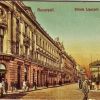
A central role in social life was played by Elisabeta Boulevard, which at that time was far from the degraded image it has today. The area pulsed with life, light, and sound, often compared to Broadway. Cinemas followed one after another, and illuminated advertisements and loudspeakers placed in the street announced the premieres of the moment.
Here, Bucharest residents could see for the first time American films starring Greta Garbo, Rudolf Valentino, or Charlie Chaplin. In the evening, the city center became a continuous spectacle, and the mirage of America was most intense after nightfall. Streets bathed in electric light, jazz music, and elegant venues turned Bucharest into a capital of modern entertainment.
The appearance of the American Buffet on Elisabeta Boulevard
In 1931, the magazine Realitatea Ilustrată enthusiastically announced the opening of a new American venue on Elisabeta Boulevard, at number 5. The tone of the article was laudatory, describing the American Buffet as a true revelation for the Bucharest public. After a long period of intense work, the venue opened its doors, promising an unprecedented experience.
The installations were presented as “the last word of modern technology,” and the elegance of the interior arrangement was considered almost a challenge to the eye. The consumables, varied and of quality, proved that the efforts invested had not been in vain. The public had eagerly awaited the inauguration, and the American Buffet was seen as a point of attraction for the most refined tastes of the Capital.
The Automat Buffet on Calea Victoriei
A real sensation, however, was caused by the Automat Buffet, a venue about which, for a long time, almost nothing was known. The first information appeared in 1930, when the newspaper Rampa announced its opening on Calea Victoriei, at number 44. Initially, its exact appearance and the identity of its creators remained unknown, but its success was immediate.
Later, the architect Hugo Stossel, who came to Romania to practice for five years, would give it its known form. Between 1933 and 1934, the venue was modified and adapted to the modernist Art Deco style, becoming a landmark of urban entertainment. The Automat Buffet was not just a bar, but a demonstration of innovation and technology applied to everyday life.
Sandwiches and spritzers by token
The description given by Rampa in November 1930 perfectly captures the atmosphere of the venue. The Capital received a new form of entertainment, an automatic buffet “garnished with everything your heart desires”: sandwiches, spritzers, flowers, whisky, cigarettes, pastries, and coffee. From early morning, starting at six o’clock, and until late after midnight, the public constantly flowed past the automatic counters.
The cashiers were responsible for turning money into tokens, and the pace was so intense that shifts ended in total exhaustion. The image was ironically compared to that of competitors in dance championships, so great was the fatigue of the staff. At the entrance, a tiny gnome, dressed in red, seemed crushed by the continuous wave of visitors, a symbol of the unexpected success of the venue.
The magic of the automat and the difference from classic restaurants
The charm of the Automat Buffet lay not only in the speed of service, but also in its modern décor. Marble, frosted or colored glass illuminated from within, crystal tables with shiny nickel legs created an irresistible attraction. Everything was designed to suggest progress, efficiency, and elegance, in a style inspired directly by America.
Authors of the time made direct comparisons with the United States, where almost every building had its own automat, and the staff was reduced to a minimum. In Bucharest, however, customers preferred to keep the pleasure of socializing.
For this reason, waiters and cloakroom attendants were reinstated, so that people could sit at tables, flirt, and observe the atmosphere around them. The major differences remained the speed of service, the more accessible prices, and the saving on tips, a detail far from negligible.
Entertainment, modernity, and the spirit of Little Paris
The Automat Buffet and the American bars of Bucharest in the 1930s became symbols of an optimistic era, in which the city dreamed of progress and synchronization with the world’s great capitals.
They reflected not only the tastes of the public, but also the desire of a society to reinvent itself. Between jazz, electric lights, and sandwiches by token, Bucharest lived through one of its most vibrant periods, leaving behind a fascinating legacy of interwar urban entertainment.
We also recommend: Budapesta Restaurant, Between Legends and Controversies. Forty Years Ago, Human Liver Would Allegedly Have Been Served Here, Sourced from the Forensic Institute