Vișoiu Restaurant, “The Bow-Legged Boulder” and the Forgotten Jewel of Last Century’s Bucharest
- Articles
- 03 MAR 26
In interwar Bucharest, a cosmopolitan city, vibrant and constantly seeking refinement, restaurants represented more than simple places where one had a meal. They were meeting spaces for artists, diplomats, politicians, and for a bourgeoisie in full affirmation. In this atmosphere of the 1920s–1930s, less than 200 meters from the Arch of Triumph – colloquially nicknamed “The Bow-Legged Boulder” – stood one of the appreciated establishments of the Capital: the family restaurant “Vișoiu-Șosea.”
A landmark of the interwar era, in the shadow of the Arch of Triumph
Located on P.S. Aurelian Road no. 48, an artery that would later be renamed Miciurin Boulevard, and today bears the name Mareșal Alexandru Averescu Boulevard no. 52, the Vișoiu restaurant had become a point of reference on the gastronomic map of the city. Its positioning near one of the most important monuments of the Capital gave it special visibility and integrated it into an area intensely frequented by Bucharest residents and visitors.
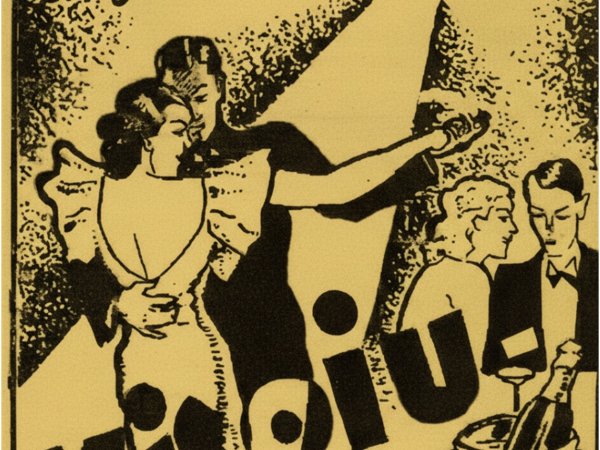
The restaurant was known not only for its appreciated cuisine, but also for the lively atmosphere it offered. Evening after evening, orchestras maintained the good mood of the clients, and among them stood out the orchestra of Nicolae Cireș, a well-known name in the era. Accompanied by him also sang the famous Jean Moscopol, one of the unmistakable voices of Romanian interwar light music. Thus, Vișoiu was not only a restaurant, but also a small temple of entertainment, where gastronomy and music blended harmoniously.
From family restaurant to diplomatic shop
The establishment of the communist regime and the process of nationalization radically changed the destination of the building. The Vișoiu restaurant disappeared as a private entity, and in its place appeared a grocery store which, according to testimonies, would have then also received the name “Triumf.” Its destiny was to be a special one: the store became a unit with closed circuit, intended for Soviet diplomats and those from the countries of the socialist camp.
For more than a decade, until toward the end of the 1960s, the space functioned as a “diplomatic shop,” a place inaccessible to the general public, but well supplied compared to the rest of the commercial network. The abolition of this status meant its transformation into a grocery with open circuit, known as “Alimentara Triumf,” which entered the Comaliment network.
In this new stage, the shop became famous for its products hard to find in other commercial units. On the shelves could be discovered “capitalist” drinks, various canned goods, including the famous Portuguese sardines “Robert,” but also domestic and imported cold cuts. For the Bucharest residents of the time, a visit to Alimentara Triumf often meant the chance to buy products that were missing from most shops.
The aromas of coffee and controlled abundance
The hall at the entrance to the grocery had a special charm. Here functioned a “Sweets-Coffee” section, where several large shiny brass grinders stood, similar to those found in old Armenian shops. The aroma of freshly ground coffee floated in the air, creating a warm and welcoming atmosphere, in contrast with the sobriety of the era.
Opposite, under an arcade, was the meat section, renowned for the fact that it offered fresh products. Also in the entrance area there was a sector dedicated to bakery products. From the hall one entered a large room, organized with gondola shelves loaded with food and drinks, and here was also the cold cuts and cheese section.
On the left side of the main building operated a fish shop which, between the beginning of the 1960s and approximately 1972, had a basin with live fish. Customers could choose for themselves the fish they wanted, a detail that recalled more prosperous times. Nearby there was also an Aprozar, where vegetables and fruits were sold.
The 1980s and the decline of a privileged destination
The period of the 1980s brought with it the generalized shortage of food, and Alimentara Triumf was not bypassed by deficiencies. Queues became a usual presence, and products were found more and more difficultly. Some of them were already distributed on ration cards, a sign of the degradation of the supply system.
The shop gradually transformed into a warehouse of jarred canned goods – stacks of vegetable stew, soup vegetable mix, or ghiveci – biscuits of questionable quality, chicken offal, Vietnamese shrimp pellets, and the so-called pork “xylophones,” for which consistent queues formed. The contrast with the period of the 1960s–1970s was evident, and the atmosphere of former times had almost completely disappeared.
To the right of the main building there was an annex body, built in an unspecified period, where operated a brasserie also named “Triumf.” It had a terrace in front and was frequented by the residents of the area, becoming an appreciated place of socialization. Even in the difficult years, the brasserie preserved part of the convivial spirit of the old restaurant.
After 1990: uncertainty, initiatives and degradation
After the fall of the communist regime, the grocery and the Triumf brasserie entered private ownership, but the details related to the new owners were never fully clarified publicly. It seems that, at present, the building is the object of a partition or restitution lawsuit among several heirs, a situation that contributed to blocking any serious rehabilitation works.
Between 2002 and 2007–2008, the spaces were temporarily revitalized through the arrangement of a restaurant called “Casa Țărănească,” an initiative of a well-known fashion designer. At one moment, rumors circulated that he wished to also develop a fashion house within the premises. The project did not have continuity, however, and the building reentered a period of stagnation.
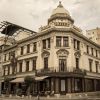
Today, the ensemble on Mareșal Alexandru Averescu Boulevard no. 52 is in an advanced state of degradation. The trees grown uncontrollably press on the fragile fence from Miciurin Entrance, the wooden canopy in the lateral courtyard is rotten, and the gutters are full of leaves and branches. A heavy winter could cause additional damage to the already weakened structure.
Even so, the building is not completely abandoned. For about 12 years it has benefited from security personnel and a video surveillance system, a sign that there is still interest in its preservation, even if the future remains uncertain. Awaiting a legal solution and a possible restoration, the former Vișoiu restaurant and later the Triumf complex remain a forgotten jewel of last century’s Bucharest – a place where the history of gastronomy, commerce, and social life intertwine in a story that deserves to be rediscovered.
We also recommend: The history of the Cireșica Restaurant, the favorite place of interwar Bucharest, where you went “to eat batoc fish and listen to Zavaidoc”