Velimir Maximilian, the best Jupân Dumitrache of the theatre, the sacred monster of operetta in Belle Époque Bucharest
- Articles
- 07 APR 26
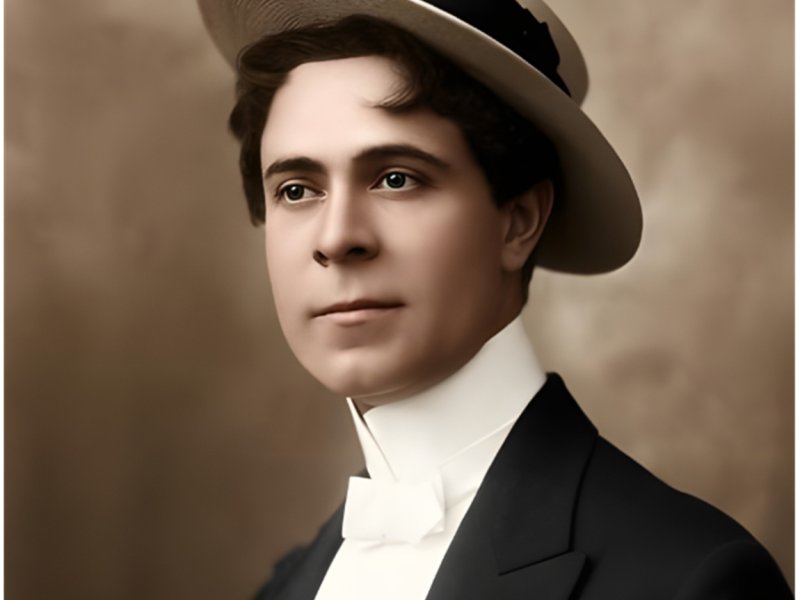
In the history of Romanian theatre, few names have managed to combine talent, refinement and longevity as naturally as Velimir Vladimir Maximilian. An actor of operetta, revue, theatre and film, Maximilian was one of the emblematic figures of the Bucharest stage during the Belle Époque period and in the decades that followed. Considered by his contemporaries a “sacred monster” of operetta, he remained in the public memory especially for his memorable interpretation of Jupân Dumitrache from the famous play “O noapte furtunoasă”. His career, spanning more than half a century, reflects not only the evolution of Romanian theatre, but also the transformations of a society caught between tradition and modernity. Maximilian was not only a talented actor, but also an engaged intellectual, a theorist of theatrical art and a promoter of the social role of the stage.
Childhood and the beginnings of an artistic destiny
Velimir Vladimir Maximilian was born on August 18, 1882, in Buzău, at a time when Romanian theatre was beginning to professionalize and take on modern contours. From childhood, he was attracted by the performances of traveling troupes that arrived in the city, fascinated by the magic of the stage and the power of acting.
He attended primary school and then the “Alexandru Hasdeu” High School, where he first showed a real interest in theatre. He frequented the performances organized at the “Moldavia” Theatre, being one of those students who not only watched, but also understood the emotion and mechanisms of the performance.
His vocal talent was noticed early. At only 11 years old, thanks to a remarkable voice, he was accepted into the choir of the “Chesarie Episcopul” Theological Seminary, led by composer Nicolae Severeanu. This musical experience would decisively influence his career, directing him toward operetta.
At the urging of Basil Iorgulescu and with the support of the great playwright Ion Luca Caragiale, the young Maximilian enrolled, in 1900, at the Conservatory in Bucharest, in the Dramatic Art and Music section. This moment marks the beginning of a spectacular career.
Debut and affirmation in operetta
During his student years, between 1901 and 1902, Maximilian already began to perform on stage as a vocal interpreter in the troupe led by George Ștefănescu. The performances at the summer garden in Cișmigiu, at Buturugă, offered him his first direct contact with the public and his first successes.
His official debut took place within the Romanian Lyric Society, where he appeared as a comic bass. He then continued in the Operetta Company led by C. Grigoriu, and in 1903 he was hired at the National Theatre, a confirmation of his rising talent.
He achieved his first major success with the operetta “Fetița dulce”, but the decisive moment came on February 13, 1905, when he played the role of Lăcustă Vodă in “Sânziana și Pepelea”. This role brought him recognition and established him as one of the most promising artists of his generation.
In 1906, together with Grigoriu, Ciucurette and Carussy, he founded the famous Operetta Society, within which he worked until 1923. From 1913 he became its director, contributing decisively to the development and popularization of operetta in Romania.
A complete actor: from operetta to theatre and film
Throughout his career, Maximilian demonstrated rare versatility. He performed roles in operettas, comedies and dramas, managing to stand out through a distinct style, characterized by fine humor, discretion and measure.
He played in nearly 250 plays and created memorable characters. Among the most well-known is Jupân Dumitrache from “O noapte furtunoasă” by Ion Luca Caragiale, a role he perfected and which brought him the reputation of being the best interpreter of this character.
He also excelled in roles from French dramaturgy, such as Topaze and César from the plays of Marcel Pagnol. His performances were appreciated not only in Romania, but also internationally, being considered one of the best interpreters of these roles worldwide.
Maximilian did not limit himself to theatre. He also acted in films such as “Un leac pentru soacre” and “Bulevardul ‘Fluieră Vântu’”, adapting easily to new forms of artistic expression.
Activity in major theatre companies
Between 1924 and 1948, Maximilian collaborated with some of the most important theatre companies in Bucharest, including those led by Maria Filotti and Tony Bulandra. He performed on the stage of the Municipal Theatre and other prestigious institutions, consolidating his status as a great actor.
International tours in Austria, Germany, France and England brought him recognition beyond the country’s borders. Foreign audiences were impressed by the naturalness and expressiveness of his performances, as well as by his ability to convey emotion beyond language barriers.
In 1930, on the occasion of his 30 years of theatrical activity, his colleagues offered him a bronze bust made by the sculptor Oscar Späethe, a symbolic gesture reflecting the respect and admiration he enjoyed within the profession.
Playwright, director and theorist of theatre
In addition to his stage activity, Maximilian was also a creator behind the scenes. He adapted plays such as “Ovu vodu”, “Omul cu urechea ruptă”, “Isprăvile lui Arsene” and “Moartea lui Arsene”, demonstrating a deep understanding of dramaturgy.
As a director, he staged operettas such as “Ciocârlia”, “Pericola” or “Cântecul munților”, contributing to the diversification of the repertoire and the modernization of performances.
He was also concerned with the social role of theatre. In his work “Teatru, actor și public”, published as early as 1913, he analyzes the relationship between stage and society, emphasizing the importance of art in shaping public taste and educating audiences. Later, in the volume “Evocări”, he offers a personal perspective on theatrical life and on the great personalities of the era.
Artistic style and impact on the public
What distinguished Maximilian from other actors of his time was stylistic balance. He never sought easy effects or exaggerations, but relied on subtlety, nuance and authenticity.
His humor was refined, built on observation and a deep understanding of human nature. His characters were alive and believable, and the audience recognized themselves in them.
This approach brought him the appreciation of critics and the love of spectators. Maximilian was not only a popular actor, but also a respected one, a benchmark for future generations.
Final years and official recognition
After an impressive career, V. V. Maximilian remained active until the 1950s. In 1954, he was awarded the title of Artist of the People, an official recognition of his contribution to Romanian culture.
He passed away in 1959, in Bucharest, leaving behind an unquestionable artistic legacy. His name remains associated with the golden age of Romanian theatre and with the elegant spirit of Belle Époque Bucharest.
In his honor, his hometown dedicated the performance hall of the Trade Unions’ House of Culture to him, which bears his name, keeping the memory of this great artist alive.
The legacy of a “sacred monster” of the Romanian stage
Velimir Vladimir Maximilian was not only a successful actor, but a symbol of professionalism and passion for theatre. He contributed decisively to the development of operetta in Romania and demonstrated that stage art can be, at the same time, entertainment and reflection.
His interpretation of Jupân Dumitrache remains a benchmark, and his entire activity is a lesson in dedication, talent and respect for the audience.
In an era when theatre was one of the main forms of entertainment and education, Maximilian managed to rise to expectations and leave a lasting mark. Today, he remains an essential name in the history of Romanian culture, an artist who knew how to transform the stage into a space of truth and authentic emotion.
We also recommend: She replied on stage to N. Leonard and V. Maximilian and raised operetta to the rank of art. The story of actress Florica Florescu