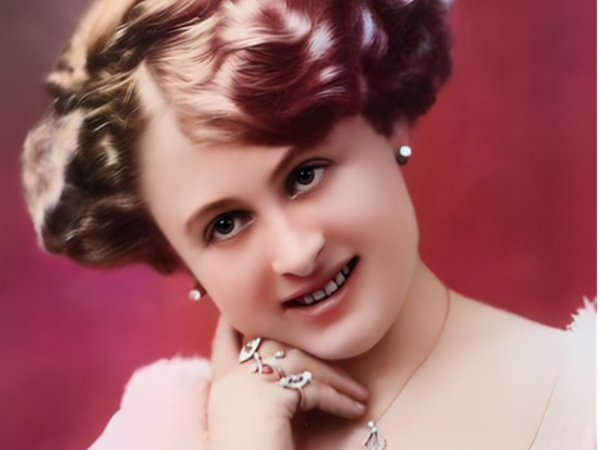
She replied on stage to Nae Leonard and Velimir Maximilian and raised operetta to the rank of art. The story of actress Florica Florescu
- Articles
- 02 APR 26
Romania is among the few countries in which operetta has not only taken root, but has also evolved into a valuable artistic genre with its own identity. The origins of this phenomenon must be sought in the first decades of the 19th century, when cultural life in the major cities was dominated by vaudeville. This form of musical theatre, light and accessible to the general public, constituted the foundation on which Romanian operetta later developed.
The birth of Romanian operetta and the artistic context of the era
In the years 1830–1831, vaudeville performances attracted a large audience, being a combination of music, dance, and humorous dialogue. Gradually, this genre evolved, borrowing elements from Western operetta and adapting them to local tastes. Thus, toward the end of the 19th century and the beginning of the 20th century, the first professional operetta companies appeared, marking the beginning of a tradition that would last for more than a century.
An essential role in consolidating this genre was played by Constantin Grigoriu, an outstanding tenor and cultural animator. Starting in 1904, he brought to the Bucharest public, in the famous Oteteleșanu Garden, an important international repertoire, contributing decisively to the popularization of operetta. Under his influence, the Romanian stage began to align with European standards, and the public became increasingly receptive to this genre.
A golden generation: the artists who made history
This effervescent period gave birth to a generation of artists who would remain in history. Among them are Nicolae Leonard, considered the “prince of Romanian operetta,” Vasile Maximilian, a master of musical comedy, as well as other notable names such as Florica Cristoforeanu, Mara d’Asti, or Maria Filotti.
In this remarkable artistic context also appears Florica Florescu, an artist who would decisively contribute to the affirmation of operetta as a respected art form. Her talent, versatility, and stage presence allowed her to stand out quickly and reach the same stages as the greatest artists of the time.
Florica Florescu was not just a simple performer, but a complete actress, capable of combining acting, music, and dance in a harmonious way. In an era when operetta was sometimes considered a minor genre, she proved that it could reach high artistic levels.
The debut and affirmation on Bucharest stages
Florica Florescu’s career began in a modest but promising way. Her first stage appearances took place in Burienescu’s troupe, alongside Maria Ciucurescu. This troupe was well known at the time and was even attended by Ion Luca Caragiale, a sign of the quality of the performances offered.
Her official debut took place on the stage of the Mitică Georgescu Garden, an emblematic space for Bucharest’s summer theatre. The atmosphere of these gardens was special: performances took place outdoors, and the audience came not only for art, but also for socializing and entertainment.
An important moment in her rise was the year 1905, when she performed during the season at the Rașca Garden, under the direction of Nicu Poenaru. Here she stood out in the operettas “Mademoiselle Nitouche” and “The Major’s Daughter,” her performances attracting the attention of critics and audiences.
These roles established her as one of the most promising actresses of the moment, opening the way to collaborations with the great troupes and artists of the era.
Collaboration with the great names of operetta
A turning point in Florica Florescu’s career was the year 1909, when she joined the troupe led by Constantin Grigoriu, performing on the stage of the Lyric Theatre. Here she had the opportunity to act alongside Nicolae Leonard and Vasile Maximilian, two of the most important artists of the time.
During the same period, she performed on the stage of the Oteteleșanu Garden in the operetta “The Hussars on Maneuvers” by Emmerich Kálmán. The press of the time noted her performance, describing her as “delightful” in travesty roles, proof of her artistic versatility.
The year 1910 brought new successes, Florica Florescu performing roles in “The Count of Luxembourg” by Franz Lehár and “Orpheus in the Underworld” by Jacques Offenbach, on the stage of the Modern Theatre. These productions, extremely popular in Europe, consolidated her status as a leading artist.
Memorable roles and artistic consecration
Throughout her career, Florica Florescu performed a series of roles that remained in the memory of the public. In 1910, she appeared in “The Fireman on Duty” by Varney, alongside G. Carussy and Elena Leonard, demonstrating an excellent ability to adapt to different styles.
In 1912, she performed in “The Doll” by Leo Fall, sharing the stage with Maria Filotti, one of the most respected actresses of Romanian theatre. This collaboration was a confirmation of her artistic value.
A year later, in 1913, she played an important role in “The Modern Woman” by Jean Gilbert, alongside G. Carussy and Vasile Maximilian. The performance reflected the social changes of the time and was enthusiastically received by the public.
In 1916, she appeared in “When Two Love Each Other” by Ed. Eysler, in a production directed by Dumitru Mitu. This role came at a difficult moment, marked by the context of the First World War, but once again demonstrated the resilience and professionalism of the actress.
Florica Florescu and the transformation of operetta into art
Florica Florescu’s contribution to the development of Romanian operetta is not limited to her performances. Through her talent and seriousness, she contributed to changing the perception of this genre, transforming it from a form of light entertainment into a respected art.
Alongside her generation colleagues, she raised the standards of performances, emphasizing the quality of interpretation, directorial coherence, and artistic expressiveness. The audience no longer came only for music and dance, but also for emotion and story.
In an era when theatre and music were undergoing transformation, Florica Florescu managed to adapt and evolve, remaining relevant and appreciated. Her stage presence, elegance, and naturalness of interpretation made her a model for future generations.
The legacy of a remarkable artist
Although time has partially faded the memory of some artists of that era, Florica Florescu’s contribution remains essential to the history of Romanian operetta. She is part of a generation that laid the foundations of a lasting artistic genre and demonstrated that operetta can reach levels of excellence.
Through her roles, collaborations with great artists, and involvement in cultural life, Florica Florescu contributed to defining a golden age of Romanian musical theatre. Her story is not only that of a talented actress, but also of a woman who knew how to follow her vocation in a field in full affirmation.
Today, when we look back at the beginnings of Romanian operetta, her name deserves to be brought back into the spotlight. It is part of a valuable cultural heritage that continues to inspire and define Romania’s artistic identity.
We also recommend: The stars of interwar Bucharest: Actress Marioara Voiculescu, the greatest tragedienne of Romanian theatre