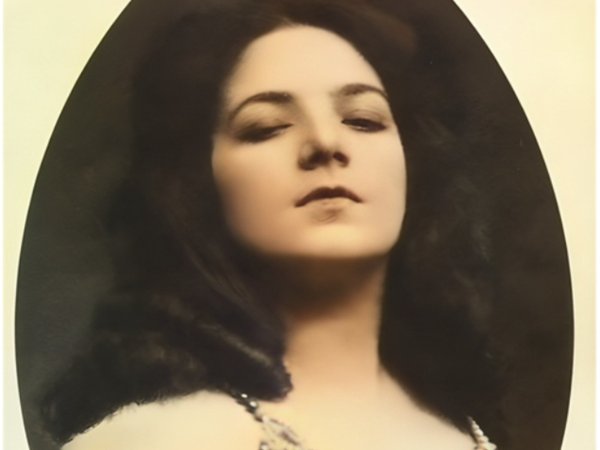
The stars of interwar Bucharest: Actress Marioara Voiculescu, the greatest tragedienne of Romanian theatre
- Articles
- 01 APR 26
Marioara Voiculescu was born in Bucharest, most likely in 1887, during a period when Romania’s capital was increasingly asserting itself as an important cultural center. Her artistic destiny did not seem clearly outlined at first. In her childhood, she was not necessarily noted for an obvious inclination toward the stage, and her school path even included certain difficulties.
The beginning of a vocation: childhood and the encounter with theatre
An apparently ordinary moment would change her life. At the age of 14, after failing mathematics, her parents decided to hire her a tutor. This tutor was Zaharia Bârsan, a young intellectual passionate about theatre, who would later become one of the important figures of the theatrical movement in Transylvania. Under his guidance, Marioara discovered the world of dramatic art and was deeply impressed by the expressive power of the stage.
This encounter was decisive. Fascinated by theatre, the teenager decided to pursue an artistic career, despite possible reservations from her family. Without informing her father, she presented herself at the entrance exam to the Conservatory and succeeded in entering the class of the prestigious Aristizza Romanescu, one of the greatest actresses of the time.
Rapid rise and debut on the stage of the National Theatre
Marioara Voiculescu’s talent was quickly noticed. During her studies, she demonstrated an unusual artistic maturity for her age, which allowed her to advance at an impressive pace. Before turning 17, she took her graduation exam, which she passed brilliantly, obtaining first prize with distinction.
Shortly after this success, on February 13, 1904, her official debut took place on the stage of the National Theatre in Bucharest, in the play “Casta Diva” by Haralamb Lecca. Her appearance immediately attracted the attention of the public and critics, who noted the intensity of her performance and the emotional force she conveyed.
This debut marked the beginning of a brilliant career. Marioara Voiculescu was not just a promising young woman, but already a powerful stage presence, capable of captivating the audience through expressiveness and authenticity. In a time when theatre was one of the main forms of entertainment and cultural education, she managed to impose herself rapidly as a leading actress.
Artistic consecration and collaboration with great personalities
Only two years after her debut, her talent was officially recognized by Alexandru Davila, one of the most influential figures of Romanian theatre. He proposed her as a full member of the company, a position that confirmed her status as an established actress.
Moreover, Marioara Voiculescu chose to follow Davila in his ambitious project of founding a new theatre – the “Davila Company.” Here, the actress had the opportunity to fully develop her artistic potential, performing complex and challenging roles.
One of the most important moments of this period was her performance in “Salome” by Oscar Wilde, where she achieved a true triumph. The role allowed her to capitalize on her qualities as a tragedienne, being appreciated for her dramatic intensity and her ability to portray deep inner conflicts.
This stage of her career consolidated Marioara Voiculescu’s reputation as one of the most talented actresses of her generation, a true force of Romanian theatre.
Personal life and the sacrifices behind the stage
Beyond professional success, the actress’s personal life was marked by intense and sometimes difficult moments. On January 22, 1910, Marioara Voiculescu married Ion Ionescu-Quintus, a renowned jurist, but also an appreciated writer and epigrammatist.
Their marriage was accompanied by controversy. Ion Ionescu-Quintus’s father, an influential banker, did not agree with his son’s choice to marry an actress, probably considering this profession unsuitable. As a result, he disinherited him, a gesture that reflects the mentality of the time and the prejudices related to the artistic world.
The couple had a single child, Paul Ionescu-Quintus, but the relationship did not last long, the two separating after a relatively short period. Later, the actress’s former husband rebuilt his life, while Marioara Voiculescu remained mainly dedicated to her career.
These personal experiences did not diminish her artistic strength; on the contrary, they seem to have contributed to the depth of her performances, offering her a broader understanding of human emotions.
Activity during the war and return to the forefront
Another important moment in the actress’s life was the period of the First World War. Unlike other artists who chose to leave Bucharest during the occupation, Marioara Voiculescu remained in the capital. Alongside other personalities of the stage, such as Aristide Demetriade, Petre Sturza, or Valentin Valentineanu, she continued to be present in the cultural life of the city, despite the difficult conditions.
This choice demonstrates not only her attachment to the public, but also remarkable courage. Theatre, in those troubled times, became a refuge for people, and the presence of artists of Marioara Voiculescu’s stature was of great importance.
After the war, in 1925, the actress returned to the stage of the National Theatre, marking a new stage in her career. In the interwar period, she became one of the most respected and admired figures of Romanian theatre, being considered a true lady of the stage.
Artistic personality and public image
A fascinating aspect of Marioara Voiculescu is related to the harmony between her stage personality and her everyday life. An interview conducted in 1931 by journalist Ioan Massoff highlights this rare trait.
The journalist noted that, in her case, there was no major difference between the person on stage and the one in real life. Unlike many actors, who adopt a completely different identity outside the stage, Marioara Voiculescu seemed to maintain the same sobriety, the same intensity, and the same authenticity.
This continuity between personal life and artistic life contributed to the strength of her performances. The audience did not see merely an actress playing a role, but a personality who truly lived every emotion conveyed on stage.
In an artistic world full of contrasts and appearances, this sincerity was one of the traits that set her apart and strengthened her status as a great tragedienne.
The legacy of a great actress of Romanian theatre
Marioara Voiculescu remains one of the most important figures of Romanian theatre in the interwar period. Her impressive career, begun early and built through talent, work, and passion, deeply influenced the evolution of dramatic art in Romania.
Through her roles, she brought a rare intensity to the stage, managing to create memorable characters and to convey authentic emotions. She was not only a talented actress, but also a symbol of elegance and professionalism.
Today, her name is associated with a golden age of Romanian theatre, in which the stage was dominated by strong and dedicated personalities. Her legacy continues to inspire, and her contribution to Romanian culture remains undeniable.
In the artistic history of interwar Bucharest, Marioara Voiculescu occupies a place of honor, being, without a doubt, one of the brightest stars of the Romanian stage.
We also recommend: The stars of interwar Bucharest: Sergiu Malagamba, the greatest dandy of the Capital who set women ablaze