Top 10 things you didn't know about interwar Bucharest
- Articles
- 26 MAR 26
Between 1919 and 1939, Bucharest underwent the most intense transformation in its modern history — demographic, architectural, cultural and social. An era in which the city reinvented itself almost entirely, though not everyone experienced it the same way.
1. The population grew by 127% in two decades
In 1919, Bucharest had just under 400,000 inhabitants. By 1939, on the eve of the Second World War, that number had reached nearly 870,000. Growth averaged 10,000 people per year in the first decade, then accelerated to 20,000–30,000 annually after the administrative expansion of 1928, when 12 suburban communes were absorbed into the capital's boundaries. This demographic explosion was driven not by a high birth rate but by mass migration: young people from across Greater Romania arrived in search of industry, commerce and civil service work. The city's surface area expanded too — from 5,614 hectares in 1919 to 7,800 in 1939 — but construction could not keep pace with demand, pushing rents up and triggering an unprecedented densification of the central neighbourhoods.
2. Dadaism was born from a Bucharester, and the movement left its mark on the city's architecture
Samuel Rosenstock, known to the world as Tristan Tzara, was born in Moinești and spent his formative years in Bucharest. He adopted his pseudonym in the summer of 1915, and a year later, at the Cabaret Voltaire in Zurich, helped lay the foundations of Dadaism. The connection to interwar Bucharest is not merely sentimental: Marcel Janco, Tzara's colleague and friend from the Dadaist group, returned to the capital in 1926 and built the city's first modernist residential buildings on Strada Trinității. Described by his contemporary Jacques Costin as "the moral author of modernism in Romania," Janco paved the way for Horia Creangă — great-grandnephew of the writer Ion Creangă — who would complete the ARO building in 1929, the first truly monumental modernist block in Bucharest.
3. Boulevard Magheru was built almost entirely in less than ten years
What we know today as Bulevardul Gheorghe Magheru was in the 1920s a newly opened thoroughfare, still taking shape, on which a remarkable collection of modernist architecture was being born. The ARO building, completed by Horia Creangă in 1929 for the insurance company Asigurarea Românească, set the tone. Creangă reportedly conceived the design "in one night, as a whole, as if in a dream" — and the result shocked the Bucharest of its day: a ground-plus-seven-storey structure with clean horizontal lines and no ornamentation, which looked as if it belonged to an entirely different city than the eclectic one that had come before it. The ARO also housed a 1,200-seat cinema, the Melody bar and ground-floor commercial spaces — a mixed-use concept that was remarkably forward-thinking for the era. Creangă went on to sign over 70 buildings in Bucharest, from the Obor market halls to the Giulești Theatre.
4. Interwar Bucharest had more modernist buildings than any other Eastern European capital
This is not rhetorical inflation but a conclusion supported by architectural scholars and validated by international exhibitions held in Brussels, Barcelona, Stockholm and London. The generation of Romanian architects trained in European schools — principally in Paris, but also in Vienna and Zurich — refused to reproduce the academic conservatism they had been taught and instead proposed an original reading of modern architecture. The result was a rare stylistic pluralism: the Neo-Romanian style pioneered by Ion Mincu, Art Déco, Bauhaus modernism and classicising elements coexisted on the same boulevards, reflecting a multicultural society searching for its own identity at an accelerated pace. Today, a significant portion of these buildings carry the highest seismic risk classification and are visibly deteriorating.
5. In 1933 there were 50 cinemas in Bucharest — more than at any other point in the city's history
The passion for cinema was one of the most democratic cultural phenomena of interwar Bucharest. Boulevard Elisabeta came to be nicknamed "Romanian Hollywood," with seven cinema halls lined up in succession: Arpa, Palas, Femina, Regal, Corso, Trianon and Capitol. In the autumn of 1929, the Trianon screened the first talking picture — The Jazz Singer with Al Jolson — to unprecedented enthusiasm, prompting hall after hall to close temporarily in order to install sound systems. By 1935, the number of cinemas in the capital had reached 62. Publications such as Dimineața reserved full pages for film advertisements, and by 1924 a dedicated film magazine simply called Cinema had already appeared. The writer and intellectual Jeni Acterian remains one of the most thoroughly documented cinephiles of the period, through her intimate journals.
6. Cafés were free universities, each with its own table of intellectuals
Tudor Arghezi once said that a serious café is worth a university — and in interwar Bucharest this was no metaphor. Capșa, on Calea Victoriei, was the haunt of established writers: Camil Petrescu arrived every morning at precisely 9:30, while Liviu Rebreanu, Arghezi himself and Ion Barbu frequented the back table. But the café that truly crackled with intellectual life was Corso, owned by a man known as papa Finkelstein, furnished in Viennese style with velvet-lined booths and Murano lamps. There, a circle had formed in which Mircea Eliade, Emil Cioran and Petre Țuțea met weekly, before or after Criterion lectures. Cioran would later evoke, from his Parisian exile, a persistent nostalgia for that Corso where, by his own account, a part of his thinking had taken shape. The café disappeared in 1939, demolished during the rearrangement of Piața Palatului ordered by King Carol II. The drink of choice for the interwar set was șvarț — a strong black filtered coffee, served in metal cups with sugar cubes, which cost a few lei and allowed hours of uninterrupted table occupation.
7. Public radio began broadcasting in 1928, and listening had become a collective activity
Radio transmission had been introduced experimentally in Romania in 1927, and on 1 November 1928 Romanian public radio broadcast officially for the first time. Unlike the solitary experience we associate with radio today, in its early years receivers were scarce and expensive, making listening a social occasion: people gathered around a single set in cafés, at neighbours' homes or at the workplace, and discussed what they heard. That same year, 1928, the first jazz music in Romania was played at the Otetelesanu café — on whose site the Palace of the Telephones now stands — a sign that European cultural modernity was arriving through multiple channels simultaneously. The written press was equally vigorous: newspapers such as Universul and Dimineața had large circulations, carried Western-style advertising and, as one observer of the era noted, were known to topple governments.
8. The Jewish community was a defining presence in the city's cultural and economic life
According to the 1930 census, approximately 757,000 Jews lived in Romania, representing 13.6% of the urban population — compared to just 1.6% of the rural one. Bucharest was home to an active and diverse Jewish community with both Ashkenazi and Sephardic roots. Its contribution to the cultural and economic life of the capital was proportionally greater than its demographic share: architects such as Marcel Janco, intellectuals, bankers, publishers, lawyers and merchants who built lasting enterprises. The 1923 Constitution had guaranteed equal rights for all citizens regardless of religion — a situation that would be radically and tragically reversed in the decades that followed. The contrast between the cosmopolitan openness of interwar Bucharest and the antisemitic violence that would intensify toward the late 1930s represents one of the most painful ruptures in the city's history.
9. Nightlife was intense, cosmopolitan — and not without its excesses
Beyond the elegant salons and literary cafés, interwar Bucharest had a night-time face considerably less idealised. In the centre, numerous variety venues operated under names such as Carlton Bar, Chat Noir and Alcazar, where a cosmopolitan clientele could watch "new artistic numbers every evening." Drugs were a recognised public problem: morphine, cocaine and ether circulated across all social strata, from elite balls to more modest establishments, and the press of the era documented the trade, overdose suicides and pharmacy raids in considerable detail. Authorities treated addiction as a moral failing rather than a medical condition, which severely limited any effective intervention. This reality, almost entirely absent from the romanticised image of the period, was documented in publications such as Ilustrațiunea română and in journalistic investigations that had the courage to describe the city without embellishment.
10. The city was, in truth, a city of extreme contrasts — not a single "Little Paris"
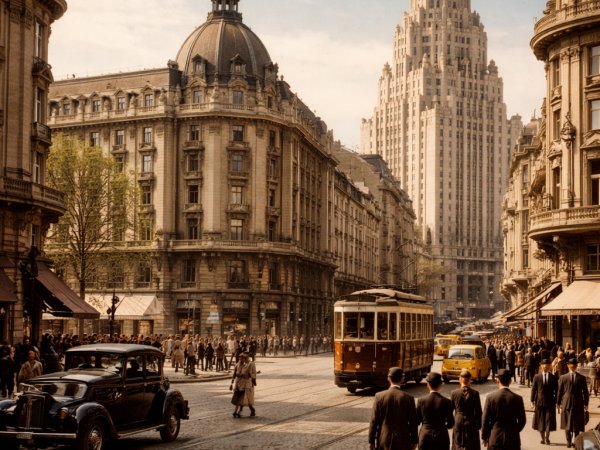
The nickname Little Paris, which historians and journalists continue to use, accurately described Bucharest's central zone: Calea Victoriei with its fashionable ladies, the modernist boulevards, the cafés and cinemas. But a few hundred metres from that gleaming centre, the outer neighbourhoods were living an entirely different reality. The German-Romanian documentary Bucharest, City of Contrasts from 1941, co-produced by the National Tourism Office and the firm Tobis-Klangfilm, deliberately showed only the centre — Cișmigiu park, the lido with its cosmopolitan youth, Calea Victoriei — and omitted entirely the periphery, where rural ways of life had persisted intact. Horse-and-cart accidents were a daily occurrence, since the automobile remained an unaffordable luxury for most, and the intensive construction in the centre stood in stark contrast to the absence of decent housing for the newly arrived. Interwar Bucharest was neither exclusively brilliant nor exclusively backward — it was, more precisely, a city living simultaneously in several centuries.
Also recommended Symbols of Bucharest: Cinema Dacia Marconi, Calea Griviței and the relic left from Interwar Capital