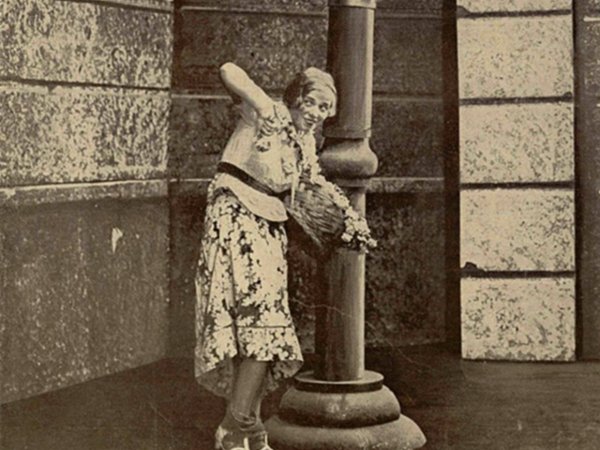
The Stars of Interwar Bucharest: Leni Caler, The Artist and the Mirror, the Star of the Maria Ventura Theatre
- Articles
- 09 JAN 26
At the beginning of the 21st century, the image of the Romanian interwar era is reconstructed not only through official documents or theatrical chronicles, but also through personal testimonies, filtered by time and memory. Among these, the memoirs of the artist Leni Caler occupy a special place. Actress and singer, a prominent personality of the Bucharest stage for more than three decades, Leni Caler revisits her professional path in the volume The Artist and the Mirror – Repertoire, Roles and Unforgettable Partners, initially written outside the country in the 1990s and later published with the support of the Jewish community and Geo Șerban. The book has rather the tone of a mature confession, in which biographical episodes are selected with lucidity, without pathos, but with constant attention to their formative meaning.
An artistic destiny built against conventions
Although she was one of the most visible figures of interwar Bucharest, the name Leni Caler is today little known to the general public. This oblivion is due not only to the passage of time, but also to the brutal rupture produced by history, which interrupted the natural continuity of an exceptional career. Her artistic training did not follow a predictable path. A graduate of the private Conservatory of Dramatic Art, led by Alexandru Mihăilescu, Leni Caler entered the theatre with the declared desire to change the mode of scenic performance, proposing a more direct, more authentic and less rigid interpretation.
The critics of the time quickly noticed this rare combination of naturalness and rigor. The intense rhythm of premieres, the carefully controlled emotion and the inner discipline were doubled by a sincerity that the actress herself considered essential: “Where emotion is missing, technique does nothing.” Her graduation exam, performed with the play Love Watches Over by Robert de Flers and G. A. de Caillavet, represented the moment when the young actress, at only 22 years of age, attracted the attention of important names of theatrical criticism, such as Camil Petrescu and Mircea Ștefănescu. Camil Petrescu would note even then the existence of a personal style, capable of creating an “irresistible contagion” over the audience.
From the Regina Maria Theatre to the affirmation of a personal style
Like many actors at the beginning of their careers, Leni Caler debuted at the Regina Maria Theatre, under the direction of Lucia Sturza Bulandra. In less than two years, she came to play leading roles, a sign of a rapid recognition of her artistic potential. However, early success did not determine her to settle comfortably into a consecrated formula. On the contrary, the actress felt the need to explore other directions, to collaborate with different theatres and directors, in search of roles that would better reflect her personality.
In this process of defining her style, Leni Caler gradually moved away from the typology of the “diva,” so present in that era. A significant gesture in this sense was the acceptance of roles in travesty, the first of which was performed at the Fantasio Theatre, in The Little Lord, after F. H. Burnett. The choice of these roles was not accidental, but revealed an artistic vision in which life and theatre constantly intersected, each nourishing the other.
Definitive consecration comes with her activity at the Maria Ventura Theatre, where Leni Caler performs exclusively leading roles, alongside actors such as George Vraca and George Timică. Productions of plays such as Pygmalion (The Flower Seller) by George Bernard Shaw, The Mouse and the Church by Fodor László, or As You Like It by William Shakespeare offer her the opportunity to work with first-rank directors, among whom Soare Z. Soare, Victor Ion Popa and Victor Barnowsky. These collaborations consolidate the image of a complete actress, capable of moving with ease from comedy to drama, from realism to stylization.
Love, creation and the fragility of an era
The year 1936 marks a new beginning with the opening of the “Comedia” company, led by Sică Alexandrescu, inaugurated with the play The First Day of Spring. Soon, however, the political climate becomes increasingly hostile, and antisemitic legislation drastically limits possibilities of artistic expression. Leni Caler, like many other Jewish artists, is forced to continue her activity at the Barașeum Theatre, a space that becomes a refuge for those excluded from the official circuit.
Despite the difficulties, devotion to theatre remains unwavering. In 1944, at the end of the war, the actress initiates, together with George Vraca, a new theatrical company, under the direction of her husband, Scarlat Froda. It is yet another proof of her faith in the power of art, even in a profoundly unstable context. The nationalization of cultural institutions, occurring shortly after the memorable performance in Pygmalion (The Flower Seller) at the Victoriei Theatre, will nevertheless mark the beginning of the decline. Until 1957, when she leaves into exile in Germany, Leni Caler appears on stage only three more times at the Municipal Theatre.
This forced withdrawal is amplified by the disappearance of essential figures from her life: Mihail Sebastian, Camil Petrescu, Soare Z. Soare. Along with them, a world fades away, that of interwar glory, which the actress still carried alive in her memory.
Leni Caler as a source of inspiration and a symbol of femininity
Beyond her stage career, the portrait of Leni Caler is shaped through the intellectual and emotional relationships she had. The first of these, with Camil Petrescu, is marked by admiration and cultural formation. Ten years younger, Leni looks at him as a mentor, accepting the rigorous exercise of reading and reflection. It is not accidental that the female characters in the novels The Last Night of Love, the First Night of War and Procustean Bed seem to retain something of her personality, as Mihail Sebastian also suggested.
The relationship with Sebastian, a playwright and critic of Jewish origin, adds a new dimension to this portrait. Their bond, which goes beyond friendship, is documented in his Journal, where love, music, creation and antisemitism intertwine in a profound confession. The dedication of the play Holiday Games to the actress and the identification of the character Corina with Leni Caler confirm the impact she had on his creation.
Admiration does not stop here. Tudor Arghezi, known for his severe critical spirit, dedicates to her a prose poem in Bilete de papagal, recognizing in her more than an actress, a presence that goes beyond the limits of the stage. Tudor Mușatescu also offers her the leading role in A Winter Night’s Dream, played alongside George Vraca.
Outside political and relational contexts, the story of Leni Caler remains, in essence, the history of an absolute passion for theatre. The question she asks herself in an interview conducted by Mihail Sebastian — “If one day it were to happen that I no longer do theatre, what would I do with everything that is in me?” — synthesizes the drama and greatness of a life dedicated to art, in an era in which the stage was, for her, the supreme form of existence.
We also recommend: The stars of interwar Bucharest: The actress Nora Piacentini, a student of the great Nottara, ended her life at the age of 40