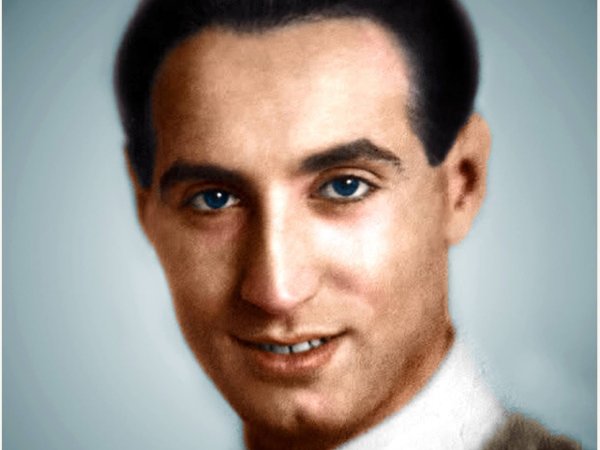
The stars of interwar Bucharest: Jean Moscopol, famous fiddler, actor, troubadour, exiled patriot
- Articles
- 14 JAN 26
Jean Moscopol remains one of the most refined and most dramatic figures of Romanian culture from the interwar period. An artist of joy, elegance, and urban romanticism, he was, at the same time, an uncomfortable conscience, a man who refused compromise and paid dearly for his uprightness. His voice brightened the evenings of old Bucharest, but later became an instrument of protest and moral resistance, carried all the way into exile.
Childhood and the formation of a cultivated spirit
Ioan Moscu was born on February 26, 1903, in Brăila, into a family of Greek origin. From early childhood, music was close to him, and his warm voice was a gift inherited from his family. A teacher noticed his talent and guided him toward the study of the guitar, thus opening his path toward music. In his adolescence, he sang in the choir of the “Buna Vestire” Church in Galați, an experience that refined his ear and artistic discipline.
Alongside his musical inclination, Ioan Moscu was an outstanding student, passionate about study. By the end of high school, he mastered five foreign languages, a rare performance for that time. He attended university courses in Bucharest, studied at the Polytechnic University, and even at the Faculty of Aeronautics, proving an uncommon intellectual curiosity. This solid education would later be reflected in the refinement of his repertoire.
Zissu Bar and the birth of Jean Moscopol
The definitive move to Bucharest changed the course of his life. In the evenings, after working hours at the bank, Ioan Moscu used to spend his time at Zissu Bar, a cozy venue frequented by high society. There, playfully, he sang for his friends, without suspecting that his voice attracted the attention of the entire establishment. His playful whistling and penetrating timbre quickly became a magnet for the audience.
The owner of the venue sensed his potential and proposed that he go on stage. Thus Jean Moscopol was born, the name under which he would come to know fame. From his first appearances, it was clear that he was not a simple restaurant singer, but a complete artist, with a personal style and an elegant presence. Interwar Bucharest quickly adopted him as one of its sonic symbols.
Interwar glory and artistic consecration
In the 1930s, Jean Moscopol became a constant presence in the elite venues of the Capital. His romances, tangos, and songs inspired by French or Italian music conquered the public, and his records sold in thousands of copies. He collaborated with major composers of the time and played an active role in shaping the lyrics and music, being extremely demanding regarding artistic quality.
He sang on the radio, appeared on the stages of revue theaters, and was cast in films, demonstrating a rare versatility. His natural elegance, both vestimentary and spiritual, turned him into a true model of style. For the Romanian public, Moscopol was not just a singer, but a state of mind, a voice of urban romanticism.
International recognition and the refusal of compromise
His success did not stop at the borders of Romania. He recorded for famous record companies, sang in Berlin and Vienna, and was courted for a stable international career. Nevertheless, the bond with Romania remained essential to him. He refused to settle permanently abroad, choosing to return home again and again, where the public loved him unconditionally.
This choice, however, was to cost him dearly. After the war, the establishment of the communist regime radically changed the cultural climate. Jean Moscopol refused to submit to the new ideology and publicly condemned the obedience of artists to power. From that moment, his artistic path entered a dangerous slope.
Anti-communist couplets and the beginning of exile
As a sign of protest, Moscopol began to write and perform satirical couplets aimed at the communist regime and its leaders. These songs, full of irony and courage, were received with enthusiasm by the public, but attracted the fury of the authorities. The artist quickly became undesirable, and his career in the country was practically destroyed.
In 1947, disappointed and persecuted, he chose the path of exile. He passed through Paris and Germany, collaborating with Radio Free Europe, then settled in the United States. Far from home, he continued to sing and write, but the former glory could no longer be recovered.
Life in America and longing for Romania
In New York, Jean Moscopol led a modest existence, far from the brilliance of the interwar years. He worked as a night watchman and sang occasionally within Romanian and Greek communities. Although his voice had preserved its charm, times had changed, and the wider public had forgotten him.
Longing for Romania constantly tormented him. His songs from exile speak about loss, hope, and love for a country that no longer received him back. Only after 1990 did his name begin to be rediscovered, and his music returned to the attention of the public.
The legacy of an uncomfortable artist
Jean Moscopol died in 1980, in New York, alone and far from the places that had consecrated him. The communist regime had tried to erase his name from collective memory, but did not succeed. After the fall of communism, his records were rediscovered, and his figure was reevaluated as a symbol of dignity and resistance through culture.
Today, Jean Moscopol is more than a star of interwar Bucharest. He is the image of the artist who chose truth instead of comfort, freedom instead of compromise, and who transformed music into a form of patriotism. His voice remains a bridge between a vanished world and the eternal need for dignity.
We also recommend: Zavaidoc, the most famous fiddler of interwar Bucharest, sang on the front of World War I and refused to become an opera tenor