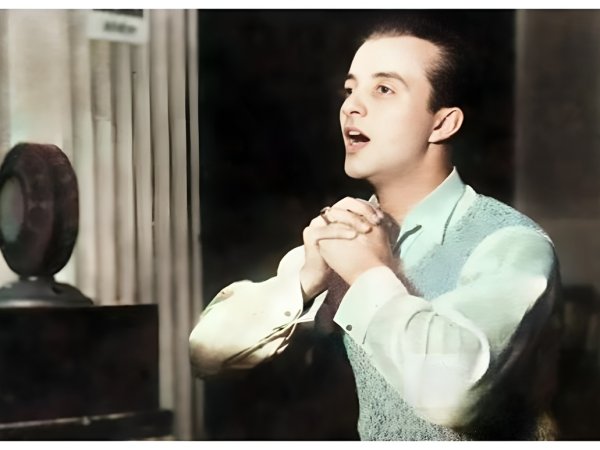
The stars of interwar Bucharest: Cristian Vasile, the suffering troubadour who drank Zaraza’s ashes
- Articles
- 06 FEB 26
The perfume of interwar Bucharest has not completely faded. It still lingers discreetly today among the weathered buildings of the Old Town, on the streets where, once, lanterns lit the steps of coquettish ladies and troubadours with guitars held close to their chests. It was an era of intense passions, long nights in cafés, and romances sung with an open soul. From that bohemian universe, one name has remained legendary: Cristian Vasile. His unmistakable and haunting voice marked the history of café music forever, and his love story with the mysterious Zaraza turned a song into an urban myth that endures to this day. Cristian Vasile was not merely a famous singer, but the living expression of an era in which music was felt viscerally and love could become fatal. His destiny, scattered with glory, passion, and tragedy, perfectly reflects the splendor and decadence of interwar Bucharest.
Interwar Bucharest, the city of romances and passions
In the years between the two world wars, Bucharest experienced a rare cultural effervescence. The city was a fascinating blend of Western elegance and Balkan melancholy. In the taverns of Lipscani, near the North Railway Station, or in the select venues of the city center, lăutari and romance singers were true stars. Music was born from longing, impossible loves, and lives lived on the edge.
It is within this context that Cristian Vasile appears, a young man destined to become the absolute symbol of café music. His voice was not just an artistic instrument, but a continuous confession, capable of stirring tears, desire, and nostalgia. The romance “Zaraza” would become the soundtrack of a love story that transcended reality.
From Brăila to the Capital, the beginning of an unexpected journey
Cristian Vasile was born in Brăila, far from the lights of the Capital. A shy boy with big dreams, he arrived in Bucharest hoping to become a tenor at the Opera. He attended the Conservatory, but fate would guide him toward a different kind of stage, one much closer to people’s hearts.
In 1928, on an ordinary autumn evening, encouraged by friends, he climbed for the first time onto the stage of a modest tavern near the North Railway Station. He was only 20 years old, of medium height, with fair skin, piercing eyes, and a timid smile. Nothing suggested then that this young man would become the most beloved troubadour of interwar Bucharest.
The atmosphere of the taverns, far removed from the rigor of the Opera, captivated him. Here he discovered the romance and the tango, genres that allowed him to express his artistic sensitivity and communicate directly with the audience.
The rise of a troubadour of hearts
Cristian Vasile began singing steadily in increasingly well-known venues. His warm voice, slightly trembling, with a special pathos, quickly set him apart from other performers. The public adored him, and young women blushed as they listened. He definitively abandoned the dream of the Opera and embraced café music, where he soon became a reference name.
Important contracts followed. He sang every evening in famous establishments in central Bucharest, promoting songs that would become classics: “În ochii tăi fermecători” (“In Your Enchanting Eyes”), “Pe boltă, când apare Luna” (“On the Vault, When the Moon Appears”), “Aprinde o țigară” (“Light a Cigarette”), and, of course, “Zaraza”. Each appearance was an event.
Musicologist Nicu Teodorescu described him as an artist who burned on stage, giving himself to song with a rare intensity. His voice expressed the spirit of an entire era, and the audience instinctively felt it.
Zaraza, the woman who changed his destiny
Although he was the idol of women, Cristian Vasile had eyes for only one. Zaraza embodied seduction: black hair, green eyes, red lips, olive skin, a goddess-like body, and an “angelic smile.” The two met for the first time at the “Vulpea Roșie” tavern on Lipscani Street. He, the absolute star of café music. She, the most desired courtesan of the city.
Love erupted instantly, defying conventions and the critical gazes of society. Their affair lasted two years, years of intense passion, jealousy, and promises. For Cristian Vasile, Zaraza became the supreme muse, the woman for whom he sang and lived.
Jealousy, rivalry, and murder
Their story could not remain untouched by envy. Zavaidoc, one of the most popular lăutari of the time and Cristian Vasile’s greatest rival, became obsessively infatuated with Zaraza. She rejected him repeatedly, and the refusals wounded his pride.
Blinded by jealousy, Zavaidoc is said to have ordered Zaraza’s assassination. On an October night in 1946, the young woman left to buy tobacco for her lover and never returned. She was killed by one of her rival’s “henchmen,” and her body was found the next day, her throat slashed, on a street in central Bucharest.
Zaraza’s death marked the end of a love story and the beginning of an irreversible tragedy.
The madness of grief and the extreme gesture
Devastated, Cristian Vasile collapsed psychologically. He isolated himself at home, drowned his sorrow in alcohol, stopped eating and sleeping. In an act of absolute despair, he stole the urn containing Zaraza’s ashes. In a gesture that fed the legend, he swallowed her ashes, hoping to fill the void in his heart.
The pain did not fade. He decided to end his life, drank turpentine, and collapsed unconscious. He survived, but the doctors delivered the verdict that destroyed his career: his vocal cords were permanently damaged. The artist died symbolically at that moment, even though the man lived on.
War, illness, and decline
During the Second World War, Cristian Vasile enlisted in the army’s artistic teams. He reached the Don River, then the Western Front. Returning to Bucharest, he tried to resume his artistic life, singing in a small restaurant near Cișmigiu.
His health deteriorated rapidly. Weak, he ended up in the hands of doctors and received a grim diagnosis: tuberculosis. He was confined to bed, living on memories of former glory. Nicu Teodorescu movingly described this slow decline, in which the once-acclaimed artist would spend hours staring out the window with tear-filled eyes.
Communism and definitive marginalization
In 1950, with the communist regime in power, Cristian Vasile’s life changed radically. He refused to sing for Gheorghe Gheorghiu-Dej, and this act of defiance cast him into obscurity. He was excluded from official musical life and forced to work on the construction site of the Gaz Metan Enterprise in Mediaș.
Later, he returned to Bucharest, working as a program presenter at the State Circus and as a director at the “Țăndărică” Puppet Theatre. Music remained only a painful memory.
The last love and the end
He met Rada Moldovan, the woman who became his wife and stood by him until the end. They moved to Piatra Neamț, where he worked as a director at a local theater and she as a prompter. His health worsened again: his heart failed, tuberculosis returned aggressively, and his vocal cords became completely paralyzed.
Cristian Vasile died in June 1974, at the age of 66. The troubadour who had enchanted an entire city and turned a love story into legend passed away quietly, leaving behind a story that continues to move generations.
The legacy of a Bucharest myth
Today, Cristian Vasile remains the romantic symbol of interwar Bucharest. His story, a blend of glory, love, and suffering, has transcended reality and become myth. The romance “Zaraza” continues to echo as the voice of an era in which music was lived with an open heart and love could kill.
We also recommend: The cruel fate of the courtesan Zaraza. Trapped in a love triangle, killed out of jealousy