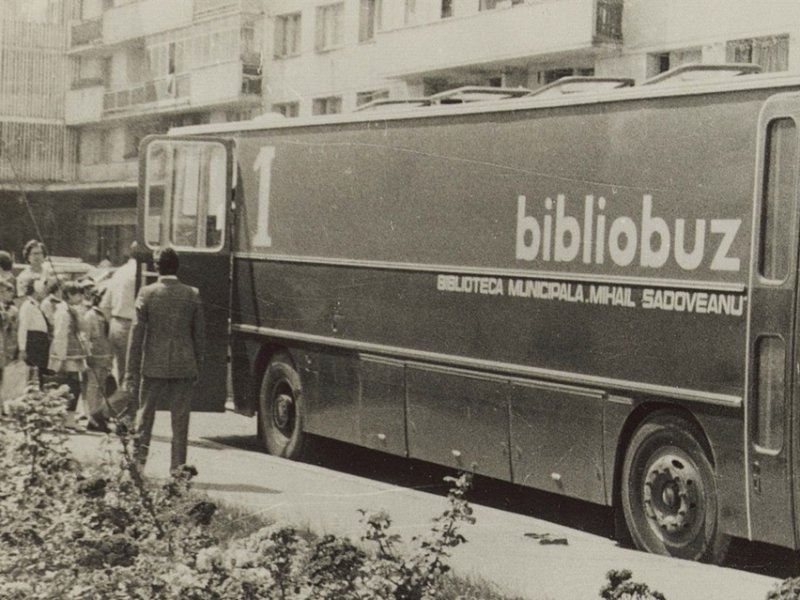
The Romanians’ library on wheels in the 1970s. Everyone read books and borrowed vinyl records from the Bibliobus
- Articles
- 27 JAN 26
Today, access to reading is easier than ever. Books can be quickly purchased from physical or online bookstores, read in digital format, and public libraries are open to a wide audience. However, this reality is relatively recent. In the first decades of the communist regime, especially in rural areas, books were a rarity. Children in villages had no libraries, no bookstores, and very often not even enough textbooks. Their cultural universe was built from the stories told by grandparents in the evening, from orally transmitted fairy tales, and from their own imagination. In large cities, however, the authorities tried to compensate for the lack of access to culture through an original initiative for that time: the bibliobus, a library on wheels that brought books directly into people’s neighborhoods.
The birth of a cultural idea in a difficult era
The bibliobus appeared as a practical solution in a period when cultural infrastructure was insufficient. The idea of a mobile library was not entirely new in Europe, but in Romania it took on a particular form, adapted to communist realities. Beginning in the 1960s and especially during the 1970s–1980s, bibliobuses became a familiar presence in major cities. Authorities decided to transform decommissioned passenger buses into mobile libraries.
The seats were completely removed, and the interior was rearranged with shelves full of books, magazines, and sometimes vinyl records. The exterior of the buses was painted in bright colors and clearly inscribed, making them easy to recognize. For children, the bibliobus was a spectacular sight, a colorful object that carried with it the promise of adventure and discovery.
The bibliobus in Bucharest and the first urban routes
In the capital, bibliobuses began circulating in 1974. They served large neighborhoods undergoing rapid urban development, such as Berceni, Balta Albă, Drumul Taberei, or Grivița. Usually, each bibliobus was staffed by a driver and a librarian employed by the “Mihail Sadoveanu” Municipal Library. The librarian was responsible for keeping track of the volumes, interacting with readers, and offering reading recommendations.
The visits of the mobile libraries were scheduled monthly and became real events for children and teenagers. Once parked in a designated spot, the bus was immediately surrounded by eager readers. The atmosphere was calm and respectful, and books were treated with a natural care, almost ritualistic.
What people read and how the lending system worked
The reading selection was varied and tailored to a young audience. Among the most sought-after titles were adventure and mythology books, such as Legends of Olympus, The Iliad, The Odyssey, The Cherry Orchard Boys, or Captain at Fifteen. Poetry and classical Romanian literature also found their place on the shelves, alongside magazines for children and young people.
Borrowing was simple and free of bureaucracy. There were no complicated forms or digital databases. A simple card was enough, and books could be taken home without difficulty. The bibliobus returned to the same place after about a month, when the volumes were returned and new ones borrowed. Everything was based on trust, and losses were rare.
Childhood memories: the bibliobus as a space of discovery
For many who grew up during those years, the bibliobus remains a powerful and emotional memory. Toma Vali recalled how, every Thursday, he went to the bus parked in front of the complex near Section 13 of the Militia. He browsed through the books, chose the most interesting titles, and continued reading late into the night, often by the light of a flashlight, hidden under the blanket.
Vasile Bodringa fondly remembers how, together with his brother, he would sit on a bench inside the bibliobus and look out the window, fascinated by that place which had become a refuge. The interior was simple, with benches upholstered in gray vinyl, well-organized shelves, and an atmosphere of silence that invited reading and dreaming.
Bibliobuses seen through the eyes of the community
On forums and social media, former users of bibliobuses recall seemingly small details, yet charged with emotion: the red color of the vehicles, the vividly colored inscriptions, the smell of printed books, and the calm voice of the librarian. Many mention that these vehicles were not ordinary DAC buses, but models modified in ITB workshops, specially adapted for their cultural role.
In Bucharest, bibliobuses circulated until 1992. After that, they began to be gradually withdrawn, amid the economic and social changes that followed 1989.
Galați, an example of cultural pioneering
A special case is the city of Galați, where the bibliobus was introduced as part of a cultural strategy in a city undergoing intense industrial development. In 1976, the “V.A. Urechia” Library put the first bibliobus into circulation, initially on the platform of the Steelworks, as an experimental project.
The success was rapid and obvious. In just a few months, thousands of volumes were borrowed, and the number of readers steadily increased. In April 1978, a second bibliobus was already operational, and a third was being prepared. The vehicles were equipped with lighting and heating and were connected to the street power grid, allowing them to operate even during the cold season.
The peak and the decline of the bibliobuses
The routes, operating hours, and stops of the bibliobuses were announced through posters, flyers, and articles in the local press. In December 1976, the newspaper România Liberă enthusiastically reported that the Galați bibliobus served daily eight fixed points in neighborhoods with over 75,000 inhabitants, distributing more than 10,000 volumes in its first two months.
Unfortunately, after the 1990s, bibliobuses began to disappear. Lack of funding, the disinterest of authorities, and the emergence of other ways to access reading—such as the internet and private bookstores—led to the gradual abandonment of this project. In the courtyard of the Bucharest Metropolitan Library, three Roman 111 buses could still be seen until the 1990s, the last remnants of the former bibliobuses.
The legacy of the bibliobus and its relevance today
Today, the idea of a mobile library is timidly returning, especially through NGO initiatives and educational projects aimed at disadvantaged areas. The communist-era bibliobus remains, however, a symbol of a time when, despite censorship and shortages, the love for books always found a way to reach people.
Bibliobuses were more than simple means of transporting books. They created communities, stimulated imagination, and shaped generations of readers. In a world dominated by screens, perhaps a library on wheels, adapted to our times, could once again become a necessary presence, bringing stories back to the places where they can change lives.
We also recommend: The Temple of Absolute Knowledge: How the Central University Library Came to Be, the Foundation Built by King Carol I