The Kandia Chocolate Factory — Romania's Sweet Dream Under Communism
- Articles
- 24 JUN 26
The story of Romania's longest-lived confectionery brand begins not in Bucharest, but in Timișoara, in a small candy workshop opened in 1890.
If you grew up in communist Romania, you know exactly the taste we're talking about: bitter chocolate with rum-flavored cream filling, a tricolor wrapper with the word "București" stamped onto the bar itself. The ROM brand became a national symbol — but few people know that its roots lie not in Bucharest, but in Timișoara, and that the factory which launched it has vanished entirely from the map, swallowed by the very capital it helped feed.
A Candy Workshop, One Man, and Eight Workers
It all began in 1890, when a merchant named Latter Mor opened a confectionery workshop in Timișoara with around eight employees. The workshop initially produced simple sweets for the city on the Bega river and the surrounding towns. Five years later, by 1895, production had expanded enough to speak of a real factory — with specialized staff, machinery, and a broader range of products. In 1909, the enterprise became a joint-stock company under the stewardship of the Bank of Timișoara.
The name "Kandia" came in 1917. The factory adopted it from the Venetian form of the name of the island of Crete — Candia — a choice that evoked an exotic world, luxury, and a remarkably forward-thinking marketing instinct for the era. Under this label, the Timișoara factory grew rapidly: during the interwar period, Kandia chocolate rivaled Western products and reached every corner of Greater Romania. In 1923, a new four-story building was constructed and equipped with the most modern machinery of the time.
Kandia was, at that point, the first chocolate factory on what is today Romanian territory — Timișoara belonged to Austria-Hungary in 1890, and the Zamfirescu factory in Bucharest opened one year later, in 1891.
Nationalization and a New Life in Bucharest
In 1948, the communist regime enacted Law no. 119, which nationalized all enterprises producing confectionery with a capacity of at least one ton per eight-hour shift. The Kandia factory in Timișoara passed into state ownership.
In Bucharest, the process worked differently. Not one factory but several private enterprises were forcibly merged into a single state entity: the Bucharest Sugar Products Enterprise. Among those absorbed was the "Frank" firm — founded in 1889 as a subsidiary of the Austrian concern Heinrich Frank Söhne from Linz — along with the "Zamfirescu" factory, the individual firm of Pavel Helioty, SAR "Corso," and the "Regina Maria" factory. The headquarters of the new enterprise was established at 20 Șoseaua Viilor, in the 5th district.
From this mixed inheritance, gathered by force under one roof, was born what Romanians would come to know as "the chocolate factory in Bucharest."
ROM: Romania's First Chocolate Bar
In 1964, the Bucharest Sugar Products Enterprise launched something new: the first chocolate bar ever produced in Romania — and the country's first product with a cream filling. It was rum-flavored cream wrapped in bitter chocolate, weighed around 30 grams, and cost 1.80 lei. The word "București" was stamped onto the bar itself, and the wrapper used the colors of the Romanian tricolor.
It was called, simply: ROM.
ROM appeared in a year of political turning points — 1964 was also the year of Romania's Declaration of independence from Moscow, the beginning of Romanian national-communism. Whether the launch was deliberately synchronized with this new ideological direction is not confirmed by any direct source, but the context left its symbolic mark on the product: a tricolor wrapper, the capital's name on the bar, a taste that would last six decades.
In 1979, the same factory launched Romania's first packaged cake: Măgura. By 1969, the factory's products were being exported to 70 countries.
Chocolate as Luxury — and as Contraband
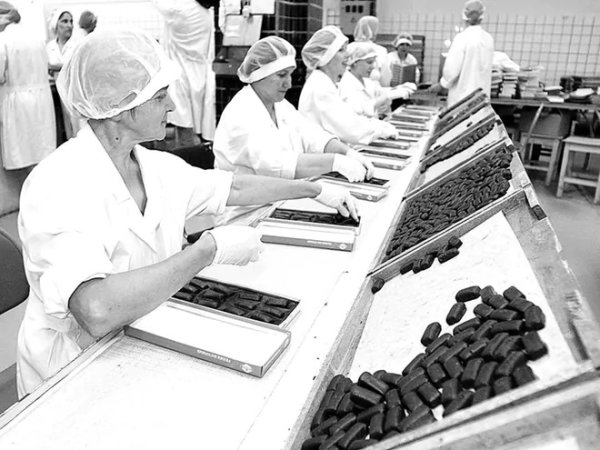
In the 1980s, as the Romanian economy collapsed and food shortages became systematic, chocolate took on a value far beyond its price tag. Kandia — both from Timișoara and from the Bucharest factory — was sought after, hoarded, gifted carefully, and sometimes bartered. Before the Revolution, the Timișoara factory alone employed 1,500 people, the majority of them women.
The taste of ROM was not just a taste. It was one of the few things that remained recognizable and constant in an increasingly unpredictable world.
Privatization, Merger, and the End of Timișoara
After 1989, the trajectories of the two legacies — Kandia Timișoara and the Bucharest Sugar Products Enterprise (renamed Excelent SA in February 1991) — collided dramatically.
The Timișoara factory collapsed through the 1990s, pushed, according to multiple economic press sources, toward deliberate bankruptcy by interest groups connected to Excelent Bucharest. In 2003, the investment fund Rivta GmbH sold Kandia Timișoara to the Excelent company in Bucharest, controlled by an investment vehicle of the Austrian Julius Meinl group, for 5.3 million euros — a negligible sum relative to the brand's value.
In 2004, the Timișoara factory closed. The last employees were dismissed. The brand, the recipes, and the history were transferred to Bucharest. The machines went silent.
In 2007, Julius Meinl sold Kandia-Excelent to Cadbury for 100 million euros — nearly 20 times what it had paid for the acquisition. Cadbury was later acquired by Kraft, but the European Commission required Kraft to divest Kandia to avoid a dominant market position in Romania. Julius Meinl bought the company back in July 2010 for under 20 million euros and gave it its current name: Kandia Dulce.
What Remains
Today, Kandia Dulce is Romania's largest chocolate producer, operating two factories in Bucharest. Its portfolio includes ROM, Măgura, Silvana, Sugus, Laura, and Primola. ROM is still sold with the same recipe from 1964.
In Timișoara, the place where the brand's heart beat for 113 years looks very different now. The halls built during the communist period were demolished in 2015. A single building survived — the one that housed the original confectionery workshop from 1890. At the start of 2026, the Timișoara City Hall issued a building permit for a supermarket on the site of the former factory. The historic building was put up for sale at 428,000 euros.
The brand that survived communism, privatization, and four changes of ownership could not save the walls it was born in.
Citește și A Sweet Nostalgia: The desserts of 1970s and '80s Bucharest