The history of the Femina cinema in Bucharest, the place where Romanians “saw” the story of the heroine Ecaterina Teodoroiu
- Articles
- 20 MAR 26
In the history of interwar Bucharest, the Femina cinema occupies a special place, not only as a well-known and frequented screening hall, but also as a space in which film became a cultural instrument, an urban symbol, and a vehicle for the public legitimization of major national themes. Located, during the interwar period, at number 12 on Elisabeta Boulevard, Femina was one of the best-known cinema halls in the Capital, a landmark of social and cultural life, but also a place important enough to enter literature. Its name appears both in the novel Roots by Hortensia Papadat-Bengescu and in the volume Bucharest: the city of collapses by Octav Dessila, a sign that its presence had already gone beyond the simple function of a screening hall and had entered the imagination of the era.
Femina, a landmark of interwar Bucharest
The fame of the cinema was built not only through its central positioning or through the social prestige of its audience, but also through the events it hosted. Among these, one remained defining for the memory of the place: the gala premiere of the film Ecaterina Teodoroiu (The heroine from the Jiu), held on January 8, 1931.
The screening was not an ordinary one, but a true state event, attended by the entire royal family, members of the government, high dignitaries, and representatives of the diplomatic corps. The fact that such a premiere was held at Femina says everything about the status of the cinema in the landscape of the Capital and about the role that film had already begun to play in the construction of an official memory about war, heroism, and national identity.
In Bucharest between the two world wars, cinema was more than entertainment. It had become part of the rhythm of the modern city, of the social life of the urban classes, and of the new way in which the public consumed stories, images, and symbols.
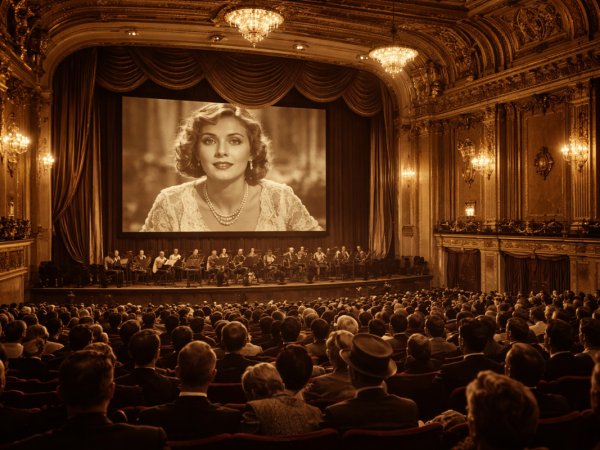
In this context, Femina had established itself as one of the best-known cinema halls in the city. Placed on Elisabeta Boulevard, in a central and vibrant area, the cinema was part of that Bucharest in which modernity was expressed through electric light, posters, shop windows, elegant halls, and an urban culture in full development.
Its importance is also confirmed by the fact that it was recorded in literature. When a place comes to be mentioned in novels or in books about the city, it means that it has gone beyond the utilitarian level and has become a recognizable element of the collective mental landscape.
Femina was not only a building in which films were shown, but a place that participated in defining the Bucharest atmosphere. It was one of those spaces in which the public came not only for the production on the screen, but also for the ritual of going out into the city, for the prestige of being present there, and for belonging to a modern urban culture.
That is precisely why the premiere of the film dedicated to Ecaterina Teodoroiu could not take place just anywhere. The choice of the Femina cinema was, without doubt, a symbolic one. The hall offered the proper setting to turn a film into a public act of commemoration, into a demonstration of patriotic consensus, and into a ceremony of national memory. Femina thus becomes not only a host, but also an active part of the story of the film and of the way in which it was received.
The premiere of the film “Ecaterina Teodoroiu”, a moment of maximum visibility
On January 8, 1931, the gala premiere of the film Ecaterina Teodoroiu (The heroine from the Jiu) took place at the Femina cinema, in a solemn and official setting. The participation of the royal family, of the government, of dignitaries, and of the diplomatic corps turned the screening into an event far beyond the level of a simple cinematic launch. It was, in fact, a public ceremony through which Romanian film was trying to assert its importance, while the monarchical state was consolidating its own narrative about the recent past.
The production had been made initially without sound, in a period in which Romanian cinematography was confronting obvious technical limits. The sound was added later in Berlin, where music, sound effects, and a few lines were added to the film. This detail is significant, because it shows both the ambition of the project and the dependence on Western technical infrastructure. In the version presented to the public at the premiere, the motion picture had a musical arrangement based on Romanian motifs, war noises, and sound interventions meant to intensify the dramatic and patriotic character of the story.
Directed by Ion Niculescu-Brună and produced by the Soremar Film production house, with Felicia Frunză in the leading role, the film followed the destiny of one of the strongest female figures of the Romanian First World War. From a narrative point of view, the motion picture begins before the outbreak of the war, captures the mobilization, the parting of the soldiers from their families, and Ecaterina’s attempt, as a scout, to find her brother.
After learning that he died on the front, the heroine decides to continue the fight in his place, taking upon herself the sacrifice. The central moment of the film is her wounding, accompanied by the line that became emblematic: “Forward, boys, for country and king!”
This formula perfectly sums up the ideological grid of the entire production. Love of country and loyalty to the king are presented as the foundations of the action and the supreme motivations of heroism. The film does not construct only a heroic biography, but also a lesson in patriotism in the political key of the era.
A film between document, myth, and propaganda
One of the important particularities of the film Ecaterina Teodoroiu (The heroine from the Jiu) is the combination of fictional elements with fragments of documentary reality. The production includes authentic archive images of Queen Maria visiting the hospital in which Ecaterina Teodoroiu was being cared for. More than that, some characters are played by people who actually took part in the real events: Ecaterina’s mother, the village mayor, or the soldiers who defended the bridge over the Jiu. This choice gave the film an extra degree of authenticity and created the impression of a direct connection between history and its cinematic representation.
Even so, the authenticity of some details does not cancel the pronounced propagandistic character of the film. On the contrary, it was precisely this combination of the real and mythologization that made it effective. The motion picture did not aim only to tell the story of a heroine, but also to fix in the public consciousness a certain interpretation of war and nation. Ecaterina is presented as a symbolic figure of total sacrifice, and her gestures are integrated into a broader narrative about national unity, devotion to the state, and the legitimacy of the monarchy.
Like any political regime, the Romanian monarchy had built its own propagandistic program. This aimed to identify the dynasty with the reunited nation and to highlight the role of King Ferdinand and Queen Maria in achieving the national ideal. In this sense, the film fits perfectly into a broader symbolic strategy. It marks, in fact, the peak moment of the providential image of Queen Maria, already consolidated in public opinion through her presence in hospitals and through the role associated with the peace negotiations in Paris.
The motion picture did not invent this image, but took it over and made it official. It transformed it into a classicized form, meant to endure and to be transmitted to posterity. The film therefore came to fix an already existing memory and to frame it within a coherent national discourse, in which the monarchy, the army, sacrifice, and collective destiny mutually supported one another.
The political context of the beginning of the decade and the symbolic stake of the film
The premiere at Femina and the film’s visibility success cannot be understood outside the political context of the beginning of the 1930s. It is a period in which nationalist discourse was becoming stronger and stronger, and the institutions of the state were seeking ever more convincing forms of symbolic legitimization. In this climate, Romanian cinematography, still at the beginning and lacking a stable infrastructure, found in the myth of the nation and of the war of unification one of the few themes capable of mobilizing the public and justifying the investment in an local production.
At the beginning of the 1930s, a genuine Romanian film industry could not be built easily. Technical resources were limited, professional experience was scarce, and the competition from foreign productions was strong. In these conditions, the appeal to subjects with patriotic charge became almost inevitable. The war of unification, individual heroism, and the role of the crowned heads offered a narrative matter that was legitimate, emotional, and politically useful.
The film about Ecaterina Teodoroiu functioned exactly within this logic. It was not only an artistic attempt, but also an act of instituting a heroic female model and, at the same time, a form of symbolic rapprochement between the Royal House and the destiny of the people. In a certain sense, the monarchy was trying through such productions to soften the perception of a foreign dynasty and to present itself as an organic part of national history and suffering. The Femina cinema was the place where this effort received a spectacular public form.
How the film was received in the press of the time
The press of the era welcomed the appearance of the film largely with enthusiasm and praise, but the reactions were not unanimous. On the contrary, they reflect very well the tension between the desire to support Romanian cinematography and the need honestly to acknowledge its technical and artistic limits. Some commentators appreciated the initiative, the theme, and the patriotic intention, while others noticed without restraint the awkwardnesses of execution.
In the article “On the margin of a new Romanian film,” published in Rampa, Vasile Timuș observes that the film suffers because of the lack of means and the numerous imperfections, which makes it hard to compare with foreign productions. The critic remarked that the Romanian producer chose to oppose to the humanist war film a poetic and heroic war film, but precisely such a choice required technical resources and great artistic availabilities of idealization, which, in his opinion, were lacking in Romanian cinematography at that moment.
Even so, Vasile Timuș does not reject the motion picture as a whole. On the contrary, he considers that Ion Niculescu-Brună manages, even without famous actors and without a screenplay of great refinement, to offer a more authentic result than Martin Berger in the Romanian-German co-production Ciuleandra from 1930. The appreciation is important, because it praises not so much the technical performance, as a certain sincerity of the approach and a better fit between the subject and the mode of representation.
At the same time, Timuș criticizes the solutions discussed in the public space for making Romanian films, especially the appeal to foreign production houses or to imported directors. For him, the true path of development of a national film industry was technical synchronization with the West, not the transfer of artistic authority outside. The central idea of his argument is that technique has no nationality and can be appropriated, if there is confidence in one’s own artistic forces.
Much more severe was Ion Cantacuzino, who, in his chronicle in Music and theater, almost demolishes the film. He clearly sees the propagandistic dimension of the production and considers that the intention of maintaining heroism in the souls of the citizens is not supported by cinematic means to match. His irony, according to which the only heroism generated by the film was that of the spectators who came to see it, remained one of the harshest critical formulas directed at the production.
On the other hand, Paul Constantin, in the magazine Cinema, adopts a more moderate and more benevolent tone. He considers that the choice of the character Ecaterina Teodoroiu for a national work was inspired and notes that the realization is, on the whole, correct, with often apt performances by Felicia Frunză and Mielu Constantinescu. In addition, he appreciates the sound as adequate, which suggests that, in relation to the expectations of the moment, the film was not perceived unanimously as a failure.
There were also frankly laudatory texts, which emphasized the satisfaction of the appearance of a film that glorified the epic of national reunification. These favorable reactions show that the motion picture was received not only in aesthetic terms, but also as a cultural and patriotic event. For a part of the public and of the critics, the simple fact that Romania had such a film mattered almost as much as its artistic value.
The definitive connection between the film and the Femina cinema
Even if the film Ecaterina Teodoroiu (The heroine from the Jiu) was considered modest from a technical point of view and strongly propagandistic, it remained forever linked to the Femina cinema. In that Bucharest hall, the noises of the battles of the First World War were heard for the first time, for the Romanian public, rendered in a sound construction meant to amplify the emotion of collective sacrifice. Femina thus became the place where the memory of the war was transposed into a solemn, public, and strongly ritualized cinematic experience.
This connection is tied not only to the date of the premiere, but also to the symbolic load of the moment. Through the film, the Royal House was trying to close the appearance of being a foreign dynasty and to identify itself with the destiny of the nation. Through the Femina hall, this message was staged in a space of urban modernity, accessible to the public and suitable for the visual consecration of a national mythology.
Ultimately, the history of the Femina cinema intersects here with the history of Romanian film, with the history of monarchical propaganda, and with the history of the way in which Romanian society represented its own heroes. Femina was not only a place where one went to the movies, but a space in which history, politics, and collective emotion met in the form of cinematic spectacle. And among all the screenings that marked its existence, the premiere of the film about Ecaterina Teodoroiu remains, without doubt, one of the most significant.
We also recommend: Cinema București, the history of the former interwar Trianon cinema where Romania’s first sound film was screened