The history of Mega Mall Bucharest: how the shopping center as big as 10 stadiums appeared in the Pantelimon district
- Articles
- 01 SEP 26
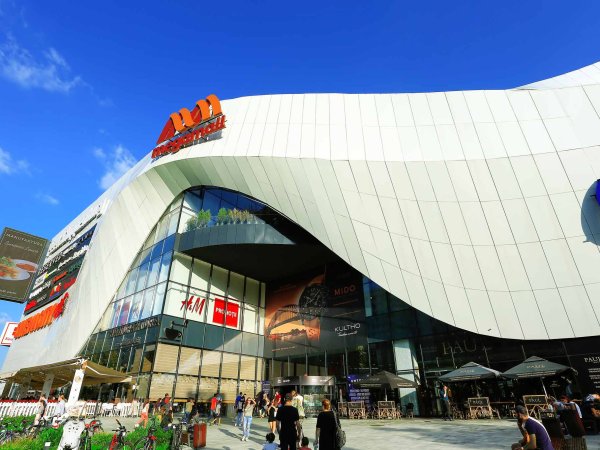
In the eastern part of Bucharest, in an area long associated with apartment blocks, major industrial platforms and heavily trafficked roads, stands today one of the capital’s best-known shopping centers. Mega Mall Bucharest radically changed the appearance of an important area of the Pantelimon district and, since its opening in 2015, has become one of the main retail and entertainment destinations in the eastern part of the city.
An ambitious project of great lengths
The story of the shopping center, however, began long before the first stores opened their doors. Mega Mall was built on the site of the former Electroaparataj industrial platform, in an area close to Șoseaua Iancului, Șoseaua Pantelimon and the National Arena. The project was initially developed by Austrian company Real4You, while in 2013 the South African investment group NEPI entered the project, acquiring a 70% stake in the company behind Mega Mall. The shopping center is now part of the NEPI Rockcastle portfolio.
The scale of the project was impressive from the very beginning. Contemporary project documents indicated a leasable area of roughly 70,000 square meters, while the completed complex reached approximately 230,000 square meters of total built area. This enormous size explains some of the spectacular comparisons that have been used over the years to describe Mega Mall.
From the Electroaparataj factory to a major retail project
Before Mega Mall appeared, the land on Pierre de Coubertin Boulevard was closely connected with Bucharest's industrial history. The former Electroaparataj factory occupied a large part of this area, as did many other industrial facilities that shaped the capital during the communist period and in the decades that followed.
The transformation of the site into a modern shopping center is therefore an example of the profound changes that Bucharest underwent after 1990. Industrial land that had once been dedicated to manufacturing was gradually converted for commercial and urban development.
The idea of constructing a shopping center on the former Electroaparataj site had already taken shape before NEPI became involved. Real4You was preparing the project, and the plans called for a large shopping center designed to serve the densely populated eastern districts of Bucharest. The location was considered particularly attractive because of its accessibility and its proximity to the National Arena.
The site also benefited from its position near several important roads and public transport routes. At the time, the eastern part of Bucharest had a large population but considerably fewer modern shopping destinations than other areas of the capital. Mega Mall was therefore intended to fill an important gap in the city's retail map.
The proximity to the National Arena became another major advantage. The shopping center was built at Strada Pierre de Coubertin 3-5, only a short distance from Romania's largest football stadium, creating a highly visible commercial destination in one of the eastern entrances to the city.
NEPI enters the project and expands the scale of Mega Mall
One of the decisive moments in the history of Mega Mall came in 2013. NEPI acquired a 70% interest in the company behind the development, taking a majority position in the project. The investment group subsequently accelerated construction and transformed Mega Mall into one of its most ambitious developments in Romania.
At the time, the project was expected to have a leasable area of approximately 70,000 square meters. The scale increased during the development process, eventually reaching roughly 72,000 square meters of retail space at opening and more than 230,000 square meters of total built area. Contemporary reports described the investment as approximately €165 million.
Construction moved forward at a remarkable pace. The project was developed in a period when Bucharest's modern retail market was expanding rapidly, and the developers wanted Mega Mall to become a major destination for consumers in the eastern part of the capital.
The concept went beyond traditional shopping. From the beginning, the project was designed to combine retail stores with restaurants, entertainment and leisure facilities. This approach was becoming increasingly important in the shopping-center industry, as consumers were looking for places where they could spend several hours rather than simply visit a store.
May 14, 2015: the day Mega Mall opened its doors
Mega Mall officially opened to the public on May 14, 2015. The opening date had initially been announced for April 23, but the developers postponed it by several weeks because construction and finishing works were still underway. The final opening date was May 14.
The inauguration attracted thousands of visitors. Contemporary reports noted that some finishing works were still being completed when the first customers entered the building, making the opening an unusual one even by the standards of major construction projects. Nevertheless, the shopping center immediately became one of the most talked-about new destinations in Bucharest.
At the time of its opening, Mega Mall offered more than 200 shops and commercial spaces, together with a Carrefour hypermarket. Its entertainment facilities included a 14-screen Cinema City, including Romania's first cinema auditorium equipped with 4DX technology at the time. The complex also included a World Class fitness center with a semi-Olympic swimming pool and a large food court.
The opening represented a major transformation for the former industrial site. Instead of factory buildings and production facilities, the area now contained a large modern complex dedicated to shopping, food, entertainment and leisure.
Why Mega Mall is compared to 10 stadiums
Mega Mall's dimensions have always been one of its most remarkable features. At the time of its inauguration, the project had approximately 230,000 square meters of total built area, while its leasable commercial space was around 72,000 square meters. Contemporary reports described it as having the largest built surface among shopping centers in Romania at the time.
The expression "as big as 10 stadiums", used in connection with Mega Mall, should therefore be understood as a comparison designed to illustrate its enormous scale rather than as an exact architectural measurement. A shopping center's total built area cannot be directly compared with the capacity or footprint of a stadium.
The comparison becomes easier to understand when the commercial space is related to football pitches. A standard football field covers roughly 7,000 square meters. A leasable area of around 72,000 square meters is therefore equivalent, in broad terms, to about ten football pitches. The phrase is consequently a vivid way of describing the huge amount of commercial space available inside the complex.
The total built area is considerably larger because it includes circulation areas, technical spaces, parking facilities and other parts of the building. In this sense, Mega Mall's dimensions are even more impressive when the entire construction rather than only the retail space is taken into consideration.
What Mega Mall brought to Pantelimon
From the outset, Mega Mall was intended to become more than a place for shopping. Its combination of retail, food and entertainment helped turn the complex into an important destination for residents of Pantelimon, Iancului, Vatra Luminoasă, Titan and other eastern districts.
The center's location also gave it an important advantage. The National Arena is located immediately nearby, while major roads connect the complex with large residential neighborhoods. On days when football matches, concerts or other major events take place at the stadium, the surrounding area becomes one of the busiest zones in eastern Bucharest.
Mega Mall consequently became part of a broader urban landscape that combines residential neighborhoods, public transport, sports facilities and commercial destinations. Its construction helped accelerate the transformation of an area that had previously been dominated by industrial activity.
The shopping center's development also reflected a broader trend in Bucharest: the conversion of former industrial land into large-scale commercial and residential projects. Similar transformations occurred in several other parts of the capital, where factories and industrial platforms gradually disappeared and were replaced by shopping centers, office buildings and new residential developments.
Mega Mall after its first decade
Mega Mall reached its tenth anniversary in May 2025. The shopping center marked the occasion with a special anniversary campaign between May 14 and May 23, 2025, exactly a decade after its opening. The official anniversary campaign described the center as celebrating "10 years" of shopping, entertainment and experiences.
The anniversary itself is significant because it demonstrates how quickly Mega Mall became established in the urban landscape of Bucharest. What had been an industrial site only a few years earlier had become a familiar destination for residents of the eastern districts.
Today, Mega Mall continues to operate as part of the NEPI Rockcastle group. The official shopping-center website describes it as a destination combining shopping and entertainment, while the center's corporate information confirms its connection with the NEPI Rockcastle group.
The history of Mega Mall is ultimately also a story about the transformation of Bucharest itself. A former industrial platform was gradually replaced by a huge modern commercial complex, reflecting changes in the city's economy, architecture and lifestyle.
For people visiting the mall today, it can be difficult to imagine what stood here before the construction began. The stores, restaurants, cinema, entertainment areas and vast circulation spaces conceal the industrial history of the land. Yet the former Electroaparataj platform remains an essential part of the story of how Mega Mall came into existence.
The official opening on May 14, 2015 marked the completion of one of the most significant retail developments in eastern Bucharest during that period. With approximately 230,000 square meters of built area and more than 70,000 square meters of commercial space, Mega Mall immediately established itself as one of the capital's largest shopping destinations.
More than a decade later, the complex remains an important landmark in Pantelimon and one of the most recognizable examples of Bucharest's post-industrial transformation. Its story illustrates how an old industrial site can be completely reinvented and turned into a new urban destination, while its scale explains why comparisons with football fields and stadiums have become part of the way Bucharest residents describe the enormous building.
We also recommend: The history of ParkLake Mall in Bucharest, an oasis of greenery and entertainment in the heart of the capital's most beautiful sector