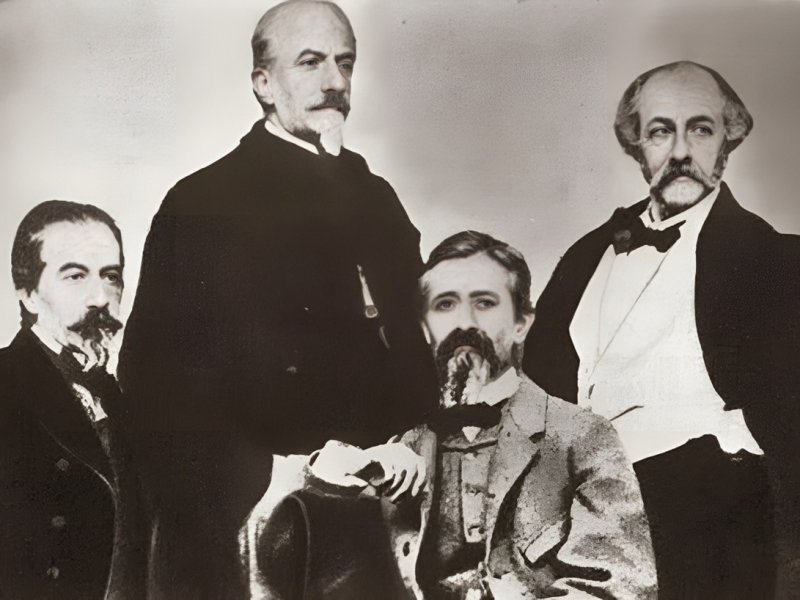
The Golescu family, the lineage of Romania’s prime ministers. The three politicians who defined national politics
By Bucharest Team
- Articles
The modern history of Romania cannot be understood without closely examining the role played by the great boyar families that decisively influenced the country’s political, social, and cultural direction. In an era of profound transformations, when the Romanian Principalities were searching for a path toward unity, independence, and modernity, several names constantly came to the forefront. Among them, the Golescu family occupies a special place, being one of the few families that gave Romania not one, not two, but three prime ministers. Ștefan Golescu, Nicolae Golescu, and Alexandru G. Golescu Arăpilă were not merely political leaders of their time, but also representatives of a broad national project built on education, reform, and civic spirit.
The Golescu lineage and the role of the boyar class in Romania’s modernization
In the nineteenth century, Romanian society was undergoing an accelerated process of change. Western influences, liberal and national ideas, as well as the desire for political emancipation, pushed the boyar class to redefine its role. If in the past social status had been guaranteed almost exclusively by wealth and origin, the new era demanded competence, culture, and public involvement. The Golescu family quickly understood this reality and invested heavily in the education of its younger members.
Dinicu Golescu, the head of the family and one of the prominent intellectual figures of the early nineteenth century, was a fervent advocate of the idea that progress comes through knowledge. His travel journals and publicly expressed opinions reflect a rare openness toward Western Europe and its values. This vision was passed on to his sons, who would later play key roles in Romania’s political history.
Western education, the foundation of the political elite
In the first decades of the nineteenth century, sending young boyars to study abroad became a strategy for political affirmation. The Golescu brothers fully benefited from this opportunity. The studies they pursued in Switzerland, France, and other European cultural centers provided them not only with solid academic knowledge, but also with direct contact with the revolutionary, constitutional, and liberal ideas of the time.
This Western education had a major impact on the way the three brothers understood politics. For them, the modern state was not merely an administrative structure, but a living organism that had to be built on strong legal, educational, and social foundations. Consequently, their political careers were closely linked to the promotion of reforms and the consolidation of state institutions.
Ștefan Golescu, the revolutionary who became prime minister
Born in 1809 in Câmpulung Muscel, Ștefan Golescu was the eldest son of Dinicu Golescu and Zoe Farfara. From a young age, he displayed a rare combination of military discipline and intellectual openness. The studies he completed in Geneva alongside his brothers gave him a Western perspective on society and politics.
After returning to the country, Ștefan Golescu pursued a military career, reaching the rank of major. At the same time, he became involved in cultural and political life, joining the Philharmonic Society, a nucleus of liberal and national ideas. This dual experience, military and civic, prepared him for the role he would play in the Revolution of 1848.
The Revolution of 1848 and political affirmation
The year 1848 represented a turning point for Ștefan Golescu. Present at the assembly of Islaz, he was appointed a member of the Provisional Government and held the position of minister of justice. In this capacity, he was actively involved in drafting the constitutional project, supporting the idea of universal suffrage, one of the most advanced proposals of the time.
After the defeat of the revolution, Ștefan Golescu was sent to Istanbul to negotiate with the Ottoman Empire, but his mission was unsuccessful. Nevertheless, his political activity did not end. After returning to the country, he continued to support the idea of the union of the Principalities and was a member of the Assembly that elected Alexandru Ioan Cuza as ruler.
Ștefan Golescu’s term as prime minister
Between 26 November 1867 and 12 May 1868, Ștefan Golescu served as prime minister of Romania in a liberal government. His term, although relatively short, was marked by consistent efforts to modernize the administration and strengthen the state. He was a politician of balance, who sought to harmonize revolutionary ideals with the political realities of the era.
Ștefan Golescu passed away in 1874 in Nancy, leaving behind the image of a leader who navigated with dignity one of the most turbulent periods in Romanian history.
Nicolae Golescu, the general with a political vocation
Born in 1810, also in Câmpulung Muscel, Nicolae Golescu initially chose a military career, eventually reaching the rank of general. His organizational spirit and the discipline acquired in the army would later help him in political life.
During the Revolution of 1848, Nicolae Golescu held the position of minister of internal affairs in the Provisional Government. After the defeat of the revolutionary movement, he was forced into exile, an experience that strengthened his political convictions and his attachment to the national cause.
Two terms as prime minister and essential reforms
Nicolae Golescu returned to the forefront of Romanian politics after the Union of the Principalities. He served as prime minister twice: in 1860 and then between May and November 1868. Although his mandates were short, they were marked by important initiatives.
On the economic level, during his governance, Romania’s exports increased significantly, and the exploitation of domestic resources was intensified. In the field of education, Nicolae Golescu supported the opening of teacher-training schools in several districts, contributing to the formation of a teaching corps prepared for the needs of a modern state.
He died in 1877 in Bucharest, being regarded as one of the pragmatic politicians of his generation, focused on concrete results and stability.
Alexandru G. Golescu Arăpilă, the intellectual reformer
The youngest of the three, Alexandru G. Golescu, born in 1819, remained known in history under the nickname “Arăpilă,” due to his dark complexion. He studied engineering in Paris, where he came into direct contact with revolutionary ideas and the major political debates of Europe.
Upon returning to the country, he actively participated in the Revolution of 1848, serving as minister of public works in the Provisional Government. After the failure of the revolution, he too experienced exile, later returning to become involved once again in public life.
A short but symbolic mandate
Alexandru G. Golescu was appointed prime minister of Romania for the period between 2 February and 18 April 1870. Although his mandate was extremely short, he remained in history as “the last minister of Prince Carol.” During this time, he attempted to promote administrative reforms and maintain balance in a politically tense period.
He died in 1881, leaving behind the image of an intellectual politician, deeply committed to the idea of a modern state and efficient administration.
The political legacy of the Golescu family
The Golescu family represents an almost unique case in Romanian history. The three prime ministers originating from this lineage navigated crucial moments: revolution, union, state consolidation, and the beginnings of the constitutional monarchy. Each had his own style, but all shared the same fundamental values: education, patriotism, and responsibility toward the public good.
Their legacy lies not only in the offices they held, but also in their contribution to defining a modern political class. Through their activity, the Golescus demonstrated that politics can be an instrument of progress and that the destiny of a nation can be decisively influenced by a few well-prepared and dedicated personalities.
We also recommend: Prince Ion Ghica, the Romanian prime minister with blue blood. He stopped piracy in the Aegean Sea and brought down Cuza