The first mayor in Bucharest’s history won his mandate by 8 votes. The story of General Barbu Vlădoianu
- Articles
- 18 FEB 26
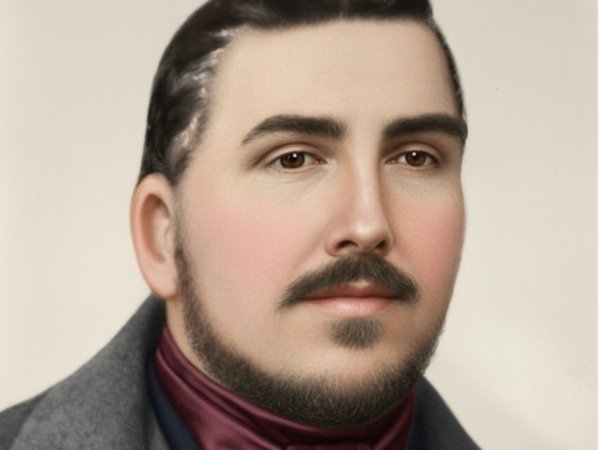
In the summer of 1864, Bucharest took a decisive step toward administrative modernity. The city, officially called at that time the “commune of Bucharest,” organized for the first time elections for the position of mayor. It was a turning point for a capital still in the process of institutional consolidation after the Union of the Principalities in 1859. At the head of the new administration was to arrive a military man with experience and a public profile already established: General Barbu Vlădoianu.
Elections with censitary voting in a city of 200,000 inhabitants
His victory was narrow. Out of a total of 18 candidates, Vlădoianu received 1,081 votes, only eight more than his direct rival, Pavel Tetorianu, who gathered 1,073. The last-placed candidate, N. Manolescu, received 826 votes. The minimal difference between the first two positions shows how close the competition was and how fragmented the electorate had become.
In the mid-19th century, Bucharest had over 200,000 inhabitants, according to the press of the time. However, the right to vote was not universal. Elections were held based on a censitary system, meaning that only those who met certain wealth or social status criteria could participate. Practically, a small part of the population decided the leadership of the city.
In this restricted context, the 1,081 votes that secured Vlădoianu’s victory were sufficient to install him in office on August 7, 1864. The mayoral term at the time lasted only one year. Later, in 1872, he would win another one-year term.
Born in 1812 and deceased in 1876, Vlădoianu was already a well-known figure in public life before becoming mayor. The first mention of his name in the press appears in 1859, in a Sibiu publication, where it was written in Cyrillic letters, a sign of the linguistic transition of the era.
From Minister of the Militia to Mayor of the Capital
In the year of the Union, 1859, the ruler Alexandru Ioan Cuza appointed Barbu Vlădoianu as Minister of the Militia. In the contemporary press, alongside other important figures such as Barbu Catargiu or Dimitrie Brătianu, Vlădoianu was mentioned as head of the Militia, in a formulation specific to the epoch.
This experience in central administration strengthened his profile as a man of institutions and recommended him for the position of mayor. His election in 1864 was welcomed by the Bucharest press, though commentators of the time did not hesitate to highlight the enormous challenges that awaited him.
One of the first actions of the new mayor was to present the financial situation of the “communal house,” that is, the city’s budget. The picture of revenues and expenditures was discouraging. The annual budget barely exceeded one million lei, an amount considered insufficient for the needs of such a large and populated city.
The press of the time noted that, under these conditions, it was not surprising that Bucharest lacked urban arrangements comparable to those in major European cities. Street lighting was precarious, water supply insufficient, and the Dâmbovița River was not even properly cleaned. Criticism existed, but financial reality severely limited intervention possibilities.
The 10-million-franc loan and the beginning of modernization
Aware of these limits, Vlădoianu proposed, in the first session of the Council, contracting an external loan of 10 million francs. It was an impressive sum for the era and reflected the ambition to radically transform the city’s infrastructure.
The mayor argued that, through careful management of revenues and reorganization of certain fiscal sources, the city could cover the interest and amortization of the loan. Although the proposal was accepted in principle, not all councilors agreed. Two of them voted against it, showing that the idea of external indebtedness raised reservations.
Even so, the initiative demonstrates a change in mentality. Bucharest was no longer seen merely as a traditional settlement but as a city that needed massive investment to catch up with the West.
Decisive interventions: Dâmbovița, streets, and civil institutions
During Vlădoianu’s first term, concrete measures were taken. The water mills on the Dâmbovița River were dismantled, and authorities began a river canalization project to prevent floods. At the time, the Dâmbovița was a frequent source of sanitary and hydrological problems, and interventions on its course were essential.
At the same time, the first corps of stoneworkers was organized, tasked with paving the streets. Bucharest’s roads were largely impassable during rainy weather, and improving the roadway was a priority.
In 1865, the administration led by Vlădoianu established the Civil Status Office, an important step in organizing population records. During that period, a concession contract was also signed for building the first railway line on Romanian territory, on the route Bucharest–Giurgiu. This project opened the way for the development of the national railway network.
Second term: Calea Victoriei and the horse-drawn tram
In 1872, Vlădoianu returned to the city leadership for another year. One of the major projects was paving Podul Mogoșoaia with tiles and granite, an artery that would be renamed in 1878 as Calea Victoriei. The works were completed in the same year, marking a new step in modernizing urban infrastructure.
Also in 1872, the first horse-drawn tram line in Bucharest, popularly known as the “tramcar,” was inaugurated. It connected Gara Târgoviștei, today Gara de Nord, with the Moșilor barrier. The introduction of this transport system radically changed urban mobility and paved the way for the later development of public transport.
These initiatives show that his mandate was not merely symbolic. Although limited in duration, it coincided with the beginning of structural transformations that would shape modern Bucharest.
Legacy of a mayor at the start of the road
General Barbu Vlădoianu died in 1876 and was buried at Cimitirul Bellu, the resting place of many Romanian personalities. Today, a street in Sector 1 of the capital bears his name, commemorating his role in the city’s history.
The mandate won by only eight votes was more than a narrow electoral victory. It represented the beginning of a modern administration, oriented toward infrastructure, institutional organization, and major investments. In a Bucharest with limited resources but high ambitions, Vlădoianu sought to lay the foundations of efficient urban governance.
Looking back, the story of the capital’s first mayor is not only about a dramatic electoral competition but about the moment when Bucharest began to see itself as a European city, with solid institutions and large-scale projects. And this beginning undeniably bears the name of General Barbu Vlădoianu.
We also recommend: Dem. I. Dobrescu, the mayor who transformed the Capital into the Little Paris, has a street named after him in Bucharest