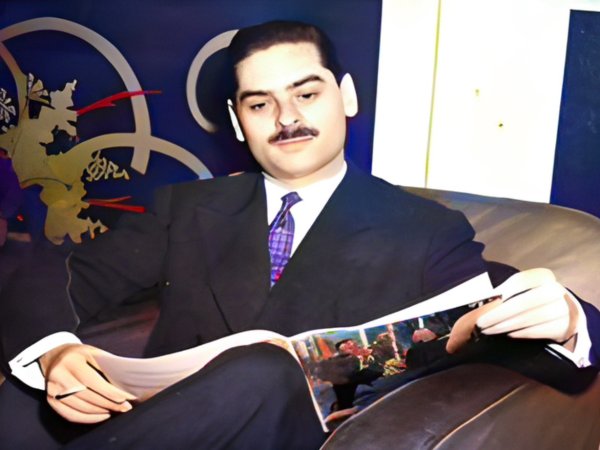
The fate of Mircea Lambrino, the illegitimate prince of Romania. What became of the son of King Carol II with Zizi Lambrino
- Articles
- 15 APR 26
The fate of Mircea Grigore Lambrino begins even before his birth, in a tense context dominated by a love story that shook the Royal House of Romania. The relationship between Carol II of Romania and Zizi Lambrino was an intense one, but deeply contested by the royal family and by the constitutional norms of the time.
A forbidden love story and a dynastic crisis
In 1918, in an unprecedented act of defiance, Carol illegally left the military unit he commanded and fled, using false documents, to Odessa, together with Zizi Lambrino. The city was then under German occupation, and the prince’s gesture was considered not only a romantic escape, but also a serious violation of military discipline and his dynastic obligations.
The two married in secret, in the Orthodox rite, and the marriage was later registered at the Romanian Consulate. The royal family was thus confronted with a fait accompli, and the reaction was extremely harsh. King Ferdinand I of Romania categorically refused to recognize this union, considering it incompatible with the status of heir to the throne.
The consequences were not long in coming. Carol was sanctioned for desertion and for violating the Constitution, and the marriage was annulled by an official decision of the Ilfov Tribunal. The pressures exerted by the family, including those of Queen Maria of Romania, were decisive. Thus, a love story quickly turned into a major dynastic crisis, with long-lasting effects on all those involved.
The birth of a child unwanted by history
Although officially separated, Carol and Zizi Lambrino continued to meet in secret. At the beginning of 1919, their relationship led to a pregnancy, and on January 8, 1920, Mircea Grigore was born. From the very beginning, his existence was marked by refusals and prohibitions.
His mother tried to register him under the name Mircea Grigore Carol Romania, but the authorities rejected this request. An order from a high level forbade the use of the royal name. Nor was the variant Mircea Grigore Carol Lambrino accepted. In the end, the child was registered simply under the name Mircea Grigore Lambrino.
This seemingly bureaucratic detail actually reflects a harsh reality: the child was not officially recognized as a member of the royal family. From birth, his identity was limited by political and dynastic decisions that would influence his entire life.
Shortly after the child’s birth, Carol left on a journey around the world, accompanied by his aide-de-camp, Nicolae Condiescu. At the same time, Zizi Lambrino and her son were sent into exile in Neuilly-sur-Seine, in France. The royal family granted them an annual allowance, but this financial support could not compensate for the lack of recognition and family connection.
Childhood in exile and the portrait of a prince without a title
Mircea Lambrino’s childhood took place far from Romania and from his father. He grew up in a universe dominated by absence, but also by a constant evocation of the paternal figure. In the memoirs published in Paris in 1950, Zizi Lambrino describes her son as the “living portrait” of Carol, both physically and behaviorally.
The boy had inherited obvious traits: light-colored hair, green eyes, but also gestures and attitudes reminiscent of his father. Even without a direct relationship, the influence of heredity was visible. Mircea showed a special sensitivity, but also a strong, independent character, sometimes difficult to shape.
From an early age, he displayed varied passions: he loved animals, especially dogs, had an attraction to flowers, and showed an early interest in art. His talent for drawing was noticed early, and his artistic inclinations would influence his later path.
At the same time, the child lived with an idealized image of his father. Raised among photographs and stories about Prince Carol, Mircea developed a true cult for the absent figure. The question “When will father return?” recurred constantly, reflecting a deep desire for belonging.
The meeting with his father and the disappointment
The first meeting between Mircea and his father took place only in 1925, in Paris. For the child, the moment was charged with emotion and expectation. His joy was immense when he learned that he would see Carol.
The meeting, however, did not live up to expectations. Although Carol noticed the striking resemblance between himself and his son, his reaction was reserved. He stroked him gently, but did not show deep affection. For a sensitive and proud child, this coldness was a painful blow.
The disappointment was amplified by seemingly minor details. Mircea had been convinced that his father would bring him a gift, but this did not happen. In the absence of gestures of closeness, the meeting turned into a sad episode that left deep marks.
Even so, the image of his father did not completely collapse. Mircea continued to idealize him, to wait for him, and to hope for a relationship that, in reality, would never be built.
Education and formation in the West
Mircea Lambrino’s education took place largely in the West. He was sent to good schools, including institutions run by Jesuits, where he received a rigorous formation. However, his health was affected in childhood, as he suffered from a severe form of whooping cough.
Later, he studied in Switzerland, in Lausanne, in an environment considered ideal for physical and intellectual development. There he became a robust young man, and the resemblance to his father became even more pronounced.
Eventually, he returned to Paris, where he continued his studies and attended the School of Fine Arts. This choice was not accidental, but a consequence of his artistic talent. An anecdotal episode from that period shows the complexity of his identity: during a medical examination, he declared that his father was a king, and his half-brother – also a king, which caused confusion for the examiner.
Personal life and family
Mircea Lambrino’s adult life was marked by several marriages. His first wife was Hélène Nagavitzine, known as Lena Pastor, an opera singer born in Paris. The marriage lasted six years and ended in 1950. From this relationship was born Paul-Philippe of Romania, in 1948.
Later, he remarried the American Thelma Jeanne Williams, with whom he had another son, Ion Nicholas George Alexander, born in 1961. His third marriage was to Antonia Colville, in London.
Throughout his life, Mircea tried to build his own identity, beyond the shadow of his father. However, this legacy could never be ignored, and his ambiguous status continued to define him.
Final years and a delayed recognition
Mircea Grigore Lambrino was never officially recognized by his father or by the Romanian royal family. This lack of recognition was one of the constants of his life.
He lived mainly abroad, far from his country of origin, and died in England on January 27, 2006, at the age of 86. Only after his death were his remains brought to Romania and buried at Cozia Monastery, a symbolic gesture of recovering a neglected history.
His fate remains a complex and contradictory one: a king’s son, but without a title; a blood heir, but without official recognition. Mircea Lambrino’s life reflects the tensions between love and duty, between the individual and the institution, between personal destiny and reasons of state.
Thus, his story is not only a biographical one, but also a relevant page in Romania’s history, in which personal drama intertwines with the rigors of a world governed by strict rules and dynastic interests.
We also recommend: Zizi Lambrino, the first love of King Carol II. For her, he gave up the throne of Romania twice, shot himself in the leg and threatened to take his own life