The fairs of Phanariot Bucharest: the floating markets and commercial centers where Romanians found goods from all the countries of the world
- Articles
- 22 MAY 26
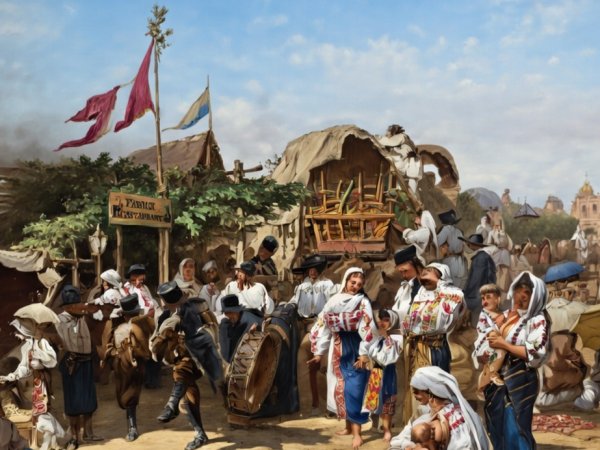
In the Bucharest of the 18th century, trade represented one of the main activities that animated the life of the city. The capital of Wallachia was already an important economic hub in southeastern Europe, located at the intersection of the commercial roads that connected the Ottoman Empire to the center of the continent. During the Phanariot period, the city was not only an administrative and political center, but also a huge market where local products, oriental goods, western textiles, spices, timber, animals, jewelry and numerous other goods brought from almost all corners of the world known at that time could be found. Beyond the improvised fairs that appeared spontaneously on the outskirts of the neighborhoods or on the intensely traveled streets, Bucharest had real organized commercial centers. These spaces attracted merchants, craftsmen and buyers from all social categories and contributed decisively to the economic development of the city. The Phanariot fairs were not only simple places of commercial exchange, but also important social centers, where people found out news, established business relations and came into contact with products and customs coming from other countries.
The Inner Fair, the commercial center of the Bucharest elite
The most important commercial space of Phanariot Bucharest was the so-called Inner Fair, located right in the center of the city. The area extended over a vast perimeter, delimited by inns, churches and watercourses that formed the economic nucleus of the Capital at that time. To the north were Radu’s inn and the monasteries of Saint Sava and Colțea, to the east flowed the Bucureștioara River, while to the south the area was bordered by the Dâmbovița River and its ponds.
The ultra-central positioning transformed this fair into a place frequented especially by wealthy people. Boyars, rich merchants, officials of the princely court and foreign traders came here looking for quality products or exotic goods. In fact, a large part of the land belonged to the church, which obtained substantial revenues from renting commercial spaces and the shops built mainly from wood.
These stores often had a double function. The craftsmen not only worked there, but also lived there together with their families. Professional and personal life took place in the same space, and the streets of the fair were permanently animated by activity. The noise of the tools, the smell of food products and the voices of the merchants formed the specific atmosphere of Bucharest in that era.
The inns and merchants who brought goods from the whole world
The Inner Fair was not populated only by local craftsmen. Numerous specialized merchants also carried out their activity here, such as grocers, bead sellers or cloth merchants, who sold goods bought from other regions or brought from abroad. The great inns of Bucharest had an essential role in this economic activity.
The inns functioned not only as accommodation places for merchants coming from outside, but also as true commercial galleries. Inside them there were warehouses and vaulted spaces where extremely diverse products were stored and displayed. Foreign travelers of the time described with amazement the richness of the goods available in Bucharest.
The French diplomat Charles-Claude de Peyssonnel noted as early as 1787 that in the inns of the Capital there were products coming “from all the countries of the world that traded.” This statement shows how connected Bucharest had become to the great international commercial networks. From oriental fabrics and spices to ornaments, weapons, household objects or rare food products, everything could be bought in the Phanariot fairs.
The Cuckoo Fair and the struggle for cheap food
If the Inner Fair was intended especially for sophisticated trade and wealthy customers, the basic food products were sold mainly in the Cuckoo Fair. It was located near the Saint George Monastery and functioned only on certain days of the week, Tuesday and Friday.
There the peasants came with cereals, flour, corn, millet, fish, vegetables, cheeses, butter, eggs, domestic birds, firewood, coal, timber and numerous other products necessary for daily life. Practically, the Cuckoo Fair was the main supply place for ordinary Bucharest inhabitants.
However, the system often generated problems. Those who did not manage to arrive on fair days were forced to buy the products from middlemen, intermediaries who took advantage of the situation and exaggeratedly increased the prices. The peasants, forced to return in the evening to their villages, often sold their remaining goods at very low prices to these speculators. Later, the products were resold in the city at much higher sums.
Speculation had thus become a serious problem in Phanariot Bucharest. The artificial increase of prices directly affected the urban population, and the authorities repeatedly tried to limit the phenomenon.
Nicolae Mavrogheni and the control of Bucharest markets
Among the Phanariot rulers concerned with the organization of trade, Nicolae Mavrogheni stood out in a special way. Unlike other rulers who were satisfied only with issuing written orders, Mavrogheni personally went through the fairs to check how trade functioned.
The ruler tried to limit speculation and protect ordinary consumers. He closely supervised even the so-called “women’s fair”, organized every Monday in the Cuckoo area. There, old clothes, patches, fabrics and other second-hand textile products were sold.
These fairs were viewed with suspicion by the authorities because the worn garments passed from hand to hand and could contribute to the spread of epidemics. In an era marked by the frequent outbreak of contagious diseases, hygiene and public health had become important themes for the administration.
Mavrogheni did not limit himself only to the central markets. He also frequently visited the Outer Fair, located approximately in the area where today Ștefan cel Mare and Mihai Bravu roads intersect. Merchants coming from the counties around Bucharest gathered there, and the activity was extremely intense.
The Outer Fair and the abuses of the tax collectors
The Outer Fair was one of the liveliest commercial spaces of the city. On fair days, the area became overcrowded because of the multitude of sellers and buyers coming from all directions. Tavern keepers, brandy sellers, pretzel makers, furriers, grocers and merchants from Brașov brought their goods to benefit from the large flow of customers.
Mavrogheni even ordered the construction of a special pavilion from where he could directly observe the activity in the market and discuss with the people coming from the provinces. The ruler was interested in finding out how the representatives of the local administration behaved, especially the district administrators and tax collectors.
They were frequently accused of robbing merchants through illegal taxes and extraordinary contributions abusively imposed. Sellers were often forced to pay important sums in order to be able to sell goods in the markets.
The personal presence of Mavrogheni in the fairs had the role of intimidating corrupt officials and transmitting the idea that the ruler directly monitored the observance of commercial rules. In many respects, his methods resembled the authoritarian style later adopted by Alexandru Ioan Cuza during the reforms of the 19th century.
The new fair at the Healing Spring
One of the most ambitious commercial initiatives of Mavrogheni was the establishment of a new fair with a cattle market near his foundation at the Healing Spring, located at the end of Podul Mogoșoaiei, today’s Victory Avenue.
The ruler wanted the new market to function on Mondays and Thursdays, thus offering Bucharest inhabitants the possibility to buy fresh products on more days of the week. The goal was to limit the speculation practiced by the middlemen, who took advantage of the fact that the traditional fairs were held only on Tuesdays and Fridays.
The place chosen for the new fair had multiple advantages. The area was intensely circulated and had become one of the most popular leisure areas of the Capital thanks to the constructions raised by Mavrogheni. In addition, the land was higher and drier, which meant that mud did not create difficulties for merchants and customers.
The existence of sufficient water sources made the area suitable both for people and animals. In the ruler’s conception, the new fair had to become an important economic center that would generate revenues even for the monastery he had founded.
Why Mavrogheni’s project failed
The ambitious plans of Nicolae Mavrogheni were not carried to completion. The outbreak of the conflict with the Austrians interrupted the arrangement of the new fair, and his successors showed no interest in continuing the project.
In the following years, the documents of the time show that the fair near the Healing Spring monastery had still not managed to develop according to the initial plans. Thus, Mavrogheni’s foundation lost an important source of income that the ruler had anticipated.
Nevertheless, the commercial idea proved inspired in the long term. Even without official infrastructure and without the support of the authorities, merchants and peasants gradually began to gather in the area at the end of Podul Mogoșoaiei. The advantageous position and the intense circulation attracted traders almost naturally.
How the markets moved without the authorities’ approval
At the beginning of the 19th century, the market gradually moved near the fountain at the end of Podul Mogoșoaiei. The phenomenon happened slowly, almost unnoticed and without the official approval of the administration.
The authorities tried to prevent this move, invoking the deterioration of the wooden pavement caused by the circulation of carts loaded with timber and other heavy goods. Peasants were asked to continue going to the Outer Fair.
In reality, however, most merchants preferred the new area because of the large number of customers. Many of those who brought timber or food products remained near the fountain and waited there for buyers until they sold their goods.
This evolution demonstrated that Mavrogheni’s vision had been correct. Even if his official project had failed, the economic dynamics of the city confirmed that the chosen area had a huge commercial potential.
Phanariot Bucharest, a city dominated by trade and economic exchanges
The fairs of Phanariot Bucharest perfectly reflected the economic and social transformations through which the city was passing in the 18th century. The Capital had become a cosmopolitan urban center in which oriental and western influences met daily through trade.
The markets represented not only supply spaces, but also true engines of urban development. Around them appeared inns, workshops, churches, commercial streets and entire neighborhoods. Merchants and craftsmen directly contributed to the prosperity of the city, while the circulation of goods connected Bucharest to the great European and oriental trade routes.
At the same time, the Phanariot fairs illustrate very well the problems of the society of the era: speculation, corruption of officials, lack of infrastructure and administrative difficulties. Despite all this, trade continued to develop, and Bucharest gradually became one of the most important economic centers in the region.
From the agitation of the Inner Fair to the cattle markets full of peasants and merchants coming from all corners of the country, Phanariot Bucharest was a city of permanent trade. There, among inns, shops and dusty streets, Romanians discovered goods from the whole world and unknowingly participated in the formation of a modern urban economy.
We also recommend: How trade and the marketplace unfolded in interwar Bucharest: merchants, professions and customers