How trade and the marketplace unfolded in interwar Bucharest: merchants, professions and customers
- Articles
- 06 MAY 26
The interwar period represented one of the most effervescent stages in the history of Bucharest. The city was undergoing accelerated transformation, becoming an important economic and cultural center in Eastern Europe. The streets were lively, the markets full of life, and trade was one of the main engines of urban development. In this context, the relationship between merchants and customers, the diversity of professions and the dynamics of markets shaped a fascinating image of everyday life. Trade in interwar Bucharest was not only an economic activity, but also a complex social experience. From elegant large stores to modest stalls in markets, each commercial space had its own identity and its own type of clientele.
Merchants – the soul of Bucharest trade
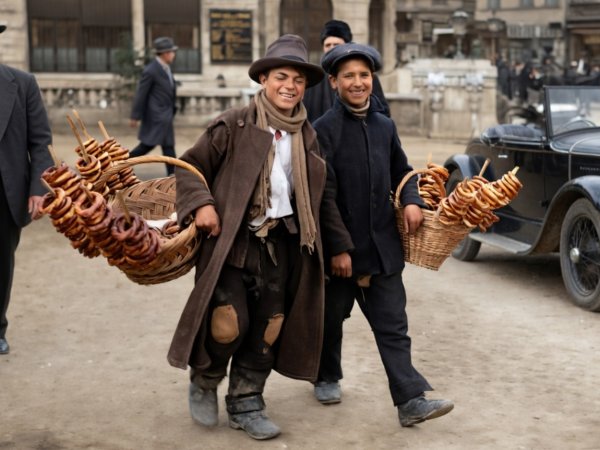
Merchants represented the backbone of the urban economy. They came from diverse backgrounds: Romanians, Greeks, Jews, Armenians or Bulgarians, each bringing with them specific commercial traditions. This ethnic diversity contributed to the richness and variety of the offer in the capital.
Many traders carried out their activity in small, family-run shops, where the relationship with the customer was a personal one. The seller knew their customers by name, knew their preferences and even their financial situation. Bargaining was a common practice, and loyalty was built over time, through trust and mutual respect.
On the other hand, there were also more prosperous merchants who owned elegant stores in central areas such as Calea Victoriei. Here, the shop windows were carefully arranged, and the displayed products attracted a refined clientele, made up of the bourgeoisie and aristocracy.
Markets – the heart of everyday life
Markets in interwar Bucharest were vibrant places, where all social categories met. Here fresh products brought from nearby areas were sold: vegetables, fruits, meat, dairy or fish. The atmosphere was noisy and colorful, with sellers shouting their goods and customers negotiating prices.
Among the most well-known commercial spaces were Obor Market and Amzei Market, which functioned as true economic centers of the city. These markets were not only places of supply, but also spaces of socialization, where people exchanged information and discussed everyday life.
Products were displayed simply, directly on stalls or in baskets, and quality was an essential criterion. Customers used to carefully check the goods, to taste or smell the products before buying them.
Traditional professions and their role in the economy
Besides merchants, an impressive variety of craftsmen contributed to the economic dynamics of the city. Tailors, shoemakers, blacksmiths, carpenters or barbers were present in all neighborhoods and offered essential services.
These professions were often passed down from generation to generation, and workshops operated near homes. The client had a direct relationship with the craftsman, and products were made to order, adapted to individual needs.
For example, a suit was not bought from a store, but made by a tailor, who took precise measurements and discussed details with the client. This personalized approach offered a high level of quality and uniqueness.
Elegant stores and Western influence
As Bucharest modernized, stores inspired by Western models appeared. These offered luxury products: clothes, perfumes, jewelry or items imported from Paris or Vienna.
The central areas of the city had become true commercial promenades. Shop windows were decorated in a sophisticated way, and the shopping experience was a refined one. Customers came not only to buy, but also to walk and admire the novelties.
These stores reflected the aspirations of a society in full transformation, which wanted to align itself with Western standards.
Customers – between tradition and modernity
The clientele of interwar Bucharest was extremely diverse. From workers and clerks to urban elites, each social category had its own consumption habits.
For the lower classes, shopping was a daily necessity, carried out in markets or small shops. On the other hand, for the bourgeoisie, trade also became a form of social affirmation. The choice of store, products and even the way of presentation reflected social status.
Women had an important role in the purchasing process, being responsible for supplying the household. At the same time, they were also the main customers of fashion and cosmetics stores.
Transport and supply of goods
An essential aspect of interwar trade was the transport of goods. Products reached the city with the help of trains, carts or, later, trucks. The proximity to rural areas facilitated the supply of fresh products.
Railway stations and warehouses played an important role in the distribution of goods. From here, products were transported to markets and stores, where they were sold quickly, especially in the case of perishable foods.
This logistics network, although rudimentary compared to today’s standards, functioned efficiently and supported the needs of a constantly growing city.
Rules, taxes and organization of trade
Local authorities had an important role in organizing commercial activities. There were rules regarding the placement of stalls, product hygiene and the payment of taxes.
Merchants had to hold permits, and inspections were relatively frequent. Although sometimes these regulations were bypassed, they contributed to maintaining a certain order in markets and stores.
The taxes collected by authorities represented an important source of revenue for the city, being reinvested in infrastructure and public services.
The atmosphere of markets and the charm of the era
Perhaps the most fascinating aspect of interwar trade was its atmosphere. Markets and commercial streets were full of life, of smells, colors and sounds. Sellers promoted their products loudly, and customers negotiated with passion.
This energy turned shopping into an authentic experience. It was not just about acquiring goods, but about human interactions, stories and community.
The charm of this era was given precisely by this combination between tradition and modernity, between simplicity and refinement.
The legacy of interwar trade
Although the world has changed radically, many elements of interwar trade can still be found today. Markets continue to be important places for supply, and the direct relationship between seller and customer remains valuable.
At the same time, the idea of shopping experience, present in the elegant stores of the time, can be found in modern shopping centers.
Trade in interwar Bucharest was more than an economic activity – it was an expression of urban identity. Through diversity, dynamism and adaptability, it contributed to transforming the capital into a modern city.
Looking back, we can better understand how everyday life functioned and how important these commercial interactions were for the community. It is a lesson about evolution, but also about continuity, about the way the past influences the present.
We also recommend: How the bourgeoisie's life unfolded in Bucharest between the two World Wars