Stories of Bucharest: Carolina Otero, the Courtesan Enchanted by Late-Night Suppers, Good Music and Radu Văcărescu
- Articles
- 29 OCT 26
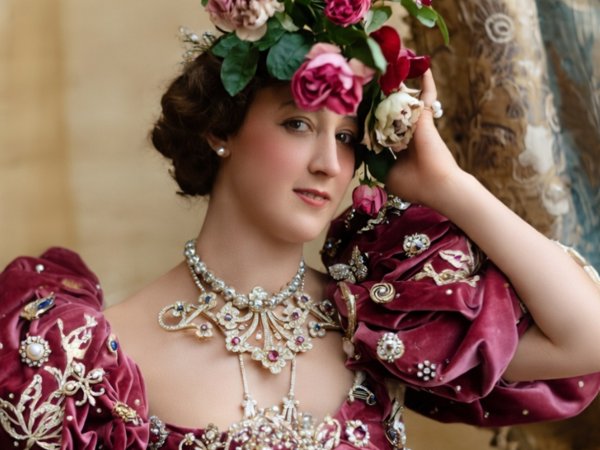
At the end of the 19th century and the beginning of the 20th century, Bucharest was a city where high society, artists, adventurers, diplomats and foreign aristocrats met in elegant restaurants, at performances and in the private salons of prominent families. The Romanian capital was building its reputation as the "Little Paris," while its nightlife, restaurants, summer gardens, theatres and legendary Capșa became part of a glamorous world where entertainment and adventure often went hand in hand. Among the celebrities who arrived in this Belle Époque Bucharest was Carolina Otero, known throughout Europe as La Belle Otero. A dancer, singer and one of the most famous courtesans of her era, Otero was accustomed to the salons of Paris, the casinos of the French Riviera and the company of kings and princes. Yet Bucharest left a special impression on her. In her memoirs, the artist spoke enthusiastically about the city, its churches, narrow streets, palaces and gardens, but above all about Romanian music. The lăutari and their rhythms fascinated her, while the evenings following her performances turned into long celebrations in which dancing became the centre of the entire atmosphere. One of these nights would become part of Bucharest's memory through a story that seems almost taken from a film: La Belle Otero dancing barefoot through the snow, accompanied by musicians, after a supper hosted in her honour by Radu Văcărescu.
La Belle Otero, the star who conquered Europe
Carolina Otero was born Agustina del Carmen Otero Iglesias in the town of Valga, Galicia, Spain, into a very poor family. Local sources from Valga give her date of birth as December 19, 1868. Her childhood was marked by deprivation and traumatic experiences, while her adolescence became the beginning of a life in which dance and entertainment would eventually become the means through which she built her freedom and fame.
She left her birthplace at a very young age and began performing as a dancer. Barcelona was one of the first important stages in her rise. There, she came into contact with artistic circles and with people who helped her gain access to major European stages. In 1889, she arrived in Paris, a city then experiencing extraordinary cultural excitement, and her meeting with impresario Joseph Oller, associated with the Moulin-Rouge and other major entertainment venues, proved decisive for her career.
In the following years, Carolina Otero created the stage persona that would turn her into a legend. "La Belle Otero" was more than a stage name: it was a carefully cultivated image based on beauty, exoticism, spectacular costumes, Spanish dances and an attitude that combined seduction with provocation. She became one of the stars of the great Parisian shows and toured Europe and America.
Her fame quickly extended beyond theatres and cabarets. Otero became associated with aristocrats, princes, politicians, writers and major financiers. Among the names linked to her biography were Edward VII, Prince Albert I of Monaco, members of the Russian aristocracy and writer Gabriele D'Annunzio.
However, many stories about her romantic adventures were amplified by the society press and even by the mythology that Otero herself helped create. For this reason, spectacular claims about the number of her lovers or the alleged suicides caused by her beauty should be treated with caution.
The Bucharest that fascinated the famous courtesan
For Carolina Otero, Bucharest offered an experience different from that of the great Western capitals she knew. In her memoirs, the city appears as a picturesque place, with numerous churches, narrow streets, palaces and gardens. It was not only the architecture that caught her attention, but also the atmosphere and, above all, the music.
Otero recalled that she was almost "drunk with dance and music" and that Romanian lăutari and their rhythms enchanted her. This observation is important for understanding how a star accustomed to the great European stages perceived Bucharest. For her, the city's charm did not consist solely of aristocratic salons and elegant restaurants, but also of the energy of traditional music.
After her performances, the evenings often continued with suppers. Otero would bring her musicians with her, and the meal would turn into a party. Dancing was not simply an artistic moment presented to an audience, but a form of personal expression. The artist danced with an energy that contemporaries described as almost frenetic, while the guests were drawn into the atmosphere she created around herself.
This combination of music, food, dancing and freedom was characteristic of the social life of Bucharest at the time. Around restaurants and private salons, a cosmopolitan world had developed in which aristocrats, politicians, artists and businessmen met late into the night. Capșa occupied a privileged place in this universe, and among those who frequented its circles was Mișu Văcărescu, known by his pseudonym Claymoor.
Radu Văcărescu and the night of dancing in the snow
The most spectacular story associated with Otero's stay in Bucharest is that of the supper hosted in her honour by Radu Văcărescu. The story was passed down through the memoirs and later recollections of the period and was also recorded by Gheorghe Crutzescu in his book devoted to Calea Victoriei, historically known as the Mogoșoaia Bridge. The Romanian Cultural Institute reproduced this account and explicitly identified the "R." in the story as Radu Văcărescu.
During the party, the dancing supposedly became so intense that Radu Văcărescu himself was swept up in the atmosphere created by the artist. In keeping with the extravagant spirit of the evening, he allegedly threw his wallet, jewellery and other valuables he was carrying at her feet.
Otero, completely absorbed in her fantasy, supposedly imagined that she was in a cabaret in Seville. She continued dancing and, at one point, walked straight out of the restaurant and into the street. Radu Văcărescu is said to have signalled to the lăutari and guitarists to follow her.
It was winter. Snow had fallen, the weather was freezing and moonlight reflected on the snow-covered street. In this almost cinematic atmosphere, Otero allegedly continued dancing barefoot all the way to her hotel, accompanied by musicians and friends who formed a genuine nighttime procession around her.
The episode is even more remarkable because, many years later, Radu Văcărescu reportedly told the story himself, adding even bolder details about the dancer's clothing. Crutzescu preserved this version in his account, turning the scene into one of the most picturesque anecdotes of old Bucharest.
The fantasy, however, also had an unpleasant consequence. According to Otero's memoirs, the cold of the night caused a pulmonary illness that kept her confined to bed for six weeks. The story nevertheless remained in the memory of those who knew Bucharest's high society as one of the most eccentric adventures of the period.
Capșa, Claymoor and the "high society" of Bucharest
Otero's story cannot be separated from the social environment in which she was welcomed. Belle Époque Bucharest had its own celebrity circuit. Capșa was one of the centres of this world, while the wealthy and fashionable young men who gathered there were described by Claymoor through a vocabulary inspired by French high society.
Among the figures mentioned by Gheorghe Crutzescu were Radu Văcărescu, Alexandru Florescu, Constantin Bălăceanu, Iancu Cretzeanu, Mihai Laptew Soutzo, Popa Miclescu, Alexandru Ghica, Costică Izvoranu and Sacha Blaremberg. Alongside them was Mișu Văcărescu, Claymoor, the chronicler who turned Bucharest's social life into a newspaper spectacle.
For women belonging to Bucharest's upper classes, having their names appear in "Carnet du Highlife" in the newspaper Indépendance Roumaine could be enormously important. Claymoor effectively determined who was visible in society and who risked being forgotten. According to recollections from the period, his home was filled with gifts from women who wanted to remain in the society columnist's attention.
In this world, La Belle Otero could hardly have gone unnoticed. She was already one of the best-known women in Europe, and her appearance in Bucharest gave local high society exactly what it sought: spectacle, exoticism and a subject of conversation for salons and restaurants.
Otero and the beginnings of cinema
Carolina Otero's fame was not limited to the stage. At the end of the 19th century, she also became associated with one of the era's most important inventions: cinema.
In August 1898, in St. Petersburg, cinematographer Félix Mesguich filmed her dancing. The footage, made in connection with a performance at the Aquarium, entered cinema history because the appearance of a Russian officer near the dancer reportedly caused a scandal. Mesguich was subsequently expelled from Russia. Archives devoted to the beginnings of cinema preserve accounts of this filming and of Otero's role in the episode.
For this reason, Carolina Otero is regarded by some sources as one of the first true stars of cinema. However, it would be inaccurate to describe her without qualification as "the first star in the history of film," since the history of the first cinematic appearances by performers is more complicated, and her early-1890s performances and the 1898 footage have different histories. What is certain is that her image was among the earliest images of an international celebrity transferred onto the new cinematic screen.
From European glory to solitude in Nice
Carolina Otero continued to be an important figure in European social and artistic circles until the period of the First World War. She performed for French audiences and took part in tours intended to boost the morale of soldiers. After the war, however, the world in which she had become famous was beginning to disappear.
She gradually withdrew from public life and settled in Nice. During her years of glory, she had accumulated a considerable fortune, but her passion for gambling and extravagant lifestyle contributed to its disappearance. Biographical sources estimate that her wealth at the height of her career amounted to millions of dollars in contemporary equivalent, although the exact figures vary from one biography to another. What is certain is that Otero lost a substantial portion of her fortune at casinos, particularly in Monte Carlo.
In old age, the woman who had once been one of Europe's most admired and photographed celebrities came to live modestly. She died in Nice in April 1965, at the age of 96, at the Hotel Novelty. Sources consulted give April 12 as the date of her death, although some accounts list April 10.
Her life was therefore almost as spectacular at the end as it had been at the beginning: from a poor childhood in Galicia to the aristocratic salons of Europe, from Parisian stages to the casinos of Monte Carlo, and from extravagant evenings in Bucharest to the solitude of her final years.
The Bucharest that remained in La Belle Otero's memory
For the history of the capital, the encounter with La Belle Otero is more than an anecdote about a famous courtesan. It offers a rare glimpse of early 20th-century Bucharest through the eyes of a woman who knew Europe's great capitals and was accustomed to the most sophisticated forms of entertainment.
What impressed her was not only the city's palaces and gardens, but also the music of the lăutari, the dancing and the way parties could continue after a performance until the early hours of the morning. And the story of the night when she danced through the snow, accompanied by musicians and surrounded by friends, became one of those scenes that seem to capture the spirit of Belle Époque Bucharest: exuberant, cosmopolitan, extravagant and, at times, completely unrestrained.
La Belle Otero left Bucharest with a powerful memory of the city. And Bucharest preserved her in its own memory through Capșa, through Claymoor's chronicles and through the story of a winter night when music, dancing and snow came together in a scene worthy of the legend of an era that would disappear forever after the First World War.
We also recommend: “To be an actor means to be a slave!” Aristizza Romanescu, the diva of the Bucharest stage during the Belle Époque, died in suffering and extreme poverty