The Cooling Machine. How Air Conditioning Changed Bucharest's Summer
- Articles
- 25 JUN 26
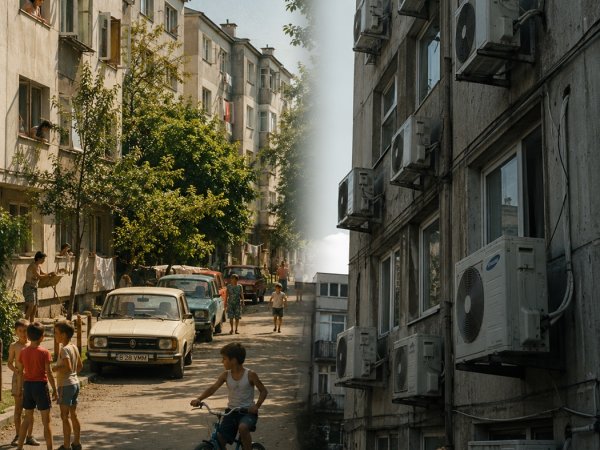
There's a sound that replaced another one. The old one was the sound of summer through an open window: voices, cars, footsteps on asphalt, neighborhood dogs, sometimes a radio. The new one is a mechanical hum, constant, coming from outside — the compressors of outdoor air conditioning units, mounted on facades, balconies, and pavements, lined up across buildings like metal parasites. Bucharest accepted them all, quietly, in less than two decades.
Air conditioning didn't just change the temperature inside the apartment. It changed the way the city lives in summer.
Before the cooling machine
A hundred years ago, summers in Romanian cities were easier to bear — not because it was cooler, but because the city was built differently. There was abundant vegetation, few paved surfaces, and most houses had coolness written into their logic: interior courtyards, shaded corridors, covered porches. Heat at 35 degrees was uncomfortable, but not necessarily catastrophic if you knew where to retreat.
Summer life happened outside. Not because it was more pleasant outside, but because there was nowhere to escape indoors. People sat on the pavement in the evening, gathered at the gate, met in parks, went to the lido — not as leisure, but as thermal necessity. The street was, in the absence of any mechanical cooling system, the only solution.
1902: Willis Carrier and the printing problem
The first air conditioning system was designed in 1902 by American engineer Willis Carrier — not for human comfort, but because the hot, humid air in a Brooklyn printing plant was wrinkling magazine pages. He built a system that cooled and dehumidified the air. The paper problem was solved. And the world was never the same.
A solution to a printing problem ended up reconfiguring cities. Air conditioning altered architectural design, enabling office buildings without openable windows and houses without verandas. If you can mechanically cool any space, why bother with cardinal orientation, natural shade, interior courtyards, or windows positioned to catch a breeze? Architecture relinquished its responsibility to climate and delegated it to a compressor.
At first the device was viewed with suspicion — a luxury, perhaps even a threat to worker discipline. Gradually, the narrative inverted: thermal comfort became productivity. Reputations shifted, prices fell. The machine moved down from corporate offices into people's homes.
Romania after 2000: the rapid expansion
In Romania, air conditioning spread to households on a large scale after the year 2000. It's no coincidence that this period overlaps with two things: post-accession economic growth, and the summer of 2000, which brought Bucharest its absolute temperature record — 42.4°C on July 5th, recorded at the Filaret meteorological station. An extreme heat wave, followed by others in 2003, 2007, and 2012, transformed air conditioning from a comfort product into a perceived necessity.
The market responded accordingly. The summer of 2024, with temperatures frequently exceeding 40 degrees and heat waves stretching from June through September, generated record orders in both the residential and commercial segments. Distributors operated at maximum capacity. Installers were booked weeks in advance.
The cycle is simple and relentless: heat waves intensify, people buy units, units consume energy and expel heat outside, the city grows warmer, heat waves intensify.
The thermal paradox: the machine that heats the city
This is perhaps the least discussed consequence of air conditioning's mass proliferation. Every outdoor unit expels the heat extracted from inside directly into the street air. Multiplied across the tens of thousands of units mounted on Bucharest's facades, the effect becomes measurable.
Researchers have found that the waste heat released by air conditioning systems raises the average nighttime temperature of cities by 1 to 1.5°C, considerably amplifying the urban heat island effect. During the day, compressors pump heat into the street. At night, when surfaces should be cooling down, the air stays warm — partly because of them.
In other words: the machine cools the interior and heats the street. Those without air conditioning pay the price for those who have it. Those who live on the ground floor, or simply walk on the pavement, absorb the warm air expelled by the units above them.
What was lost when the windows closed
Before AC spread, an open window in summer wasn't an option — it was the basic condition of habitation. Through it came the air, but also the sound: street noise, neighbors' voices, a radio from the second floor, the smell of linden blossom or wet asphalt after rain. The city was permeable.
The open window was also an unorganized form of social communication. People heard what was happening, knew they weren't alone, involuntarily participated in the life around them. Air conditioning didn't produce urban isolation, but it enabled it: if you can sit behind closed doors and windows, comfortably, without feeling the need to step outside, the likelihood of interaction with your neighbor drops. The balcony, once a place to sit in the cool of the evening and exchange a few words with the person next door, has become, in many cases, simply the support bracket for the outdoor compressor unit.
There's also a mild irony in the quality of the coolness the machine provides. The dry air, the 20-degree office temperature in a 38-degree heat wave, the abrupt transition from artificial cold to the blaze outside — all of this has a different texture than the coolness of a shaded arbor, a cellar, a window open onto a courtyard. It's a plastic coolness compared to the real shade of an old tree.
Thermal inequality: not everyone got one
The mass proliferation of air conditioning conceals an uncomfortable reality: not everyone received it. The person living in an old apartment block, on the top floor, with no thermal insulation and no financial means to buy a unit, lives through summer far harder than the person in a new flat with double-glazing and the AC running continuously.
Heat doesn't strike uniformly. It strikes according to income, floor level, building quality, and neighborhood. Bucharest's old center, with its compact buildings, asphalt, and scarce greenery, is hotter than the periphery with its parks. And it is precisely in the hottest areas that people with the least access to cooling solutions tend to live.
There's a term for this — thermal vulnerability — and it describes a reality any Bucharest resident can observe: in the middle of a heat wave, the hardest hit are the elderly living alone in apartment blocks without AC, not those who can switch on a compressor.
The machine that separated us from summer
There's a formulation that circulates among urban planners and deserves to be taken seriously: air conditioning transformed summer from a public experience into a private one. Before, everyone suffered together on the pavement or cooled off together at the lido. Now, each person suffers or cools off separately, inside their own space.
Thermal solidarity — if the term doesn't sound too grand — disappeared along with the open window.
The solution is certainly not to give up the machines. In summers with 40-degree heat, AC saves lives, in the literal sense. But cities that understood this earlier also looked for something else in parallel: trees, shade, permeable surfaces, wind corridors, cool public spaces where someone who can't afford air conditioning can spend an afternoon without risking collapse.
Bucharest has large, beautiful parks. It also has entire neighborhoods without a single tree to sit under. It has a tradition of solving comfort problems through individual solutions — everyone with their own unit — rather than through intervention in public space. It's a logic of survival, not of design.
The hum of the compressors continues. Summer hasn't shortened and hasn't cooled. It's simply moved indoors.
Also recommended Bucharest's Lost Open-Air Pools: How the City Cooled Off 50 to 100 Years Ago, at Tei and Floreasca