The Arhimandritului Slum, a Brief History. How the Historic Area on the Right Bank of the Dâmbovița Disappeared
- Articles
- 24 SEP 26
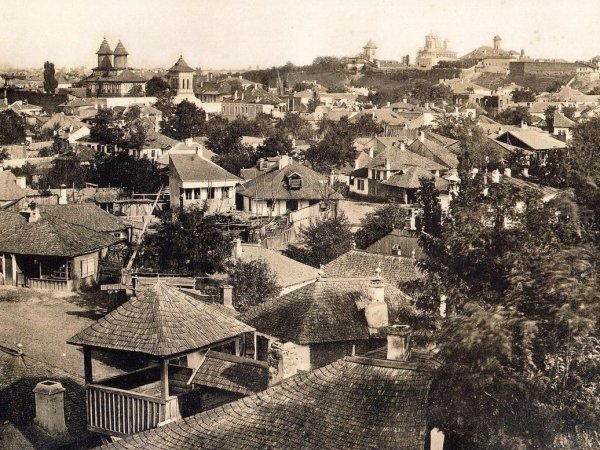
In present-day Bucharest, there are places where the past has not completely disappeared, but has instead been almost buried beneath streets, blocks of flats, and the city's major thoroughfares. One such place lies near Națiunile Unite Boulevard, around the Church of the Holy Apostles Peter and Paul. Here, for several centuries, there was part of the old urban fabric of the capital, successively known as the Târnoveanu Slum, the Arhimandritului Slum, the Dudescului Slum and, during certain periods, the Holy Apostles Slum. The story of this area is closely connected to the Dâmbovița River, old monasteries and boyar estates, but also to the dramatic transformations of Bucharest in the 20th century. The slum developed on the right bank of the river, in a space that today is difficult to associate with the image of a traditional slum. In place of narrow streets, houses with gardens, boyar courtyards and small shops, boulevards and blocks of flats appeared. What survived is primarily the Church of the Holy Apostles, a monument that remained as a landmark of an almost vanished urban world. Historical and archaeological research confirms that around this place of worship there was an important monastic complex, traces of which have been identified including in the area of Vânători and Apolodor Streets.
From the Târnoveanu Monastery to the Arhimandritului Slum
The origins of the area must be sought in the second half of the 16th century. On the site of the present-day Church of the Holy Apostles there was initially a wooden church, while documents indicate the existence of a monastery as early as 1585–1586. The establishment was connected to a monastery in Tarnovo, Bulgaria, which is why it became known as the Târnoveanu Monastery. A document from 1626 mentions the existence of the monastery and its properties, some documents having been kept “across the Danube, in Tarnovo.”
Around this religious establishment, a slum gradually developed. Research by the Museum of the Municipality of Bucharest places the development of the Târnoveanu Slum after 1600, further west of the Postăvari Slum, also on the southern bank of the Dâmbovița. The area is mentioned in documents under several names, the changes in name reflecting the evolution of properties, the place of worship and the boyar families who came to own important estates here.
A key moment occurred in 1636, when Prince Matei Basarab replaced the old wooden church with one made of stone. The building erected at that time forms the basis of the church that can still be seen today. The establishment, however, had a much more extensive character than that of a simple church: around the place of worship there were monastic cells and other buildings. Archaeological research has identified traces of this complex, confirming the scale it once had.
After the reign of Matei Basarab, the monastery became known as the Monastery of the Holy Apostles, after the church's patronal feast. In the 18th century, the name Monastery of the Archimandrite also appears, while the surrounding slum was recorded as the Arhimandritului Slum. Research dedicated to the evolution of Bucharest's urban toponymy explicitly identifies the succession of “Târnoveanu Monastery Slum,” “Arhimandritului Slum,” “Holy Apostles Slum” and “Dudescului Slum.”
The Dudești Boyars and the Change in the Slum's Name
In the history of the area, the Dudești family played an important role. After 1700, the territory is increasingly encountered under the name Dudescului Slum, because the Dudești boyars owned extensive estates here. According to historical research published by the Museum of the Municipality of Bucharest, these properties were connected to the expansion of the family's estates and to the gradual transformation of the old slum's territory.
The Dudești Houses became one of the remarkable properties of old Bucharest. In the 18th century, Constantin Dudescu and later Nicolae Dudescu expanded and embellished the complex, which came to be regarded as one of the city's important residences. Around the houses there was an extensive garden, described in sources as having been arranged according to the model of English gardens. Over time, the land was divided into plots, and streets and new buildings appeared on the former garden grounds.
Connections with the great boyar families of Wallachia appear as early as the 17th century. Elena, the daughter of Radu Șerban, who was married to the postelnic Constantin Cantacuzino, owned property in this area. Historical sources concerning the Cantacuzino family confirm this marriage, Elena being the daughter of Radu Șerban and the wife of Constantin Cantacuzino.
The slum should not, however, be imagined as an exclusively boyar district. Like other old areas of Bucharest, it was a mixture of large estates, households, more modest houses, shops, workshops and religious spaces. It was precisely this juxtaposition between large properties and the homes of ordinary people that gave the slum the characteristic atmosphere of pre-modern and early modern Bucharest.
The Dâmbovița River and the Problem of Flooding
The geographical position of the Arhimandritului Slum represented one of its main vulnerabilities. The area was situated on the right bank of the Dâmbovița, in a low-lying sector of the city, while the river did not yet have the controlled and regulated form that we know today.
The overflowing of the Dâmbovița represented a recurring danger for the districts located close to the water. Historical sources concerning Bucharest's slums explicitly mention the Arhimandritului Slum together with Izvor among the areas affected whenever the river level rose. The water could cover significant portions of the riverbank and turn the streets into a space that was difficult to access.
The problem was not only related to rainfall. For centuries, Bucharest's Dâmbovița was a difficult river to control, with its course influenced by mills, ponds, tributaries and successive hydraulic works. Old descriptions of the city mention the existence of marshes and ponds in this part of Bucharest, including the Arhimandritului Pond, connected to the old water system in the southern part of the city.
The transformation of the Dâmbovița into a controlled watercourse came much later. The regulation and canalization of the river fundamentally changed the relationship between water and the city, but the interventions of the 20th century also had profound urban consequences. The river ceased to be merely a natural element of the city and became part of a completely redesigned urban infrastructure.
How the Slum Disappeared During the Demolition Years
The disappearance of the Arhimandritului Slum did not occur at a single moment. The area gradually changed as old properties were divided, some buildings disappeared, and the modern city altered the configuration of the historic districts. Even the monastic complex itself was considerably reduced. Historical sources show that the old cells surrounding the church no longer existed in their original form by the 19th century.
The decisive blow came during the communist period, especially in the 1980s. The large-scale systematization program in central Bucharest radically changed the districts on the right bank of the Dâmbovița. The Sfinții Apostoli, Izvor, Uranus, Antim and old neighborhoods around what is now Unirii Square were caught up in a process of demolition and large-scale reconstruction.
Sfinții Apostoli Street was one of the victims of this transformation. A study dedicated to the historical-geographical reconstruction of the street shows that the demolitions of the 1980s destroyed much of the old route and the surrounding urban fabric, as part of the works that made way for the new civic center.
Around 1982, systematization reached this area. Documentary sources concerning Bucharest's demolitions show that, by no later than 1984, most of the buildings in the respective area had disappeared. Some buildings were spared, including a writers' block on Sfinții Apostoli Street, built in the 1960s.
The Church of the Holy Apostles survived, but in a completely transformed urban landscape. Instead of remaining the nucleus of a slum with streets and houses, it became almost visually isolated among the buildings erected in the following decades. Today, the place of worship is difficult to see from the major thoroughfares, being hidden behind the blocks on Națiunile Unite Boulevard.
The transformation was not limited to houses. The entire urban context of the area was changed. Historic streets disappeared or were fragmented, while the old relationships between the church, houses, courtyards and the Dâmbovița were broken. The street system that gave the slum its identity can no longer be read as easily on the ground today.
What Remains of the Arhimandritului Slum
Today, the most important witness to the old slum is the Church of the Holy Apostles Peter and Paul. It represents a rare material continuity between late medieval Bucharest, the boyar city of the 17th and 18th centuries, and the modern capital. Built of masonry during the reign of Matei Basarab and rebuilt and modified over the following centuries, the church underwent several interventions and restorations.
The parish house also recalls the history of the place. The current building, designed by architect Cristofi Cerchez in 1927, was erected over the vaulted cellars of the former abbot's houses of the Târnoveanu Monastery. Thus, even where the visible building belongs to the 20th century, traces of the old complex are preserved below the present ground level.
The importance of the area is also confirmed archaeologically. The archaeological site at the Church of the Holy Apostles – Vânători Street – Apolodor Street includes the remains of the Târnoveanu Monastery, including traces of the monastic cells, as well as remains attributed to the courtyard of the Dudești boyars. Therefore, the old slum has not disappeared completely: part of it continues to exist in the form of archaeological remains and surviving monuments.
The Arhimandritului Slum is, in essence, one of those areas of Bucharest that can be better understood by looking at what can no longer be seen than at what has remained. Its name now appears only in documents, maps and works of urban history, while the streets and houses that gave it its identity were largely erased by the city's transformations.
In place of the old slum there is now a completely different Bucharest. Națiunile Unite Boulevard, the blocks of flats and the new configuration of the city center make it almost impossible to visually reconstruct the neighborhood of the past. Nevertheless, the Church of the Holy Apostles, the cellars, the archaeological remains and the old names preserved in documents make it possible to reconstruct, at least in imagination, a world that existed here for several centuries.
The story of the Arhimandritului Slum thus shows how profoundly Bucharest changed between the city crossed by an uncontrolled Dâmbovița and the capital built around the major axes of the communist era. Fragments remain of the old slum, but they are enough to demonstrate that beneath the contemporary city there is still a much older historical geography, in which the Târnoveanu Monastery, the Archimandrite, the Dudești family and the Holy Apostles gave names and identity to one of the old districts on the right bank of the Dâmbovița.
We also recommend: The Antim Neighborhood and Antim Monastery, the history of a lost piece of the former Uranus district of Bucharest