Steaua Stadium, the legend of Ghencea that rose from its own ashes. The history of one of the best-known arenas in Bucharest
- Articles
- 04 DEC 25
Few places in Bucharest carry an emotional weight comparable to that of the former Steaua Stadium, the legendary arena that became synonymous with performance, passion, and the identity of Romanian football. Built at the beginning of the 1970s and reopened today in a completely new form, the stadium in Ghencea went through a spectacular history, marked by glory, decline, and rebirth. Its story is, in fact, the story of an entire era: from the energy of the years when Steaua dominated domestic and European competitions, to the recent years when the arena transformed into a symbol of the modernization of Romania’s sports infrastructure.
The birth of a symbol of Romanian football
Steaua Stadium was inaugurated on April 9, 1974, following ambitious works meant to offer the Army’s club a modern arena adapted to the standards of the time. The first match played on the new pitch was a friendly game between Steaua Bucharest and OFK Belgrade, ending in a 2–2 draw. This event marked the beginning of a history that would last for more than four decades.
At the moment of the official opening, the stadium had an impressive capacity for that era: 32,000 seats. It was designed as a football-only stadium, without an athletics track, which allowed the stands to be closer to the field and, implicitly, for a more intense atmosphere that quickly earned it the aura of a “temple” of Romanian football.
Located in the Ghencea neighborhood, in the south-west of the Capital, the stadium was part of the Steaua Sports Complex, a vast space dedicated to the training of military athletes.
Transformations, upgrades, and the first signs of decline
The stadium evolved constantly over the years, going through several modernization stages. In 1991, with the installation of plastic seats, the total capacity dropped to 28,365 seats, but spectator comfort increased significantly.
The same year was marked by the inauguration of the floodlight system, officially opened on August 14, 1991, during the match Steaua – FCM Bacău, which ended with a 4–1 victory for the hosts. The floodlights allowed the organization of international matches and European competitions at higher standards, giving the stadium even more visibility.
In 1996, the arena underwent extensive modernization. All stands were equipped with new seats, and the players’ accommodation area located under the second stand was renovated to the level of a four-star hotel — a remarkable standard for that period. Essential utilities were also improved, which made the stadium conform to the requirements imposed by FIFA and UEFA in terms of safety, comfort, and media logistics.
In the spring of 2007, the modern electronic scoreboard was inaugurated during the famous derby between Steaua and Dinamo. The arena continued to represent not only the home of Steaua Bucharest but also the preferred venue of the national team, which played many of its “home” matches on this stadium.
However, starting with the 2010s, the stadium began to feel the wear of time. Administrative conflicts between CSA Steaua and FC Steaua — later FCSB — led to the relocation of the team in 2015 to the National Arena. On March 22, 2015, the last official match played on the old Ghencea arena took place: Steaua – FC Viitorul, final score 4–1. After this break, the lack of a stable team and investments led to the accelerated deterioration of the stadium.
The road to ruin and the radical decision to rebuild
After FCSB left the stadium, the Ghencea arena, which remained under the administration of CSA Steaua, degraded rapidly. Without matches, without investments, and without a constant flow of spectators, the stands and locker rooms turned into ruins.
Although CSA Steaua re-established in 2017 a football team registered in the Bucharest Fourth League, it did not play its home matches on the main stadium, but on field number 5 of the complex. The monumental arena, once full of life, remained empty.
Eventually, the authorities decided to demolish the old stadium in the autumn of 2018, to make room for a completely new arena built to the standards required for the UEFA Euro 2020 Championship, for which Bucharest was a host city. The new stadium was meant to serve as a training ground for the teams participating in the tournament, as well as a modern venue for the future.
Technology and security — top-level elements at the old stadium
Even if in its final decades the old Steaua Stadium was technically outdated, for the period in which it was built it represented a model of modernity. The stadium was equipped with a complex surveillance system consisting of 7 fixed cameras and 9 mobile cameras, capable of monitoring both the stands and the spectators’ access routes. In the official stand, there was a special monitoring room used by law enforcement when needed.
These facilities made it possible to organize high-risk matches safely, including the traditional Steaua – Dinamo derbies, which usually attracted tens of thousands of supporters.
Demolition and rebirth: a new stadium in place of a legend
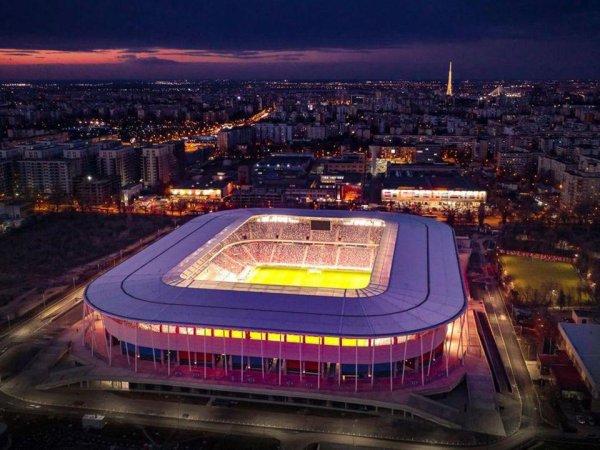
The demolition in 2018 did not mark the end of the Ghencea legend, but the beginning of a new stage. The new Steaua Stadium, completed after several years of construction, preserves the spirit of the old arena but translates it into a modern structure with over 31,000 seats, state-of-the-art facilities, and a design meant for twenty-first-century football.
Through the rebirth of the stadium, the spirit of Ghencea has been brought back to life: the noise of the stands, the enthusiasm of the fans, and the red-and-blue identity have gained a new space in which tradition can continue. The new arena honors the glorious past of Steaua, but also projects it into the future.
We also recommend: The history of Dinamo Bucharest Stadium: “The Pit,” the “dogs” of Ștefan cel Mare, and a red-and-white love story