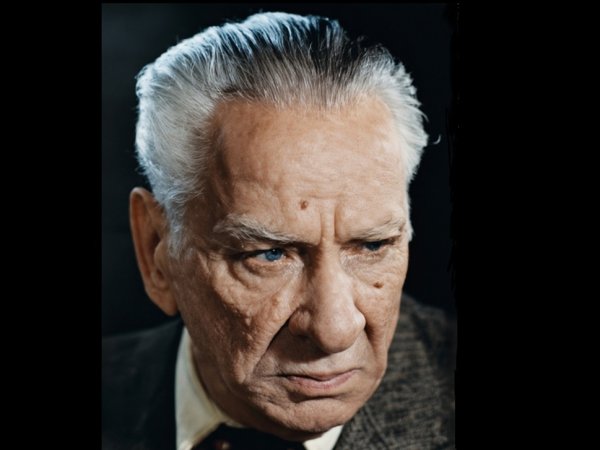
Stars of Interwar Bucharest: Actor Gheorghe Storin, the Great Professor of Dramatic Art of the Romanians
- Articles
- 18 AUG 26
In the history of Romanian theater, there are actors whose names have remained associated not only with the roles they played, but also with an entire era of the Bucharest stage. Gheorghe Storin was one of them. Born in Bucharest on March 16, 1883, and passing away on October 1, 1968, the great actor crossed more than six decades of Romanian history, from the beginnings of modern theater to the period after the Second World War. Storin was an actor of great dramatic force, but also an important educator. He studied dramatic art at the Conservatory in Bucharest, in the proximity of personalities who were essential to the development of Romanian theater. Biographical sources mention him as a student of C.I. Nottara, while documents preserved by the Museum of the National Theater of Bucharest show that, during the early stages of his training, he also studied with Petre Liciu, who is said to have noticed his talent and recommended that he be admitted directly into an advanced year. The Museum of the National Theater preserves documents that also attest to the official recognition Storin received throughout his life.
From the Conservatory to the great stages of Bucharest
Gheorghe Storin’s career was built during a period when Romanian theater was undergoing a process of professionalization and consolidation. Bucharest at the beginning of the 20th century was increasingly becoming an important theatrical center, while the National Theater represented one of the fundamental institutions of cultural life. For a young actor, appearing on the stage of this institution meant entering a world in which talent had to be supported by discipline, culture, and the ability to interpret extremely different characters.
Regarding his debut, some biographical sources indicate the year 1902 for his first appearances on the stage of the National Theater in Bucharest, while documentation from the National Theater Museum mentions his actual debut in 1904, in the play “Stingerea,” under the direction of Alexandru Davila. The difference may be related to the way in which the first stage appearances are distinguished from the official debut. What is certain is that, during the early years of the last century, Storin had already entered the circuit of the great Bucharest stages and was going to build a long-lasting career.
The actor did not limit his activity to the National Theater. He was a member of the Alexandru Davila Company and, later, of the famous Bulandra–Storin–Manolescu–Maximilian company. In these theatrical companies, Storin worked alongside important names of Romanian theater, at a time when private companies contributed decisively to the diversification of performances and to the emergence of new forms of stage representation. His career was also connected to other Bucharest stages, including the Bulandra Theater, the Maria Filotti Theater, Teatrul Nostru, and the Savoy Theater.
An actor of powerful characters and great conflicts
Gheorghe Storin distinguished himself through an extremely diverse repertoire. He was not an actor of only one type of character or one literary period. He played both characters from Romanian drama and figures from the great works of universal literature. His dramatic strength allowed him to move from characters dominated by passions and inner conflicts to authoritative, dark, or morally contradictory figures.
Among the roles that brought him appreciation from audiences and critics were Castriș in “Patima roșie,” by M. Sorbu, Michelangelo in the play by Alexandru Kirițescu, Vulpașin in “Domnișoara Nastasia,” by G.M. Zamfirescu, as well as Don Salluste in “Ruy Blas,” Victor Hugo’s play. He also played Scarpia in “Tosca,” based on the drama by Victorien Sardou, Nikita in “The Power of Darkness,” by Leo Tolstoy, as well as Satin and the Actor in “The Lower Depths,” by Maxim Gorky.
The diversity of these roles says a great deal about the actor’s artistic stature. From the dramatic universe of Hugo and Tolstoy to modern Romanian literature, Storin constantly had to change his interpretative register. His characters required authority, tension, expressiveness, and a remarkable ability to convey inner conflicts. It was precisely this artistic versatility that transformed him into one of the representative actors of Bucharest theater during the first half of the 20th century.
A particular moment in his career was the period of the First World War. Gheorghe Storin was mobilized for a short period, approximately three months, an experience that made him pass, like many people of his generation, through the realities of an era shaken by war. After returning to his artistic activity, he continued his theatrical career, becoming increasingly well known in the cultural world of the capital.
Gheorghe Storin and interwar Bucharest
The interwar period represented one of the important stages of Storin’s career. Bucharest was then a city undergoing a spectacular cultural transformation, with theaters, cinemas, restaurants, performance halls, and an intense artistic life. Actors had become true stars of the era, and their names circulated in the press and in fashionable social circles.
In this vibrant Bucharest, Gheorghe Storin occupied an important place. He was one of the established actors of his generation and participated in theatrical life at a time when audiences had access to an increasingly rich repertoire. Theater was not merely entertainment, but one of the principal ways in which Bucharest residents discovered literature, ideas, and the great conflicts of society.
Through his work, Storin contributed to strengthening the prestige of the actor as a cultural personality. At a time when Romanian cinematography was still in its early stages, the stage was the place where great stars were formed and established. For this reason, his career should be viewed primarily through the lens of theater, even though his appearances in films are today important documents for the history of Romanian cinema.
From the stage to cinematography
Gheorghe Storin also had a cinematographic career, during a period when Romanian cinema was searching for its language and building its first traditions. His known filmography includes “Amorurile unei prințese,” from 1913, “Pe valurile fericirii,” from 1920, “Televiziune,” from 1931, in which he played the banker Noris, and “Trenul fantomă,” from 1933, in which he played Dr. Stirling.
“Trenul fantomă” is one of his best-documented film appearances. The film, directed in its Romanian version by Jean Mihail, featured Tony Bulandra and Gheorghe Storin and was produced in Budapest in two versions, Romanian and Hungarian. According to Aarc, the Romanian version is considered the first sound film spoken in Romanian. Storin played Dr. Stirling, and his appearance alongside Tony Bulandra connects Romanian cinema with the tradition of the great stage actors.
Although Storin’s filmography is not particularly extensive compared with his theatrical work, these appearances have a special value. They preserve the image of an actor who belonged primarily to the theater, but who also participated in the early stages of Romanian cinematography.
The professor who trained new generations of actors
A fundamental stage of Gheorghe Storin’s biography began after the Second World War, when his stage experience was transformed into a pedagogical experience as well. Between 1947 and 1952, he was a professor of dramatic art at the Institute of Theatrical and Cinematographic Art “I.L. Caragiale,” an institution that would play an essential role in training Romanian actors and filmmakers.
For students, meeting Storin meant direct contact with an actor who had accumulated decades of experience. He could pass on not only acting techniques, but also a certain conception of the acting profession. In addition, the fact that Storin came from the generation formed around the great personalities of Romanian theater made him a link between the stage tradition of the beginning of the century and the new generations of artists.
His name also appears in testimonies concerning the training of actors who came after him. One documentary source mentions him, for example, among the teachers of actor Toni Zacarian, demonstrating that his pedagogical influence extended beyond the period of his own stage activity.
Official recognition and final years
The prestige accumulated by Gheorghe Storin over the decades was reflected in an impressive series of distinctions. In 1942, he received the Order of Cultural Merit, Knight, First Class, for his contributions to theater.
In 1951, he was awarded the title of Meritorious Artist of the Romanian People’s Republic, while in 1952 he received the Medal “Fifth Anniversary of the Romanian People’s Republic.”
In 1953, Storin was named Artist of the People and received the Order of Labor, First Class. He was also a recipient of the State Prize before 1955. In 1963, he was decorated with the Order of the Star of the Romanian People’s Republic, First Class, and in 1967, one year before his death, he received the Order of Cultural Merit, First Class, for his entire theatrical career.
A document preserved by the National Theater Museum shows that official recognition of his merits had begun as early as the period of the monarchy.
The museum preserves a Bene Merenti brevet, First Class, awarded to actor George Storin by King Ferdinand I in 1923. The museum’s collection also includes several diplomas and documents illustrating his artistic career and the honors he received over time.
The legacy of a great actor of the Romanian stage
Gheorghe Storin died in Bucharest on October 1, 1968, at the age of 85. He was buried in Bellu Cemetery, the place where numerous personalities of Romanian culture, art, politics, and science rest.
Today, his name may be less familiar to the general public than those of actors who had much more visible film careers. For the history of Romanian theater, however, Gheorghe Storin remains an essential figure.
He was an actor trained in the tradition of the great masters of the stage, an artist who gave life to memorable characters, a participant in the vibrant theatrical life of interwar Bucharest, and, later, a professor who passed on his accumulated experience.
His importance is not measured only by the number of roles he played or the distinctions he received. Storin belonged to a generation that built, through hard work and professionalism, the prestige of modern Romanian theater.
From the great Bucharest stages and the theatrical companies in which he performed to the chair of dramatic art and his appearances in cinema, his career tells the story of an artist who crossed several historical eras without losing his place in Romanian culture.
We also recommend: The stars of interwar Bucharest: Fory Etterle left law and seafaring to become one of the greatest Romanian actors