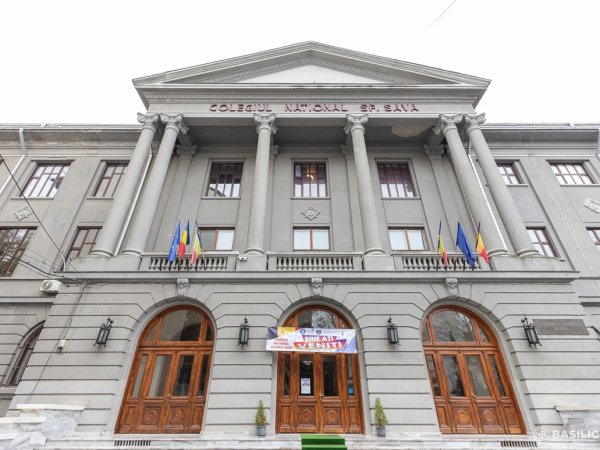
Saint Sava National College, from the Royal Academy founded by Constantin Cantacuzino to the prestigious high school of today
- Articles
- 04 DEC 25
During his travels in the West, the great scholar and humanist Constantin Cantacuzino was deeply inspired by European educational systems and wished that his native country would also have a prestigious school similar to those he had attended. In support of this ideal, Cantacuzino found an ally in Lord Constantin Brâncoveanu, a protector of culture, open to Western influences, but also devoted to local values. Thus, between 1680 and 1683, in the old buildings of the “Saint Sava” Monastery, the Royal Academy was established. This institution included all levels of education, from elementary to higher education, but the main emphasis was on higher education, intended for the sons of rulers and descendants of major boyars.
The dream of Constantin Cantacuzino and the founding of the Royal Academy
The Royal Academy was founded in a context of the revival of Hellenic culture in the Orthodox space, which explains the profound influence of Greek language and philosophy on education. Classes were conducted exclusively in Greek, considered universal, equivalent to Latin in the West.
The education was based on Neo-Aristotelian philosophy, as transmitted by the Athenian professor Theophil Coridaleus. Students were trained in Greek and Latin language and literature, logic, mathematics, and theology, forming a generation of well-prepared young intellectuals. The first director of the Academy was Sevastos Chirmenites, a Greek language professor with international experience who had taught in Trebizond and Constantinople.
The Royal Academy quickly became a reference institution, rivaling the Phanar Academy and the Higher School of the Patriarchate of Constantinople. Even the Patriarch of Constantinople sent students to study in Bucharest, and for the Balkan peoples, the Royal Academy represented a true “beacon of light.” Among its first students were nobles, sons of boyars, and students sent by the Patriarch, including Dinu Golescu, Ion Câmpineanu, and the historian Dionisie Fotino.
The Phanariot era and educational reforms
Under the rule of the first Phanariot princes, the school gradually lost its brilliance and lacked notable manifestations until later reforms. Princes Constantin Mavrocordat, Grigore II Ghica, Constantin Racoviță, Ștefan Racoviță, Alexandru Sc. Ghica, and Alexandru Ipsilanti contributed to reorganizing education, aiming for the school to reach “the best possible state, with good teachers and many apprentices, who, through the teachers’ diligence, would prosper, both sons of boyars and others from lower ranks.”
The reform envisaged expanding the teaching staff from 2 to 9 professors and introducing four classes or cycles of three years each. The boarding school accommodated 75 scholarship students, including both privileged children and “the poor and needy.”
Plans for the school building, which included 60 rooms for classrooms, boarding, and teacher residences, were completed in 1779. The charter of Alexandru Ipsilanti in 1776 formalized this stage, but the building was devastated in 1788 during the Austro-Russian war, and in 1791 the school temporarily moved to “Doamna Bălașa,” while the original Saint Sava buildings were restored for the royal residence.
Even the 1806-1812 war interrupted activity, but through Ioan Vodă Caragea’s reform in 1814, the school experienced a revival through the restoration of buildings, increased capacity, and hiring of new teachers.
Gheorghe Lazăr and the beginning of the national school
Ioan Vodă Caragea reinforced the Eforia Charter through the decree of March 24, 1818, establishing the Romanian language school in the cells of Saint Sava. Gheorghe Lazăr was appointed as the main teacher, considered the most competent among available Romanian educators.
The first students of the national school were those who had left Greek-language courses and six Moldavian scholarship students, establishing the institution as a school for all Romanians. Under Lazăr’s leadership (1818-1823), the school consolidated definitively and became the foundation of all modern cultural institutions in Romania.
After his appointment as governor of the Principalities, Pavel Kisseleff ordered the reopening of the public school, and from December 22, 1831, the French language chair was officially established, with teachers from France, including J. A. Vaillant. In 1832-1833, the institution received the name Saint Sava National College.
Admission and end-of-year exams were supervised by the Metropolitan, the public instruction chancellor, and even the Prince, and were published in the Official Bulletin. The college thus aligned with the provisions of the public school regulation of Wallachia, published in 1833.
Consolidating the curriculum and expanding educational stages
After a temporary suspension due to ideological and political threats, Saint Sava College resumed activity at Schitul Măgureanu. The educational program was reorganized into three stages: primary, high school, and special (higher), with instruction in Romanian and Latin.
Greek was eliminated, while German and French became optional from grade IV. In the 1851-1852 school year, the seventh grade was formed, and the following year the eighth grade, to cover the full range of subjects without overburdening students.
In October and November 1863, the Higher School of Sciences and the Higher School of Letters were established to train teachers in mathematics, physics, natural sciences, classical and modern languages, literature, philosophy, history, and geography. These higher schools were later integrated in 1864, alongside the Faculty of Law, through the decree of Alexandru Ioan Cuza, forming the University of Bucharest.
The modern era and the college’s role in Romanian culture
Saint Sava College was the only complete school until 1864, offering primary, high school, and university-level courses, and at the beginning of the 20th century it hosted “His Majesty’s Class of the Great Voivode of Alba Iulia.”
During the communist period, the institution was renamed Middle School No. 1 and then Nicolae Bălcescu High School, but from 1992 it regained its historic name, Saint Sava National College, preserving the memory of the era in which the Romanian language and culture were truly asserted.
Throughout its history, Saint Sava National College has been a true incubator of intellectuals, statesmen, and professors, contributing to the formation of elites who fought for the development of the Romanian nation. Its close connection to the historical and cultural evolution of Romania makes it a symbol of educational continuity and national values.
From Royal Academy to prestigious high school
Saint Sava National College today stands as a monument of Romanian education, a reference of excellence and tradition, rooted in the vision of Constantin Cantacuzino and the support of Constantin Brâncoveanu.
From the Royal Academy, where the sons of rulers received an international-level education, to the modern high school, which continues to train elite young people, its history reflects the cultural and social transformations of Romania.
Each generation of students and teachers has contributed to maintaining high standards, making Saint Sava College a symbol of continuity and achievement in Romanian education.
We also recommend: Gheorghe Șincai National College, one of the oldest high schools in Bucharest, designed by Romania’s first female architect