Romania's Capital. Why Is It Called Bucharest?
- Articles
- 16 APR 26
A name six centuries old, an unconfirmed legend, and an etymology linguists are still arguing about
Few European capitals have a name as contested as Bucharest. Paris traces back to the Gaulish tribe of the Parisii, London to Roman Londinium, Vienna to Celtic Vindobona. Bucharest, on the other hand, comes from... nobody knows for certain. Or more precisely, it comes from several places at once, depending on which historian, linguist, or chronicler you choose to believe.
Vlad the Impaler's charter and the first written trace
The exact date exists: 20 September 1459. On that day, Vlad Țepeș, ruler of Wallachia, signed a charter in Old Slavonic confirming the property of a certain Andrei and his sons. The document was issued from the fortress of Bucharest — and this is the first place the city's name appears in writing (on parchment, to be precise).
The charter survived six centuries and is preserved to this day. By historical convention, it marks the official date of Bucharest's documentary attestation — commemorated every year on 20 September.
Vlad Țepeș had moved to Bucharest for practical reasons too: between 1458 and 1459, with the help of craftsmen from Brașov, he had raised a new fortress on the banks of the Dâmbovița river, on the site of an older wall built by Mircea the Elder a few decades before. The historical record shows that Mircea the Elder had erected a small defensive fortification there at the end of the 14th century — its foundations, uncovered much later by archaeologists, still lie beneath the ruins of the Old Court in the city centre.
So when Vlad Țepeș wrote "the fortress of Bucharest" in 1459, the place already had a name. Where did that name come from?
The shepherd Bucur and the power of a legend
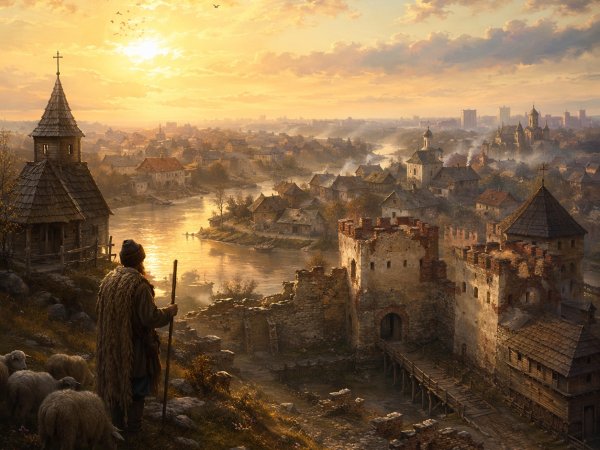
The first explanation — and the most widespread in popular memory — comes from the Saxon historian Johann Filstich, in his work Tentamen Historiae Vallachicae, written sometime in the early 18th century. Filstich recorded an oral tradition according to which "the name of this city derives from a hermitage, built on a small hill, raised by a shepherd who wandered there and bore the name Bucur, a name later given to the entire settlement, which filled with inhabitants — that is, București."
A shepherd named Bucur, a hut, a small wooden church, a spring — and from these, a capital. The story is beautiful, unmistakably charming, and it circulated for centuries as the accepted explanation. The problem, consistently noted by historians, is that Bucur the shepherd left no verifiable trace in any document. His existence remains in the realm of legend — where, as it happens, many other city founders reside.
Bucur: one name, several roots
Whether or not a Bucur ever existed in flesh and blood, the name itself is real and well documented in the medieval Romanian world. And this is where linguists step in with their own theories.
The most widely accepted today is that "București" derives from an anthroponym — a personal name, Bucur — followed by the distinctly Romanian suffix -ești, which denotes belonging or descent. The same mechanism produced hundreds of Romanian place names ending in -ești: Florești, Ioanești, Mihăilești. By analogy, "București" would mean, literally, "Bucur's people" or "Bucur's place."
As for the name Bucur itself, linguists place it within the word family of a se bucura (to rejoice), bucurie (joy), bucuros (joyful) — an entirely native root, old and widely present in Romanian personal names. Alexiu Viciu argued in 1929 that Bucur was a name borrowed from Slavic, but that hypothesis remained a minority view against the one that reads it as a word of Romanian or even pre-Roman origin.
A third theory, raised periodically in the literature, links bucur to the Albanian bukur — meaning "beautiful" or "pleasant" — and would place the name's roots in the Thraco-Illyrian substrate of the Romanian language. It is a linguistically interesting proposal, but contemporary scholars treat it with caution, favouring derivation from the Romanian root of joy.
Beech trees and other botanical theories
Among the less frequently cited theories, though one with some presence in specialist literature, is the idea that appeared around 1800 in a book published in Vienna: the city's name derived from the beech forests that once covered the area, known locally as bukovie. The theory has a certain geographical appeal — the Wallachian plain was far more forested in earlier centuries than it is today — but the absence of direct documentary support keeps it firmly in the category of working hypotheses rather than conclusions.
What we actually know
A few things stand firm: by 1459, Bucharest already existed under this name. The suffix -ești indicates, with reasonable certainty, that the name originates with a real or legendary figure called Bucur. And that name points, in the broadest academic consensus today, toward the semantic family of joy in Romanian — a living root with centuries of tradition in the language's vocabulary and personal names.
As for the shepherd Bucur — did he exist, or was he invented by the collective memory of a city that needed a founder? The historian Constantin C. Giurescu noted that Bucharest existed as a market town long before the reign of Vlad Țepeș, perhaps even before the founding of the medieval state of Wallachia. If a real Bucur existed, he lived somewhere at the border between centuries that documents barely illuminate.
Perhaps that is exactly where the name's charm lies. Capitals with clear, certified origins are plentiful. One that carries within it, invisibly, the Romanian word for joy — that is rather less common.