Red Easter Eggs, 200 Years Ago: How Bucharest Women Dyed Them Before the Dye Packet Existed
- Articles
- 09 APR 26
The grandmothers who are still around today remember exactly how the kitchen smelled on Holy Thursday. Not like cozonac — like boiled onion skins. Sharp, persistent, the kind of smell that settled into the curtains and stayed there until the next day. The sign that the Easter eggs were on the stove.
Onion skins and a kitchen with one option
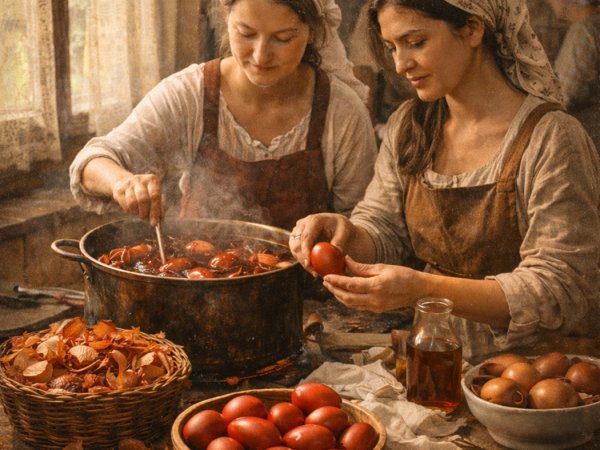
In Bucharest two centuries ago, natural dye wasn't a conscious choice — it was simply the only thing available. Women in the old city quarters saved onion skins for weeks before Easter, a slow, deliberate kind of stockpiling that turned kitchen scraps into something valuable.
The skins from about twenty onions would simmer for nearly an hour. The liquid was strained, and raw eggs went in with salt and vinegar. The vinegar was essential — it locked the color evenly onto the shell, keeping the red from coming out patchy or uneven.
Red onions gave deep, reddish-brown tones. Yellow onions leaned toward rust and terracotta. Many women used both, adjusting the ratio by instinct and experience depending on whether they wanted a brighter or darker red. The knowledge passed from mother to daughter, never written down, each woman arriving at her own version.
The parsley leaf and the nylon stocking
Beyond the base color, the old Bucharest neighborhoods had a decorative technique as clever as it was simple. A dill frond, clover leaf, or sprig of parsley was pressed flat against the egg, the egg was slipped snugly into a nylon stocking to hold the leaf in place, and the whole thing went into the dye bath. When the stocking came off, a white silhouette of the leaf appeared against the red — a botanical negative, never quite the same twice.
The technique had no inventor and no written recipe. It traveled from courtyard to courtyard, from the southern neighborhoods all the way to the northern ones.
The final shine
Once dry, the eggs were wiped with a cloth dabbed in oil — sunflower, olive, or lard. They took on a warm, natural sheen that gave them a quiet presence on the holiday table. A polished egg looked deliberate, cared for. The difference from a dull, unfinished one was visible across the room.
What the market sold
The market was never far, and in Holy Week the stalls filled with vendors selling dyeing powders and solutions — ingredients measured out by the spoonful, straight from the counter. A few teaspoons of uncooked rice added to the dye water helped even out the color on the shell.
Older plant-based powders circulated too, sold under names like galascău and mierială, yielding yellows and reds. They moved through the same trade networks as cinnamon and cloves. Bulgarian and Greek merchants from Obor and Calea Moșilor were part of this seasonal commerce the way they were part of any other.
A wider palette than tradition suggests
Tradition says red. But the neighborhood kitchen worked with whatever it had. Yellow came from onion skins or bird cherry bark. Black — the color associated with Christ's suffering — came from green walnut shells or alder berries. Black eggs were rare and carried a different weight: they went to the cemetery on Bright Monday, not to the Easter table.
Elaborate geometric or botanical ornamentation belonged to other regions — Bucovina, Banat, Neamț. Bucharest was a city of plain red eggs: well-dyed, glossy, and ready for the tap.
The second day of Easter, at Cișmigiu
The red eggs didn't stay indoors. On the second day of Easter, Bucharest families headed outside — to Cișmigiu Garden or along the Dâmbovița river — with grilled meat, Easter bread, cozonac cake, and eggs packed in a bag. The holiday meal moved into the open air, and the Easter greeting was exchanged under the spring sky just as easily as at the table.
The city came loose from itself — out of houses, out of courtyards, out of the narrow streets of the old quarters — and settled with noise and appetite onto the grass.
What the dye packet changed
Synthetic dye reached Romanian stores around the middle of the twentieth century. A few minutes, uniform color, no smell. It spread quickly. The old neighborhood as a way of life had already disappeared — apartment blocks had replaced courtyards, electric stoves had replaced wood-burning ones.
What shifted with the transition was, above all, the rhythm. Collecting skins for weeks in advance. The slow simmer on Thursday evening. Waiting for the color to take. The final wipe with an oiled cloth. Each step in that older process marked, in its own way, that something important was approaching.
Dyeing eggs with onion skins has come back quietly in recent years — not out of necessity, but something harder to name. The people doing it again know the packet would be simpler. They choose the skins precisely because the process is longer, less predictable, and tied to a time that no longer belongs to them — but that they want to touch, at least once a year.
Also recommended Easter Lamb in Bucharest: Where It Came From, Who Could Afford It, and What It Meant to Have It on the Table a Century Ago