Pajura, the neighborhood that refuses to be just a train station in northern Bucharest
By Bucharest Team
- Articles
- 05 FEB 26
Any urban explorer may find themselves lost in a place that seems familiar yet completely foreign. This can happen on any given afternoon, somewhere behind the Free Press House, where you might feel like you are in an extension of the Dămăroaia area or, why not, in a time loop from the 1970s.
The streets become suspiciously quiet, the buildings take on a friendly height, and the only striking sound is a distant metallic rumbling reminiscent of a forgotten train station. You are, of course, in the Pajura neighborhood. A neighborhood that is "invisible" on the mental map of many Bucharest residents, even though it occupies an enviable geographical position. It is an enclave that has grown, somewhat stubbornly, between vegetable gardens and railroad tracks. But its history deserves to be unraveled step by step.
From mud and cabbage to the architect's drawing board
If you had the misfortune to walk through this area at the beginning of the 20th century, you would have needed sturdy rubber boots and a solid stick to keep the local geese at bay. Before the "history of the Pajura neighborhood" became synonymous with concrete and district heating pipes, subsistence farming reigned supreme here. The land belonged partly to the commune of Băneasa, the other part being a kind of no man's land where the city lost its energy and melted into the Bărăgan plain.
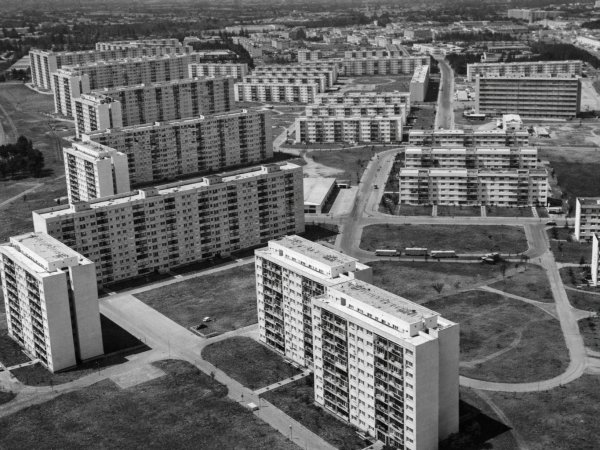
Urbanization came here with a specific and unpoetic purpose. During the interwar period and immediately after, Bucharest suffered from an acute housing crisis, and the vacant land in the north seemed the ideal solution. However, the real transformation can be dated to the 1950s and 1960s. The architects of the communist regime looked at the maps, drew straight lines across the irregular plots of the peasants, and decided that this is where the working people would live.
The process was quick and brutal for the idyllic landscape, but necessary for the capital's population explosion. What you should note is that, although they poured tons of concrete, the planners retained a human scale that later dormitory neighborhoods, such as Militari or Drumul Taberei, completely lost in favor of ten-story giants. Pajura remained an experiment in medium density, a compromise between village and metropolis.
The great iron barrier and splendid isolation
The element that defines the experience in Pajura remains the railway. It functions as a modern city wall separating the neighborhood from the rest of Sector 1 and, in a way, from immediate reality. The presence of the Bucharest-Constanța railway line dictated the shape of the neighborhood and imposed its physical limits.
You will notice that the residents have developed a complex relationship with trains. On the one hand, the rhythmic noise becomes a background sound that you quickly get used to, like the ticking of an old clock in a living room. On the other hand, access has historically been limited, turning the area into a kind of island.
This geographical isolation has had an interesting side effect that you feel as soon as you enter the side streets. Pajura became a gated community before the term "secure residential complex" appeared in real estate developers' brochures. People got to know each other for the simple reason that no one passed through Pajura to get somewhere else.
If you were on Pajurei or Faurei Street, you were there because you had business there or because you lived there. This urban dead end preserved an air of rare intimacy. Neighbors knew when you bought a color TV or when you changed your furniture, information that circulated faster than the internet through the complex network of banks in front of the block.
The "P" blocks and the minimal space experiment
Looking at the "socialist architecture" in Pajura, you notice a detail that escapes the untrained eye. The blocks here, many of them built in the 1960s, are a case study in how to maximize the number of tenants while minimizing living space, all without causing an immediate revolt. The apartments are small in size. The kitchens seem to have been designed by someone who believed that cooking was a bourgeois activity that should be discouraged or who ate exclusively from space capsules.
However, there is a subtle balance that you will appreciate if you come from a new neighborhood. The architects compensated for the stinginess of the interior space with the generosity of the exterior space. The distance between the blocks is large, an absolute rarity in today's Sector 1 urban planning, where you can shake hands with your neighbor in the next block without stepping out onto the balcony.
In Pajura, the vegetation has had time to grow. The trees planted when the blocks were newly built are now giants that shade the facades and hide the fallen plaster. Walking among the four-story blocks, you feel like you are in a park that has been accidentally inhabited, a lesson that modern developers persistently ignore, preferring to sell luxury residences overlooking the neighbor's garbage dump, while old Pajura offers you the simple luxury of seeing the sky through the branches of a magnificent linden tree.
Schools, high schools, and a changing demographic
Another pillar on which the neighborhood's identity was built is education. Pajura was well equipped with schools and high schools, which initially attracted young families. The Constantin Brâncoveanu Theoretical High School and Secondary School No. 178 are landmarks that anchor the community. In the morning, the neighborhood suddenly comes alive with waves of students, breaking the sanatorium-like quiet that reigns the rest of the day.
It is fascinating to observe how the population has changed. Those who moved here in their youth, when the neighborhood smelled of fresh paint, have aged along with the buildings. Today, Pajura has one of the oldest populations in Bucharest, and you can sense this in the slow pace of life and in the conversations in the market, which inevitably revolve around blood pressure and pensions. However, in recent years, there has been a new vibe. Young people are rediscovering the area, attracted by the still decent prices compared to Aviației or Herăstrău and the omnipresent greenery. It is a natural cycle of urban regeneration that is happening organically, without the brutal intervention of any five-year plan.
A unique fauna and the Commercial Complex
You can't talk about Pajura without mentioning the former commercial complex, often referred to simply as "the complex." During the communist era, this was the center of the local universe. Here you could find the grocery store, the barber shop, the post office, and the pastry shop where savarina seemed to be the supreme achievement of gastronomy. The architecture of these neighborhood complexes was standardized, but their social function was vital. Basically, they functioned as a modern agora where you could find out the latest news.
Today, many of these spaces have been transformed, compartmentalized, and modernized in a chaotic manner. Modern supermarkets with bright logos have replaced the old grocery stores, but the basic structure has remained. The old guard of the neighborhood meets the new corporate arrivals who work in the glass towers of Piața Presei. Pajura is a fascinating cultural crossroads, where you can see a grandmother pulling a market cart alongside a young man ordering an oat milk latte, both navigating the same cracked sidewalk.
False myths about the Pajura neighborhood
The history and geography of Bucharest are often optional subjects for its inhabitants, so confusion inevitably arises. Here are some mistakes that are made in discussions about this neighborhood.
Confusion with Dămăroaia or Bucureștii Noi
Some tend to lump the entire northwest under the same umbrella, but Pajura is a distinct neighborhood. Dămăroaia is, historically, a neighborhood of houses resulting from the parcelling of the Dămăroaia estate, with a bohemian atmosphere and different architecture. Pajura is defined by blocks of flats and medium density. The border is subtle, but for those in the know, it exists.
The idea that it is a luxury neighborhood
Although you are in Sector 1 near expensive areas, you should know that Pajura was and remains a middle-class neighborhood, or working-class at its origins. Real estate agents sometimes try to inflate its price by association, but the reality of the old apartment buildings and modest finishes tells a different story. The luxury here is the green space, not the marble in the stairwell.
Ignoring the accessibility of the metro
You may think that Pajura is isolated from rapid transport, but you are wrong. The Jiului metro station, although "technically" located on the outskirts, serves the area quite well. People tend to complain about the isolation of the railway and forget that the metro has radically changed the connectivity of the neighborhood in recent years.
The myth of a lack of history
It is often said that apartment block neighborhoods lack history. But this is a false statement. Every alley in Pajura hides the story of a displaced family, an architect who tried to steal a few square meters of green space from the party, or the social transformation of the last fifty years. History is not just about palaces and princes, but also about the daily lives of thousands of ordinary people.
A neighborhood asking for its right to quiet
Pajura remains a pleasant anomaly in Bucharest’s urban landscape, living proof that a centrally planned neighborhood can grow into a warm, organic community if given enough time and enough trees. In a capital that seems forever sprinting toward the next real estate trend, Pajura sits calmly between its railway tracks, like a retiree who has seen it all and no longer feels the need to prove anything to anyone.
If you find yourself in the area, the best advice is to ignore the main road and slip in between the apartment blocks. Look for the small gardens tended by ground-floor residents, where roses grow beside slightly crooked boxwood shrubs. That is where the spirit of the place reveals itself. If you are lucky, you will catch the quiet, almost magical moment when a train passes in the distance and the whole neighborhood seems to hum softly, reminding you that this is a borderland of sorts, a place of transit that has improbably turned into home.
When was the last time you explored a Bucharest neighborhood without any specific purpose, simply to see how life unfolds two stops away from your own everyday universe?
P.S. What is a pajură?
The pajură is a large diurnal bird of prey, commonly known as the golden eagle, defined by strength, speed, and sharp talons. The term is also used to describe the reverse side of a coin, often bearing a coat of arms, and is linked to the symbol of power in the expression “heads or tails.”
You may also like: Bucureștii Noi, the Bucharest neighborhood built from scratch by lawyer Nicolae Basilescu