How the State Jewish Theatre Was Born, the Only Theatre of a Minority in Romania
- Articles
- 29 NOV 25
The story of the State Jewish Theatre is deeply connected to the cultural evolution of the Jewish community in Romania and represents one of the longest and most stable theatrical traditions of a minority in Europe. This history begins in the year 1876, in a moment when the cultural life of the city of Iași was in full effervescence. On August 19, in the summer garden “Pomul verde,” a place famous at the time for its artistic events, the writer and actor Avram Goldfaden laid the foundations of the first professional Jewish theatre in the world.
The roots of Jewish theatre in Romania: the beginnings of a unique tradition
Goldfaden, considered today the father of Yiddish theatre, was not only a man of the stage but also a visionary creator. He understood the potential of the Yiddish language as a theatrical language and formed a professional troupe with which he presented performances dedicated to the Jewish community in Romania. This was the spark that triggered a cultural movement that would later spread throughout the world, from New York to Warsaw, transforming Yiddish theatre into an international phenomenon.
In this context, Romania became the place where the cornerstone of a unique theatrical genre was set. The premiere of 1876 was more than a show: it was the beginning of a cultural path that would extend for almost a century and a half. Here, in an official way, professional Jewish theatre was born, and this accomplishment turned the Romanian cultural space into a major reference point of Yiddish culture.
From an itinerant troupe to a state institution: the consolidation of a theatrical identity
After the founding moment in Iași, Jewish theatre in Romania continued to evolve, and Goldfaden’s troupe began to perform in several cities, contributing to the spread of Yiddish culture. Bucharest, which was gradually becoming the cultural center of the country, turned out to be the ideal setting for developing a stable and professional stage dedicated to Yiddish-language performances.
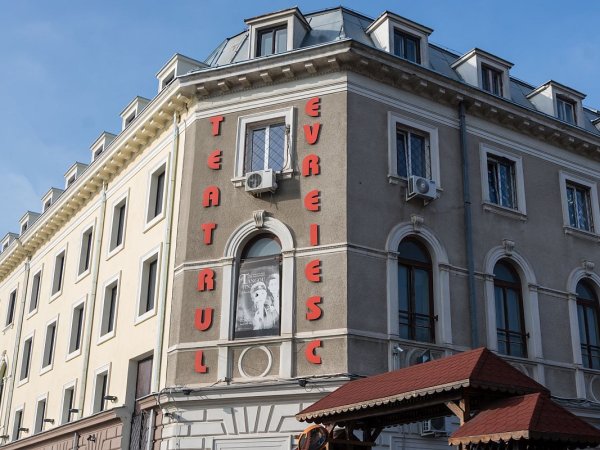
The turning point in the institutional history of Jewish theatre occurred in the year 1948, when the Jewish Theatre in Bucharest was officially recognized as a state institution. This transformation offered stability, recognition, and the resources necessary for continuous artistic activity. From then until today, the theatre has functioned in the building on Dr. Iuliu Barasch Street, preserving that particular character that has made it a cultural symbol.
In the more than seven decades of functioning as a public institution, the theatre has staged over 200 premieres. This vast repertoire reflects both the richness of Yiddish literature and the diversity of universal dramaturgy. Constantly, the theatre’s stage became the place where tradition and modernity meet, where the works of great Jewish authors coexist with plays of classical authors from the world repertoire.
The repertoire that defined a style: between Yiddish tradition and universal dramaturgy
One of the most remarkable characteristics of the State Jewish Theatre is the breadth of its repertoire, which covers a wide range of styles and influences. Adaptations of the works of great authors of Yiddish literature, Shalom Aleichem, I.L. Peretz, Mendele Mocher Sforim, Isaac Bashevis Singer, or Ephraim Kishon—have occupied a central place on this stage. Through the showcasing of these texts, the theatre has decisively contributed to preserving and promoting Jewish cultural identity in Romania.
At the same time, the stage of the Jewish theatre has hosted plays by important Jewish playwrights from Romania, such as Mihail Sebastian, Aurel Baranga, Alexandru Sever, and Dumitru Solomon. The presence of these authors in the repertoire strengthened the theatre’s connection with the Romanian cultural space, underlining the fact that Yiddish art integrates naturally into the national culture without losing its own identity.
The list of playwrights represented on the theatre’s stage also extends to international names such as Arthur Miller, Israel Horovitz, or Mario Diament, as well as authors from universal dramaturgy, Molière, Lessing, Ibsen, Brecht, Feuchtwanger, Max Frisch, Dürrenmatt, or Arnold Wesker. This openness to universal culture demonstrated the versatility of Yiddish theatre, as well as the ability of actors to take on complex roles, in different styles.
Likewise, the State Jewish Theatre has been, over time, the place where exceptional actors have shined. Names such as Sevilla Pastor, Beniamin Sadigursky, Dina König, Lia König, Carol Feldman, Mauriciu Sekler, Isac Havis, Samuel Fischler, Mano Rippel, Benno Popliker, Seidy Glück, Sonia Gurman, Eugenia Balaure, Leonie Waldman Eliad, or Theodor Danetti became landmarks of the stage. These artists demonstrated, through their talent, the unique character of the Jewish actor: a complete performer, able to act, sing, and dance with the same naturalness.
The State Jewish Theatre today: identity, continuity, and uniqueness
With an uninterrupted existence of 77 years as a state institution, the State Jewish Theatre remains the only professional Yiddish theatre in Romania and one of the few of its kind in the world. This fact gives the institution a unique profile, both in the national cultural landscape and internationally.
Today, the theatre continues to be a reference point of the theatrical movement in Romania, being appreciated for its artistic quality, for the authenticity of its style, and for its ability to keep Yiddish tradition alive in a world in continuous change. At the same time, it remains a meeting point between generations, offering the public the opportunity to discover a culture with deep roots and inexhaustible stories.
For Bucharest, the existence of this theatre represents a true cultural treasure. In a city where history has often intertwined with dramatic transformations, the State Jewish Theatre has remained a space of artistic stability, tradition, and diversity. At the same time, the institution plays an essential role in preserving the Yiddish language, a language full of memory and emotion, which continues to be spoken on stage with the same passion as 150 years ago.
A living heritage, open toward the future
The State Jewish Theatre is not only a cultural monument but also a dynamic institution, adapted to the contemporary public. Continuing Avram Goldfaden’s tradition, the theatre assumes the mission of preserving Jewish cultural heritage while opening itself to new forms of artistic expression. It is a bridge between past and present, between heritage and innovation.
Thus, the story of Jewish theatre in Romania is not a finished one. It is a history in continuous writing, carried forward by established artists and new generations, by loyal spectators and by those who discover for the first time the magic of the Yiddish language.
The State Jewish Theatre remains a symbol of cultural continuity, an institution that has survived time, has grown, has transformed, and has always kept alive the essence of its identity. In a world that changes rapidly, this theatre continues to be proof that authentic traditions can endure if supported by talent, dedication, and respect for culture.
We also recommend: Nottara, the theatre and the drama of love. The wife of Romania’s greatest actor fell into the arms of I.L. Caragiale