How the job of STB inspector came about and what fines were imposed in the beginning
By Bucharest Team
- Articles
- 03 FEB 26
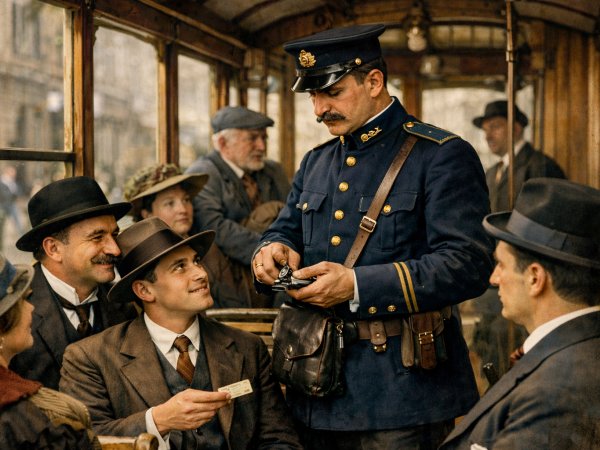
In 1872, Bucharest smelled of dust, tanned leather, and animal exertion. On the narrow streets, where mud seemed to be a permanent state of matter, the first horse-drawn trams made their way with a metallic noise that heralded the modern era. A gentleman in a top hat hurriedly climbed aboard, adjusted his coat, and searched his vest pocket for a small coin, hoping not to be questioned by the sharp gaze of the man in the cap.
That gaze belonged to the precursor of what we now call a ticket inspector, a figure born out of the desperate need to bring order to a financial system that was in danger of collapsing under the weight of the "fare dodgers" of the time. Bucharest's public transport system created a whole mythology around ticket inspection and fines received under the curious gaze of the market.
The institution of order on wooden rails
Before the Bucharest Tramway Company (STB) became the colossus it is today, transport was a motley business, managed by entrepreneurs who understood that Romanians have a natural inclination to evade payment. The first horse-drawn tram lines, operated by foreign-owned companies, imposed strict rules to justify the massive investment in infrastructure. The ticket inspector appeared as a guarantor of public honesty in a city that was still learning what paid public service meant.
These first agents wore uniforms that mimicked military rigor, with metal buttons and epaulettes that inspired a truly judicial authority. They had the duty to board the carriages at irregular intervals, interrupting conversations about politics or the price of wheat to ask for proof of payment.
In practice, their presence was a social event, as a check could reveal an embarrassed minor official or a young bohemian trying to "cheat" the system for an extra coffee at Capșa. This interaction laid the foundation for a complex relationship between the citizen and the urban authority, where the ticket was a contract of respectability.
Cardboard tickets and the art of perforation
The fare collection system at the beginning of the 20th century was a logistical challenge that required close attention to detail. Tickets were often printed on thin cardboard or low-quality paper, with different colors depending on the distance traveled or the class of the carriage. The ticket inspector at that time had to be a bit of an expert in urban topography, checking whether the time marked on the ticket corresponded to the position of the tram at the time of inspection.
The ticket seller usually stood on the rear platform, but it was the conductor who patrolled between stations. A concrete example of this rigor was the use of a perforating pliers, an instrument that made a specific metallic sound, inducing a slight state of anxiety in passengers with a guilty conscience.
While today we scan a card, back then validation was a tactile, mechanical process that left small pieces of confetti on the wooden floor of the tram. This method made ticket fraud difficult, as the perforations had shapes specific to each agent, a kind of mechanical signature that was impossible to replicate without the official tools.
Fines that emptied interwar wallets
Penalties for traveling without a ticket were designed to be painful enough to discourage any attempt to steal services. In the early days, fines could also involve a rather unpleasant form of public exposure. There were cases where the offender was forced to get off at the first station under the disapproving glances of other passengers, sometimes being escorted to the nearest police station if they refused to show their ID.
The amount of the fine depended on the specific regulations of the transport company, but as a rule it exceeded ten or even twenty times the price of a regular ticket. For a worker with a modest salary, such a penalty was equivalent to several days' worth of food, which made STB checks a real scare tactic.
From the archives of the time, we learn that these fines were collected with extreme rigor, the amounts being paid directly into the budget for the maintenance of horses or, later, for the electrification of the lines. There were also special situations, such as those in which the passenger accidentally presented an expired ticket, where leniency depended solely on the mood of the inspector and the manners of the passenger.
The social relationship between the agent and the "blatist"
The interaction between the inspector and the passenger generated a veritable subculture of excuses and inventiveness in Bucharest. As trams had quickly become the main means of transportation, they mixed social classes in a confined space, putting the ticket inspector in the delicate position of having to ask both a banker and a shopkeeper to pay their fare. There are reports of passengers who, seeing the agent boarding at the end of the line, simply jumped off the moving tram, risking a sprain to save a few coins.
This dynamic created a kind of urban chess game. Ticket inspectors had learned to identify fare dodgers by their behavior, usually those who stared intently out the window or pretended to be fast asleep as soon as the uniform appeared on the horizon.
A skilled ticket inspector knew that a passenger who frantically searched all his pockets without finding anything was most likely a fare dodger. At such moments, the tension in the carriage could be cut with a knife, with the rest of the passengers watching the scene with a mixture of compassion and moral satisfaction.
Interwar tactics and iron manners
During the interwar period, Bucharest underwent a spectacular metamorphosis, becoming "Little Paris" in terms of both architecture and social etiquette. The ticket inspectors of this era were an interesting mix of urban police and stern butlers, not limiting themselves to checking tickets, but also ensuring that good manners were observed in the carriages. For example, it was their duty to remind gentlemen that smoking or spitting on the floor were unhygienic gestures and would be severely punished.
The agents of the Bucharest Tram Company often worked in tandem. One would climb onto the front platform, the other onto the rear platform, creating a human "pincer" from which escape was almost impossible without jumping off the moving vehicle. At that time, control was a matter of honor; if a pretentious person was caught without a ticket, they would often prefer to pay a considerable sum as a fine on the spot rather than risk a public scandal that would tarnish their reputation in the neighborhood.
The inspectors took advantage of this type of personal pride, using extremely polite but firm language that made the penalty seem more like a lesson in civic education than a financial punishment.
The gray uniform and iron discipline of the golden age
With the establishment of the communist regime and the transformation of STB into ITB (Bucharest Transport Company), the role of the ticket inspector underwent a radical paradigm shift. Interwar politeness was replaced by proletarian rigor, where "fare evasion" had turned from cunning into a form of economic sabotage against the state. Ticket inspectors during this period became much more numerous and, in practice, much more feared, as they had the authority to detain passengers until the Militia arrived.
In the 1970s and 1980s, when buses and trolleybuses were often so crowded that people hung from the stairs like bunches of grapes, ticket inspection had become a mission of urban guerrilla warfare. The inspectors operated in large groups, wearing those long gray or dark blue tercot coats, and would rush onto the bus at key stops, such as Piața Unirii or Universitate.
It was the era of tickets stapled to mechanical machines mounted on the walls of the vehicle, and the inspectors would check with an almost metaphysical magnifying glass whether the perforation pattern matched the code for that day. A common mistake made by passengers was to try to "recycle" old tickets by smoothing out the perforation marks with their fingernails, a method that ITB agents could immediately detect by simply feeling the paper.
At the same time, upper-class students invented an ingenious method of evasion. They collected tickets perforated in various ways (the tickets were printed with 9 squares, each means of transport having its own perforation pattern) and, when boarding a tram, bus, or trolleybus, they perforated a blank ticket. Depending on the perforation pattern, they would then take out a similar ticket from their collection to show to any ticket inspector who might appear.
The chaos after 1989 and the transition to digital
After the events of December 1989, the authority of ticket inspectors entered a period of sharp decline, reflecting the general state of rebellion in society. In the 1990s, the job became one of the most thankless activities in the capital.
The lack of a solid legislative framework and the increased aggressiveness of the public turned ticket checking into a contact sport. Ticket inspectors, often left without official uniforms due to lack of funds, operated in plain clothes, which led to endless disputes about legitimacy and abuse.
It was only after the 2000s, with the introduction of magnetic cards and later SMS or bank card payment systems, that the role of the ticket inspector began to professionalize again. Iron tongs were replaced by optical readers, and interactions became shorter and more technical.
Currently, the RATB ticket inspector (later renamed STB – Societatea de Transport București) is more of a mobile data operator than a law enforcement officer, although tension still hangs in the air when the famous phrase is heard: "Please show your ticket." The evolution from cardboard tickets to QR codes is, in essence, the story of Bucharest's forced modernization.
We also recommend: The history of trams in Bucharest: from the first lines to modernization today