How the Famous Hotel Splendid Disappeared, the Grandest and Most Luxurious Hotel of Interwar Bucharest
- Articles
- 20 AUG 26
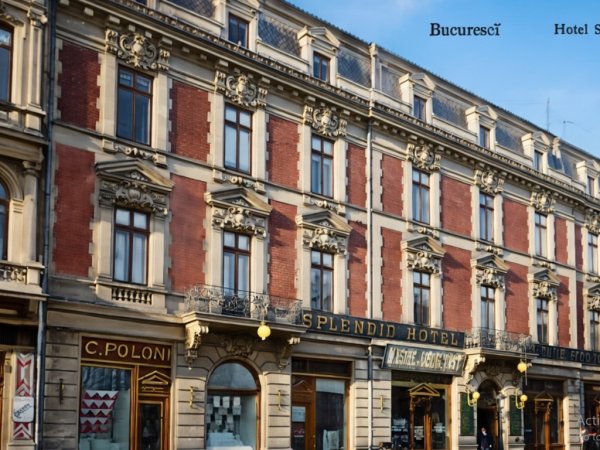
Today, Calea Victoriei is one of the best-known thoroughfares in Bucharest, but few of the buildings that Bucharest residents pass every day still preserve the image of the city of the past. Among the buildings that have disappeared forever is Hotel Splendid, one of the most important and elegant hotels of the Capital at the end of the 19th century and during the interwar period. Located in a privileged position, near the Royal Palace and the Romanian Athenaeum, the hotel eventually became, after the transformations of the 1920s, considered the largest hotel in Bucharest. Its history, however, is older than the interwar period. The building was erected in 1898 on the site of an older hotel, Hotel Orient, and before that, the same location was occupied by Hanul Piteșteanului. The evolution of this place actually tells the story of Bucharest's transformation from a city dominated by inns and traditional buildings into a modern capital, where luxurious hotels, elegant restaurants and representative buildings had become symbols of modernization.
From Hanul Piteșteanului to Hotel Splendid
Before Hotel Splendid came to dominate this section of Calea Victoriei, the land was occupied by Hanul Piteșteanului. For centuries, inns had been an essential element of Bucharest's urban life, offering accommodation to travelers, commercial spaces and meeting places for merchants. As the city modernized during the second half of the 19th century, however, the old type of inn began to be replaced by the Western-style hotel, adapted to an urban society undergoing profound transformation.
Hanul Piteșteanului was therefore modified and transformed into Hotel Orient, an intermediate stage in the evolution of the site. Toward the end of the 19th century, when Bucharest was consolidating its status as the capital of modern Romania, the old building no longer sufficiently met the new requirements. In 1898, Hotel Splendid was erected, in one of the most important locations in the city, on Calea Victoriei, near the Royal Palace.
The hotel's location was one of its main advantages. Calea Victoriei represented the principal artery of the Capital at the time, while the area around the Royal Palace, the Romanian Athenaeum and what would later become Palace Square concentrated institutions, shops, restaurants, hotels and representative buildings. Hotel Splendid was therefore not merely a place of accommodation, but part of the elegant urban landscape of Bucharest.
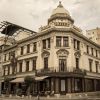
Over time, the building became one of the familiar images of Calea Victoriei. Period photographs show the hotel next to buildings that have since disappeared, in a Bucharest whose streetscape was very different from today's. In the same area stood Hotel Athénée Palace, Hotel High-Life and Hotel Imperial, each contributing to the cosmopolitan atmosphere of the center of the Capital.
The glory years of Bucharest's largest hotel
Hotel Splendid reached its true splendor during the interwar period. Between 1925 and 1927, the building underwent a major transformation, with its northern section being raised by additional floors. The intervention substantially changed the appearance and capacity of the complex, and the hotel became the largest hotel in Bucharest. In the following decade, Hotel Splendid continued to be presented in contemporary guides and publications as one of the Capital's principal hotels.
The hotel had approximately 250 rooms, equipped according to the modern standards of the time, while its size and location gave it a special status. For interwar Bucharest, such a hotel represented more than a simple accommodation building: it was a symbol of prosperity, international tourism and the Capital's aspiration to resemble the great European cities.
The hotel's architecture was associated with architect Arghir Culina, one of the important names of modern Bucharest architecture. Culina became particularly known for designing hotels and buildings influenced by Modernism and Art Deco. Hotel Splendid belonged to this stage in the transformation of the Capital's architecture, when old buildings were adapted or replaced in order to make room for taller and more functional structures.
The importance of the hotel can also be understood by comparing it with its great competitors. Athénée Palace stood nearby and represented one of Bucharest's most prestigious hotels. Splendid nevertheless managed, after its expansion during the 1920s, to occupy the leading position in terms of size and number of rooms. Its supremacy was lost only at the end of the 1930s, when Hotel Ambasador, inaugurated in 1939, opened with approximately 300 rooms.
Hotel Splendid was therefore, during its glory years, a landmark of Bucharest life. Because of its central location, size and standards, it stood at the heart of an urban world that would disappear brutally only a few years later. It is precisely this association between luxury, modernity and interwar Bucharest that makes its disappearance all the more remarkable.
The 1944 bombings definitively changed the hotel's fate
The end of Hotel Splendid is directly connected to one of the most dramatic periods in Bucharest's history. In 1944, the Capital was hit by devastating aerial bombardments. Important areas of the city were attacked, including Gara de Nord, the Cotroceni, Grivița and Ghencea neighborhoods, Calea Victoriei and the area around Băneasa railway station. In the center of the city, numerous buildings were severely damaged, and the hotels along Calea Victoriei were not spared.
Hotel Splendid was hit so severely that the building became practically beyond recovery. A particularly evocative testimony belongs to Academician Gheorghe Zane, who described Bucharest immediately after one of the air raids. His account conveys the image of a devastated city: Athénée Palace was burning, other buildings were smoking, while Hotel Splendid, farther up Calea Victoriei, was almost completely demolished. The sidewalks were covered with shards from destroyed shop windows, while collapsed buildings and traces of the explosions could be seen throughout the surrounding streets.
Period photographs confirm the scale of the destruction. Hotel Splendid appears severely damaged, while other buildings in the same area can also be seen affected. Athénée Palace was hit as well, but its structure could be repaired and it survived. In the case of Hotel Splendid, the situation was different: what remained of the building could no longer be restored to its original form.
This is also one of the explanations for the hotel's definitive disappearance. It was not simply a matter of an urban redevelopment decision made before the war, but the destruction of a building that had survived for decades and had been modernized and expanded less than two decades earlier. The war transformed one of Bucharest's most luxurious hotel buildings into a ruin.
The hotel disappeared, and the city around it changed
After the bombings, the ruins of Hotel Splendid remained for some time in the landscape of Calea Victoriei. The demolition of the remains took place in the years after the war, and during the following decades the area was profoundly reorganized. According to photographic documentation dedicated to old Bucharest, the complete demolition of the hotel took place in the years following 1944, with the land left vacant becoming part of an urban area undergoing transformation.
The disappearance of the building also had an important consequence for the route of Știrbei Vodă Street. After the reorganization of the area, the street was extended to Calea Victoriei, changing the urban configuration known by Bucharest residents during the interwar period. The square near the Romanian Athenaeum and the Royal Palace also acquired a different configuration, while the buildings that had survived the war became the new visual landmarks of the center of the Capital.
In this new landscape, Hotel Athénée Palace remained standing and became one of the buildings dominating the area. The irony of history is that the hotel which had once been one of Splendid's most important rivals survived, while Splendid remained only in photographs, plans and the memories of those who knew interwar Bucharest.
Moreover, the land cleared by the disappearance of the old buildings was incorporated into the urban planning projects of the communist regime. During the 1950s, Stalinist-style buildings appeared in this area, associated with the complex known as “Piața Palatului R.P.R.” Thus, the disappearance of Hotel Splendid did not merely mean the loss of one building, but also the gradual replacement of an entire urban image.
It is also important to clarify a frequent confusion: Hotel Splendid should not be confused with Hotel Splendid Parc. The latter was a separate building, located on the former route of Știrbei Vodă Street, at number 4, and was inaugurated in 1935. It was also associated with architect Arghir Culina and had an equally short existence, being destroyed in the 1944 bombings. The two hotels were located close to each other and were connected through ownership and through their architect, but they were separate buildings.
A luxurious building left only in photographs
The story of Hotel Splendid is ultimately the story of a Bucharest that almost completely disappeared within only a few decades. From Hanul Piteșteanului and Hotel Orient to the great 250-room hotel of the interwar period, the site went through all the stages of the Capital's modernization. Splendid witnessed the transformation of Calea Victoriei into an elegant thoroughfare, the development of tourism and the emergence of modern architecture.
Its destiny was abruptly interrupted in 1944. The bombings turned the building into a ruin, while its subsequent demolition almost completely erased the hotel's physical trace from the center of Bucharest. Period photographs remain today among the few pieces of evidence of its size and elegance. Images of Splendid before the bombings, with its imposing façade and busy Calea Victoriei, contrast dramatically with photographs taken after the attacks, in which the building appears devastated.
Hotel Splendid was therefore not forgotten because it gradually lost its customers or because it was abandoned in favor of another destination. It disappeared in a dramatic historical context, together with an important part of interwar Bucharest. The urban transformations that followed the war made even the site on which it had stood difficult to recognize today.
Seen from the perspective of present-day Bucharest, Hotel Splendid is one of those buildings that seem almost legendary precisely because they no longer exist. It was once one of the largest and most luxurious hotels in the Capital, competing with Athénée Palace and dominating this section of Calea Victoriei. It survived the changes of the early 20th century, was modernized and expanded to meet the demands of a European capital, but it could not survive the war.
Today, neither the monumental façade nor the luxurious rooms, restaurants and salons that made Splendid a landmark of interwar Bucharest remain. What survives are photographs, testimonies and its place in the urban history of the Capital. Its story demonstrates how quickly the face of a city can change and how fragile even a building that seemed destined to remain forever one of Bucharest's symbols can be in the face of major historical events.
We also recommend: Symbols of Bucharest: Hotel Ambasador, “born” in the interwar period, witness to crimes and passionate suicides