How The Damaris Inn Disappeared from Bucharest: From Hotel de France to AFI Central Tower
- Articles
- 28 SEP 26
There are places in Bucharest where history has not disappeared, but has simply been covered by the city that came after it. The plot of land at 15 Calea Victoriei is one of the most spectacular examples. Today, the eye is drawn to an office tower undergoing a major transformation, but beneath and around this building lie the traces of several eras of the capital: an old Bucharest inn, an elegant 19th-century hotel, a building affected by earthquakes and, later, the first major symbol of post-communist office architecture. The National Archaeological Record identifies here the site “Foundations of the Victoria Hotel (Hotel de France) in Bucharest”, at 15 Calea Victoriei, and explicitly mentions “Hanul Damaris” as an alternative name for the site. According to the same source, Hotel de France was built in 1881 on the site where the inn had previously stood, while archaeological research identified the foundations of Hanul Damaris in the inner courtyards of the former Victoria Hotel and in the immediately adjacent area. It is, practically, an address that can be read as a cross-section through the history of Bucharest. From the world of inns and trade to the current AFI Central Tower urban regeneration project, each generation built over what the previous one had left behind.
Hanul Damaris and the Bucharest of merchants
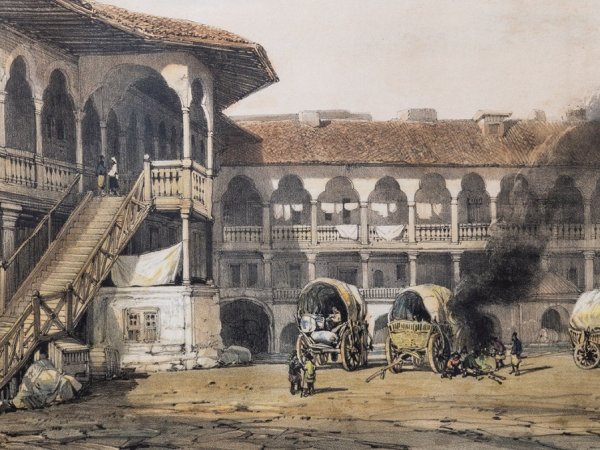
Hanul Damaris was part of a world in which inns represented much more than simple places of accommodation. In the Bucharest of the 18th and 19th centuries, such complexes housed rooms, shops, cellars, stables and spaces for storing goods. The Museum of the Municipality of Bucharest shows that inns were genuine commercial centres and that many of them bore the name of their owner or founder. Among the examples listed by the museum is also Hanul Damaris.
The story of Hanul Damaris is connected to the families and properties in this part of the city. According to historical information established in works about Bucharest's inns, the land had initially been associated with Maria Cantacuzino, and in 1793 it came into the possession of the Greek boyar Ion Damaris. After his death, the group of houses on the land was transformed into an inn, while the owner's name remained attached to the place. The inn operated during the first decades of the 19th century, in an extremely important area for the trade and movement of people in central Bucharest.
Its location also explains its importance. It stood on the old Podul Mogoșoaiei, today's Calea Victoriei, in an area close to the Dâmbovița River and to some of the city's major inns. The National Archaeological Record also confirms that archaeological research carried out in the 1990s revealed, beneath the present site, traces of the former riverbed of the Dâmbovița and a structure intended to reinforce the riverbank.
This discovery is one of the most interesting components of the story. The land at 15 Calea Victoriei does not conceal only the foundations of a vanished building, but also traces of the way in which Bucharest constantly changed its relationship with the Dâmbovița River. The city was built, expanded, levelled and rebuilt over its own layers.
From inn to Hotel de France
As Bucharest modernised during the 19th century, the old model of the inn was becoming increasingly unsuitable for the aspirations of a capital trying to adopt Western models. The Museum of the Municipality of Bucharest points out that, during the first part of the 19th century, merchants began to prefer modern buildings, with commercial spaces facing the street and more generous shop windows. Earthquakes, fires and urban transformations also contributed to the disappearance of many inns.
The Hanul Damaris plot also entered this new stage. Around 1850, the old establishment was transformed into a hotel known as “Otel de Franța”, and later the land received an entirely new building. In 1881, Hotel de France was erected, a building that would become one of the elegant landmarks of Calea Victoriei. The National Archaeological Record clearly establishes the construction date as 1881 and states that the hotel was built on the site of the former Hanul Damaris.
The hotel went through several names, including Hotel de France, Grand Hôtel de France, Hotel Lafayette and Hotel Victoria. The change of name also reflected the transformation of the area. Calea Victoriei was becoming the representative artery of a capital searching for a Western profile, while hotels, cafés, shops and restaurants contributed to the city's new image.
The 1881 building should not be confused with the inn that preceded it. Archaeology shows that the foundations of Hanul Damaris were located in the inner courtyards and near the former Victoria Hotel. In other words, the inn did not continue to exist as a visible building after the hotel was constructed, but some of its material traces remained underground.
Earthquakes and the disappearance of Hotel Victoria
The hotel passed through one of the most turbulent periods in the history of modern Bucharest. It survived the 1940 earthquake, but the earthquake of 4 March 1977 was to definitively change the fate of the building. AGERPRES includes Hotel Lafayette, Grand Hotel de France and Victoria, at 15 Calea Victoriei, among the buildings seriously affected by the 1977 earthquake.
The images and testimonies about Bucharest after the earthquake show the scale of the disaster that struck the centre of the capital. The hotel at number 15 could no longer be preserved, and its demolition followed in 1979. Thus ended almost a century of existence for the building erected in 1881 and, at the same time, one of the historic landmarks of Calea Victoriei disappeared.
The demolition did not, however, mean the complete disappearance of the site's history. On the contrary, what remained underground later became the subject of archaeological research. In 1994, the Museum of the Municipality of Bucharest carried out preventive archaeological research, and the results were included in the official documentation of the site. Foundations associated with Hanul Damaris were identified, along with elements of the former Dâmbovița riverbank structure.
It is one of Bucharest's architectural ironies: a building that has almost completely disappeared from the cityscape can continue to exist through documentation and archaeology beneath a much newer construction.
From vacant land to the Bancorex building
After the disappearance of Hotel Victoria, the plot entered another stage of its history. For a period, the site remained vacant, and the decisive change came after 1989, when Bucharest began to receive a new commercial and financial architecture.
On this site was built the building known as the Bancorex building, later becoming Bucharest Financial Plaza. Real-estate sources describe it as the first modern office building constructed in Bucharest during the 1990s. The building later also became known as myhive Victoriei. In 2021, the building was acquired by Immofinanz from BCR, and in August 2024 it was purchased by AFI Europe in a transaction estimated at approximately 27 million euros.
Thus, after the merchants' inn and the elegant hotel of Belle Époque Bucharest, the plot became a symbol of post-Revolution financial capitalism. Bancorex, one of the important financial institutions of the transition period, became associated with the building, and the property quickly became one of the architectural landmarks of the new business Bucharest.
The building's destiny continued to change along with the real-estate market. Bucharest Financial Plaza entered the Immofinanz portfolio and was later acquired by AFI Europe. For the new owner, the complete demolition and replacement of the tower was not the chosen solution. The plan is one of conversion and modernisation, preserving the tower while profoundly changing the configuration and functions of the complex.
AFI Central Tower, a new life for a historic address
In 2026, 15 Calea Victoriei is once again a construction site. AFI Europe has announced the transformation of the former Bucharest Financial Plaza into AFI Central Tower, an urban regeneration project combining office functions with commercial uses. The company states that the project will have approximately 29,400 square metres of leasable area, while the concept aims to obtain LEED Platinum certification.
In July 2026, AFI announced the appointment of BOG’ART as the general contractor for the conversion and modernisation works. According to the data published at that time, the project will provide approximately 28,100 square metres of leasable area, of which around 24,500 square metres will be dedicated to Class A offices and approximately 3,600 square metres to ground-floor commercial spaces. The concept includes restaurants, shops, a pharmacy and other services intended both for employees and the general public.
The transformation is all the more interesting because it does not involve completely erasing the 1990s construction. AFI is preserving the tower and integrating it into a new project adapted to current standards of efficiency, safety and sustainability. In this way, the Bancorex building does not simply disappear, but enters a new stage of its existence.
An address where Bucharest rebuilt itself several times
Few places in the capital illustrate so clearly the way the city constantly changes its appearance. At 15 Calea Victoriei, the memory of Hanul Damaris can no longer be seen by the ordinary passer-by. There is no longer a façade telling us that an inn once stood here, nor can the Hotel de France be admired today. Nevertheless, archaeological documents confirm that the remains of the inn are located at this site, while the research carried out in 1994 recovered precisely this lost part of the site's history.
That is why the story of the plot is more than a succession of buildings. It is the story of the way Bucharest evolved from a city of inns and merchants into the capital of the Belle Époque, then into a city of grand hotels, communist reconstruction and, finally, the financial and commercial centre of contemporary Romania.
Hanul Damaris disappeared long ago, but its site was never truly empty. Hotel de France was built over its foundations, the memory of the hotel was followed by the Bancorex building, and that building is now being transformed into AFI Central Tower. On the surface, Bucharest seems to constantly change its scenery. Underground, however, the old layers remain, turning 15 Calea Victoriei into one of the most spectacular “cross-sections” of the capital's urban history.
We also recommend: How Saint George Inn disappeared. The story of a lost symbol of old Bucharest