How the Antiquarians’ House in Bucharest, the Cultural Center on Duca’s Maidan, Disappeared in Just 20 Years
- Articles
- 08 JUN 26
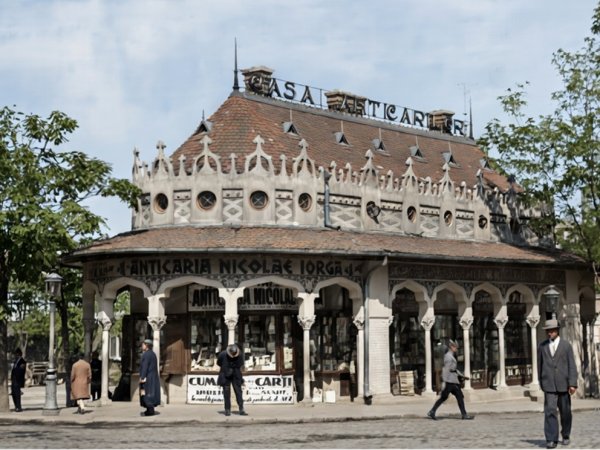
The history of Bucharest is full of vanished buildings that left behind more than simple gaps in the urban landscape. Some of them represented true cultural landmarks, places where entire communities were formed and where the city’s intellectual life unfolded naturally, far from the major official institutions. Among these places was the Antiquarians’ House, a building that existed for only two decades but managed to become one of the most important cultural centers of interwar Bucharest. Located near the CEC Palace, in an area that today looks completely different from its former appearance, the Antiquarians’ House was much more than a simple old-book market. It represented a meeting place for intellectuals, professors, students, and book lovers, becoming one of the most authentic expressions of Bucharest’s cultural life. Its disappearance, after only 20 years of existence, reflects one of the great losses of the Capital’s urban and intellectual heritage.
Bucharest’s antiquarians before the appearance of the pavilion
At the beginning of the 20th century, Bucharest’s antiquarians carried out their activities under modest conditions. The trade in old books was scattered throughout various corners of the city center, and booksellers and dealers in rare volumes were forced to move frequently from one place to another.
During a period when Bucharest was developing rapidly and seeking to strengthen its status as a European capital, the need for a permanent space dedicated to this activity became obvious. Generations of antiquarians had earned their living by selling rare books, manuscripts, and valuable editions, yet they did not have a building of their own that could provide stability and modern conditions.
The need for such a place was felt both by the merchants and by the city’s educated public. In a Bucharest where interest in culture and education was constantly growing, a house for antiquarians was becoming almost a necessity.
The birth of the Antiquarians’ House in 1924
The spring of 1924 marked the beginning of an ambitious project. The Antiquarians’ Association initiated the procedures for constructing a building dedicated exclusively to the trade in old books, at 2 Belvedere Square, in a central and highly frequented area.
The project was entrusted to architect Edmond van Saanen Algi, one of the important figures of Romanian architecture during the interwar period. Best known for his contribution to the construction of the Telephone Palace, the architect designed a modern and functional building for the antiquarians.
The new building offered facilities that seemed remarkable for that era. The shops benefited from electricity, water installations, and well-organized spaces for storing and displaying books. For the first time, Bucharest’s antiquarians had a permanent headquarters, adapted to their activity and capable of offering customers civilized conditions.
The importance of the building was so great that the entire surrounding square changed its name, becoming known as Antiquarians’ Square.
A cultural center in the heart of the Capital
The Antiquarians’ House was not merely a commercial building. It quickly became one of the most important meeting points for Bucharest’s intellectual elite.
At a time when access to information depended largely on printed books, antiquarian bookshops represented genuine centers of cultural discovery. Here one could find rare editions, volumes no longer available in bookstores, old publications, and books that were difficult to obtain elsewhere.
The atmosphere was different from that of a library or an academic institution. Visitors could browse the volumes freely, discuss with the booksellers, exchange opinions, and learn about new arrivals or valuable editions.
Books were not viewed as museum objects, but as living instruments of knowledge. It was precisely this sense of normality that made the Antiquarians’ House a special place, where culture circulated naturally and was integrated into the city’s everyday life.
The favorite place of great intellectuals
The prestige of the Antiquarians’ House grew rapidly, and in a short time it became a regular destination for numerous personalities of Romanian culture.
Each pavilion of the building bore the name of an important cultural figure, such as Dimitrie Cantemir or Nicolae Iorga, emphasizing the educational and symbolic role of the entire complex.
Nicolae Iorga was one of the square’s regular visitors. The historian often engaged in long conversations with the antiquarians and searched for rare volumes for his research. Among those who also frequented the area were literary critic Eugen Lovinescu, historian Constantin Moisil, and professor Tudor Vianu.
The presence of such personalities strengthened the place’s reputation and transformed the Antiquarians’ House into a landmark of Bucharest’s intellectual life.
A small building, but with enormous influence
From an architectural point of view, the Antiquarians’ House did not impress through monumental dimensions. It could not compete with the Capital’s great administrative palaces or representative buildings.
Its importance came instead from the function it fulfilled. It was part of what historians call a city’s informal cultural infrastructure—those spaces that do not always appear in tourist guides, yet without which intellectual life cannot exist.
Communities formed around the antiquarian bookshops, ideas were exchanged, and professional and cultural relationships were built. For numerous researchers, professors, and students, the Antiquarians’ House was an essential resource.
In a Bucharest that was building its prestige through universities, academies, and public institutions, this discreet pavilion added an extra dimension: culture experienced directly within the urban space.
The beginning of the end
The fate of the Antiquarians’ House was, however, surprisingly short. In 1943, after only two decades of existence, the antiquarians were evicted, and the pavilion disappeared.
The departure of the booksellers meant the loss of a place that had already become part of the city’s cultural identity. With the disappearance of the building, Bucharest lost not only a physical space but also a particular way of consuming and transmitting culture.
The historical events that followed made the rebirth of such a project impossible. The end of the Second World War and the establishment of the communist regime radically changed the rules governing trade and the circulation of books.
The severe censorship introduced by the new regime directly affected the antiquarians’ activity. Shops, warehouses, and private collections were subjected to strict inspections, and after the process of nationalization, the book trade came under state control.
What remains today of the Antiquarians’ House
The urban transformations of the following decades profoundly altered the area where Antiquarians’ Square once stood. Demolitions, reconstructions, and changes in use erased almost all traces of the old complex.
On the site where the antiquarians’ cultural center once existed, modern buildings were erected, and the atmosphere of the past disappeared forever. Today there are no longer any walls, shops, or visible clues that recall that place.
Nevertheless, the Antiquarians’ House continues to exist in Bucharest’s urban memory. Its story speaks of a period when culture was not limited to academic halls or major libraries but was part of the city’s everyday life.
Its disappearance is symbolic of the transformations through which the Capital passed during the 20th century. Bucharest did not lose merely a building. It lost one of its most refined and vibrant spaces, a place where books, ideas, and people met naturally, contributing to the city’s cultural identity.
Today, the memory of the Antiquarians’ House remains one of the most evocative images of a vanished Bucharest, where the passion for books occupied a central place in community life.
We also recommend: Symbols of Bucharest: The Cartea Românească Bookstore, the Favorite Place of Interwar Intellectuals