How much apartments in Bucharest cost in May 2026. Prices, conditions, units for sale
By Raluca Ogaru
- Articles
- 29 JUN 26
The apartment market in Bucharest continued to become more expensive in May 2026, while the difference between new and old homes remains one of the capital’s most important particularities. While in other major cities prices for new and old apartments are close, Bucharest still shows a visible gap: old apartments often end up being, on average, more expensive than new ones, especially because many of them are located in already established areas, with better access to the metro, schools, parks, markets and services.
According to Storia’s analysis for May 2026, the average asking price for new apartments in Bucharest reached €2,015/sqm. This level is 9% higher than in May 2025 and 1% above April 2026. In the case of old apartments, the average asking price was €2,535/sqm, 14% higher than in the same month last year and 2% above the previous month.
How much a studio, a two-room apartment and a three-room apartment cost
Based on the minimum legal floor areas, a studio in a new building in Bucharest cost around €74,568 in May 2026. A studio in an old building reached approximately €93,795. The difference is significant and shows how much location weighs in the final price, especially in neighbourhoods where older blocks are close to the metro, shopping centres, markets or office areas.
For a two-room apartment, the average price was around €104,799 in new buildings and €131,820 in old buildings. In the case of three-room apartments, the difference becomes even more visible: €133,014 for a new home and €167,310 for an old one.
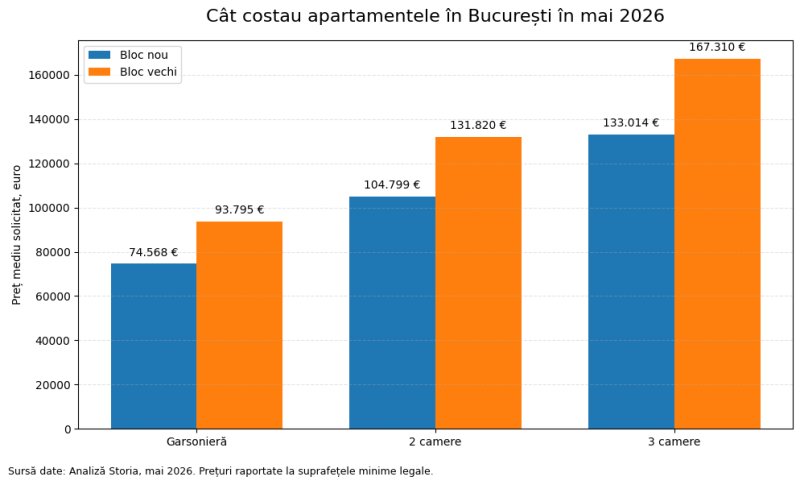
These values should be read as average asking prices, not final transaction prices. In other words, they show what sellers ask for in listings, not necessarily what is actually paid at the notary. In a market where demand remains high, but financing costs and buyers’ incomes put pressure on budgets, the difference between the asking price and the final price can depend greatly on the area, the age of the building, the floor, the condition of the apartment, the parking space and how quickly the owner wants to sell.
Why old apartments are more expensive than new ones in Bucharest
At first glance, it may seem surprising that an old apartment is more expensive than a new one. In Bucharest, however, the explanation is largely linked to location. Many old apartment blocks are in mature neighbourhoods, with infrastructure already in place: metro, tram, buses, schools, kindergartens, hospitals, parks, markets, shops and faster access to the centre. For a buyer who wants to move in immediately and not depend on future developments, these advantages may matter more than the year of construction.
In the new-build segment, the offer is more varied, but many projects are located in developing areas, on the outskirts of the city or near the border with Ilfov. The price per square metre may be lower, but the buyer also needs to calculate other costs: daily transport, parking spaces that may not be included, distance to the metro, time spent in traffic, furnishing costs and, sometimes, VAT displayed separately in listings.
New apartments can also have smaller usable areas for the same number of rooms, different layouts or open-space kitchens, which makes the comparison more complicated. An old two-room apartment located near the metro and with a more generous surface area can end up costing more than a new home in an area where infrastructure is still developing.
This difference explains why, in Bucharest, buyers do not look only at “new” or “old”, but at the entire package: area, access, additional costs, seismic risk, installations, insulation, parking space, surroundings and resale potential.
What the Imobiliare.ro index shows about prices in the capital
Another important source for reading the market is the Imobiliare.ro Index. For May 2026, it indicates an average price of €2,295/sqm for apartments listed for sale in Bucharest. This value is 0.7% above April 2026 and 12.8% higher than in May 2025.
For new apartments, the Imobiliare.ro Index shows an average price of €2,637/sqm, up 0.2% from the previous month and 24.4% compared with May 2025. For old apartments, the index indicates €2,247/sqm, 0.7% above April and 11.3% higher than one year earlier.
The differences between Storia and Imobiliare.ro data should not be read as a direct contradiction, but as the result of different methodologies, different listing databases and different calculation methods. For readers, the important information is the common trend: in May 2026, apartments in Bucharest were more expensive than one year earlier, and the pace of growth remained visible.
In a large and highly fragmented real estate market, the city average does not tell the whole story. An apartment in Sector 1 or in a premium area can have a completely different price from one in a neighbourhood on the edge of the capital. That is why general figures are useful as a benchmark, but the buying decision must be made by neighbourhood, building, street and concrete conditions.
Where the most expensive and most affordable new apartments are
According to Imobiliare.ro data, the most expensive new apartments in Bucharest are found in Sector 1, where the average asking price reaches €4,326/sqm of usable area. Sector 2 comes second, with €4,062/sqm. These values reflect demand for the northern and north-eastern areas of the capital, proximity to parks, private schools, office areas, restaurants and premium neighbourhoods.
At the opposite end, the most affordable new apartments are in Sector 4, where the average asking price is €2,374/sqm of usable area. In recent years, Sector 4 has become one of the active areas for new residential projects, including due to infrastructure expansion and better access to the southern part of the city.
For buyers, the differences between sectors show that the budget must be carefully linked to the area. The same number of rooms can mean a premium home in the north, a new apartment in a developing residential complex or an old apartment in a well-connected neighbourhood. The price per square metre is only the first stage of the comparison.
What you receive for that price also matters: finishes, parking, storage space, proximity to public transport, year of construction, energy efficiency, maintenance costs, surroundings and the possibility of reselling easily in a few years.
How many apartments were listed and how many properties were sold
On the supply side, Imobiliare.ro displayed, at the time of consultation, more than 27,000 apartment listings for sale in Bucharest. This is a large volume of supply, but not all listings are comparable. Some properties are in new buildings, others in old buildings, some have VAT listed separately, others include or exclude parking, while prices can vary strongly depending on surface area and location.
On the transaction side, data cited by Imobiliare.ro, based on information from ANCPI, shows that around 9,600 properties were sold in Bucharest in May 2026. The highest number of transactions was recorded in Sector 1, with 3,144 properties sold, followed by Sector 3, with 2,112, and Sector 2, with 1,627.
Sector 6 recorded 1,168 properties sold, Sector 4 had 991, while Sector 5 had the fewest transactions, 577. It is important to note that these figures refer to properties in a broad sense, meaning they may include apartments, houses and land, not exclusively apartments.
Even so, the distribution shows where the market pace was most intense during that month. The fact that Sector 1 leads in the number of properties sold is relevant in a context in which the same sector also has the highest prices for new homes. The capital therefore remains a market where demand persists even in expensive areas, but where buyers are becoming increasingly attentive to the total cost of acquisition.
What a buyer should check before making an offer
In a rising market, buyers may be tempted to rush, especially when an apartment seems well located or when the agent suggests that there are several interested buyers. Even so, before making an offer, several checks remain essential: ownership documents, the property’s history, year of construction, seismic risk classification where applicable, cadastral status, possible maintenance debts and how the usable area is listed.
For new homes, the buyer should pay attention to whether the displayed price includes or excludes VAT, the stage of the project, the delivery deadline, the building permit, final acceptance, the parking space and additional costs. Sometimes, the apparently better price of a new apartment can increase after adding parking, VAT or finishes.
For old homes, the checks are different: installations, structure, elevator, thermal rehabilitation, neighbours, homeowners’ association, maintenance costs, possible interior modifications and access to transport. An expensive old apartment can be a good choice if it has an excellent location and is in a solid building, but it can become a difficult investment if it requires major renovations or has technical problems.
In Bucharest, buying conditions are not limited to price. A good home is, in fact, the combination of budget, location, future costs and how well it responds to the buyer’s real needs.
What the market looked like at the end of May 2026
At the end of May 2026, the picture of Bucharest’s residential market was clear: prices continued to rise, the differences between new and old homes remained large, and well-connected areas and premium sectors continued to put pressure on budgets. For first-time buyers, price thresholds are becoming increasingly difficult to support without substantial savings or carefully calculated financing.
For investors, Bucharest remains an active market, but not a uniform one. The return on a purchase depends increasingly on the choice of area, the type of home and rental potential. An apartment bought at a high price in a good area may remain liquid, but the profit margin must be calculated realistically.
For sellers, the moment is favourable, but not every asking price automatically becomes an accepted price. Buyers compare more, negotiate more carefully and look at total costs. In a city where differences between neighbourhoods are huge, the correct price is not set only by the average, but by the reality of each property.
Bucharest remains the largest and most complex residential market in Romania. In May 2026, the figures confirmed the same direction: homes became more expensive, supply is large, but affordability is becoming increasingly important. For anyone who wants to buy, the key is not only to find the right apartment, but to understand exactly what they are paying for and why.