He lost his mind because of poverty and died alone in an asylum. Poet Dimitrie Bolintineanu has a street bearing his name in the center of Bucharest”
- Articles
- 10 DEC 25
Poet, revolutionary, and political figure Dimitrie Bolintineanu experienced a tragic end that contrasts deeply with the cultural legacy he left behind. He lost his mind because of poverty and died alone in an asylum in Bucharest, far from the world of literature that once celebrated him. His life had been marked by honesty and dignity, yet these virtues brought him no material benefit, on the contrary, they pushed him toward marginalization and suffering.
The tragic end of a poet who lived with dignity
Born in 1819 in Bolintinu din Vale as Dimitrie Cosmad, he chose later in life to adopt the name of his native village, thus becoming known as Dimitrie Bolintineanu. His father, Enache Cosmad, was an Aromanian from Ohrid, a merchant, leaseholder, and modest clerk without wealth.
At the age of ten, young Bolintineanu was sent to Bucharest, where he attended the Colțea school. Orphaned early, he was raised by an aunt who supported him through his formative years. After finishing primary school, he continued his studies at the “Sf. Sava” High School. At only twenty-two, he became a clerk, taking the position of copyist at the Secretariat of State.
A life shaped by love, loss, and exile
At the age of twenty-two, he also experienced a devastating love story that marked him for life. He fell in love with a young woman of nineteen who was ill, and he witnessed her die before his eyes. The pain of this loss drove him to write the elegy “A young woman on her deathbed,” a poem that was published in the newspapers of the time and made a remarkable impression on both literary circles and the general public.
In 1843 he was elected a member of the “Literary Association of Romania” and received a scholarship to study at the Collège de France in Paris. His first book, “Collection of the poems of Mr. D. Bolintineanu,” appeared in 1847.
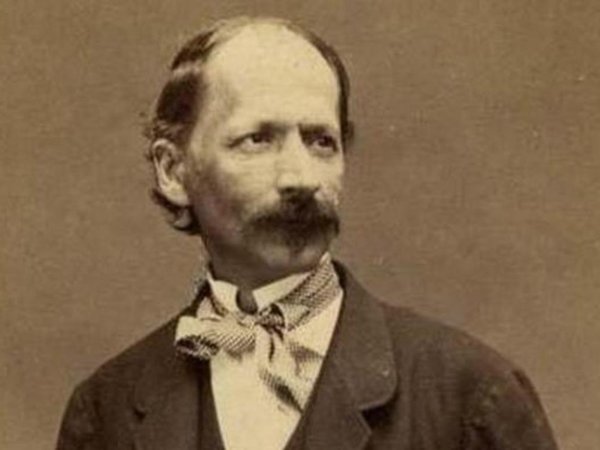
Nicolae Petrașcu described him in his book “Dimitrie Bolintineanu” as follows: “Tall and slender in stature, with dark hair and face, with a broad and meditative forehead that gave his appearance a masculine and poetic character at the same time, with his rare smile springing from a deep kindness of soul that softened his usually sad expression, Bolintineanu was an interesting and sympathetic young man.”
He returned to the country when the 1848 Revolution broke out. After the movement was crushed, he was arrested along with other compatriots who had fought for the homeland. He managed to escape and fled into exile in Paris. From exile, filled with longing for the land he was forbidden to return to, Bolintineanu wrote:
“Exiled for many years from my homeland, with what sadness and with what pleasure I looked at the shores of my native country. With sadness, for I was forbidden to set foot on this land, always prey to its enemies and to its unworthy sons; with pleasure, for whatever the causes that separate me from these places, however sad and monotonous the days in this country may be, and however beautiful life abroad may have been, one does not easily forget the place where our eyes first saw the sun.”
In 1852 he left Paris and traveled to the Gates of the Orient. In 1855 he published the novel “Manoil,” considered the first work of its kind in Romanian literature. In 1857, after the general amnesty, Bolintineanu returned to the country and entered politics. He served successively as Secretary of State at the Department of Foreign Affairs, Minister of Religious Affairs in the Kogălniceanu government, and member of the Council of State. Despite his political career and access to influential figures of the era, Bolintineanu remained a modest man.
“ He lived in a single room in the Bosel house in front of the theater. Having almost no one around him, increasingly bored and saddened by what was happening around him. His meditative, book-loving temperament did not match a political career. He had received the honor of being a minister, but he always said that he was not made for such things,” writes N. Petrașcu in his biography of Bolintineanu.
Decline, illness, and the loneliness of the final years
After the coup of May 2, 1864, Bolintineanu, who had adopted an opposing stance, was forced to resign from the ministry. He later served for a time as secretary in the Council of State, but once the position was abolished, he was left without any income. By the age of fifty, he survived on a miserable pension.
“The poet was dressed in a long, old black frock coat. He invited me to sit before him and gave me advice for the future: to study a lot, to read only great writers with deep attention, and to stay away from the plague of imitation. To avoid politics and preserve the honor of my face, he added, shuddering as if from a chill, for honesty, look where it brings you… And with his left hand twisting the right sleeve of his frock coat, he showed me the elbow worn to the lining,” recalls N. Petrașcu, quoting a contemporary who met Bolintineanu during these years of hardship.
Poverty made him ill and pushed him to the brink of madness. In April 1871 he was admitted to the Pantelimon Asylum. In the patient registry he was recorded as: “Dimitrie Bolintineanu, former Minister of Religious Affairs, admitted without clothes.”
Drowned in debt, Bolintineanu was executed financially, and his belongings were put up for auction. His colleagues from the literary world tried to help by publishing appeals in the press:
“Poet Bolintineanu has fallen into such weakness of body and mind that his friends—not he—feel obliged to appeal to all those whom his verses and prose once delighted, to all who admired his talent and capacity. We appeal to all sensitive Romanians to hurry and participate in the lottery in which Bolintineanu’s furniture and library have been placed,” wrote “Trompeta Carpaților” on April 4, 1871.
The money raised from the sale of his belongings was insufficient to pay his debts. His friends appealed to the Chamber of Deputies for financial aid.
“The Chamber refused him. A deputy from the majority even confessed aloud the indifference of this country: ‘What can we do? …’” recounts N. Petrașcu in his book “Dimitrie Bolintineanu.”
A humiliating fate even after death
Dimitrie Bolintineanu died on the morning of August 20, 1872, at the Pantelimon Hospital. He was buried in the soil of his native village, Bolintin Vale. Even after death, humiliation and misery continued to follow him. His remains were exhumed to be placed beneath his bust a few years later.
Until the pedestal was ready, his bones lay forgotten in the church attic, among tools and rodents, waiting for the inauguration of his statue. Dimitrie Bolintineanu Street is located in Sector 3 of the Capital, in the center of Bucharest, near Colțea Hospital.
We also recommend: The story of the artist Ilinca Cerbacev, descendant of Dimitrie Bolintineanu. She gave up skiing to dedicate herself to music