He discovered Alecsandri and educated generations of students in Bucharest. The exploits of Petre Dulfu, the father of Păcală
- Articles
- 15 APR 26
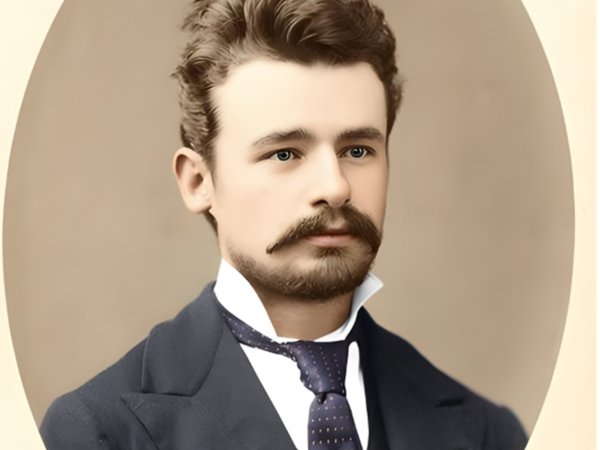
Petre Dulfu was, without a doubt, one of the most widely read Romanian authors at the end of the 19th century and the beginning of the 20th century. His books circulated extensively, were present in school textbooks, in popular libraries, and in the homes of ordinary people. Entire generations grew up reading his stories, and his characters entered deeply into the collective imagination. However, paradoxically, the author’s name has today become almost unknown to the general public.
An extremely widely read author, but almost forgotten
Petre Dulfu’s writings were not intended only for elitist literary circles, but for a broad audience: students, teachers, ordinary people from rural or urban environments who did not necessarily have access to “high” literature, but needed stories, models, and explanations. Precisely this accessibility made his work extremely widespread. He managed to create a bridge between popular culture and written literature, offering texts that were easy to understand, yet rich in moral and educational content.
Today, however, the situation is different. His texts continue to be read, especially in the area of children’s literature, but the author has gradually been pushed into the shadows. His characters are still alive – Păcală is an emblematic example – yet the name of Petre Dulfu appears less and less often in discussions about Romanian literature. It is a typical case of an author who was popular in his time, but insufficiently recovered in contemporary cultural memory.
Childhood in Maramureș and the beginnings of education
Petre Dulfu was born in March 1856, in the village of Tohat in Maramureș, into a family of well-off peasants with strong ties to the church environment. His father was a respected household head, and his mother came from a family of priests, which created a favorable framework for education from the very first years of his life.
His intelligence was noticed early on, as was his shy nature, which would characterize him throughout his life. His first lessons were given by his maternal uncle, Grigore Bran, a teacher in the village, who insisted that the boy be sent further to school in order to make the most of his potential. Thus began his educational path, at a time when access to schooling was not at all guaranteed for children from rural areas.
Arriving in Baia Mare, Dulfu attended primary and secondary school in a Hungarian-language education system, typical of Transylvania at that time. At the same time, however, he began to actively seek contact with the Romanian language, which he discovered through readings outside of school. This personal search became essential for his cultural formation.
The decisive moment came with his entry into a reading society of Romanian students. Its library was modest, but sufficient to open new horizons for him. Here he systematically discovered Romanian literature and began to participate actively: he read, recited, translated, and presented his own texts. In this context, he discovered Vasile Alecsandri, the author who would decisively influence his path.
Discovering Alecsandri and intellectual formation
Reading the volume “Doine și lăcrămioare” by Vasile Alecsandri had a profound impact on the young Dulfu. This literary encounter was the moment when his passion for writing gained a clear direction. Literature was no longer just an attraction, but was becoming a possible path in life.
His activity within the reading society intensified: he was elected to internal positions, participated constantly in meetings, and became one of the most involved members. There he shaped his literary voice and began to gain confidence in his own abilities.
His educational path continued in Cluj-Napoca, where he attended high school and then the Faculty of Letters and Philosophy. Here he entered a rigorous academic environment that offered him a solid intellectual formation. He was noticed by professor Grigore Silași, who supported his development and recognized his talent.
The relationship between the two became an important one: Silași came to send some of Dulfu’s texts even to Vasile Alecsandri. The favorable response of the latter represented an essential validation for the young writer. From that moment on, literature became a clear and assumed direction.
During his student years, Dulfu began publishing in magazines such as “Familia” or “Amicul Familiei,” gradually building a literary profile. He wrote poetry, speeches, and texts addressed to a broad audience, actively participating in the cultural life of the university environment.
Doctorate and the choice of Bucharest
A defining moment in his intellectual path took place in 1881, when he defended his doctorate in philosophy, with a work dedicated to Vasile Alecsandri. The choice of topic was not accidental: the author who had inspired him in adolescence now became the subject of academic study, marking a continuity between personal passion and intellectual construction.
After completing his studies in Cluj-Napoca, Petre Dulfu decided to leave Transylvania and settle in Bucharest. The move had a deep significance for him, being perceived as a transition from a space dominated by cultural restrictions to one in which the Romanian language and culture could be freely expressed.
For a person with a reserved nature, this change was a difficult one. He arrived in a large city, without support and without connections, but determined to build his own path. His choice was motivated by the desire to write and to contribute to Romanian culture in a favorable environment.
Teaching career and influence in education
Once in the capital, Petre Dulfu quickly entered the education system. He was appointed professor of pedagogy at the “Carol I” Normal School, at the recommendation of V.A. Urechia. Here he began to train future teachers, contributing directly to shaping the educational system.
Later, he was sent to Turnu Severin, where he became director of the Normal School. After its dissolution, he returned to Bucharest and taught at the “Elena Doamna” Asylum and at the Normal School of the Society for the Education of the Romanian People. His teaching activity became central to his entire career.
At the same time, he came into contact with important personalities of Romanian culture, such as Ioan Slavici, Mihai Eminescu, Bogdan Petriceicu Hasdeu, Alexandru Vlahuță, or Barbu Ștefănescu Delavrancea.
For Dulfu, education was not just a profession, but a mission. He saw school as a fundamental instrument for transforming society. In his speeches, he constantly emphasized the idea that the future of a nation depends on the level of education of its citizens.
Literature inspired by folklore and the success of Păcală
Alongside his teaching activity, Petre Dulfu developed a substantial literary work, largely inspired by folklore. He did not invent entirely new worlds, but took existing stories, anecdotes, and legends, which he reorganized and adapted for a broad audience.
His most well-known work is “The Exploits of Păcală,” published in 1894. It brings together disparate episodes from folklore into a coherent narrative, with a central character that is easy to recognize. Păcală thus becomes a symbol of popular intelligence and Romanian humor.
Other important works include “Gruia, son of Novac,” “The Story of Făt-Frumos,” “Ion the Poor,” or “The Fairy of Flowers.” All these texts are based on folkloric material, but are presented in an accessible form, suitable for readers of all ages.
Dulfu’s literature functions as a bridge between oral tradition and written culture. He manages to transform popular stories into stable texts, easy to read and to pass on further.
The spread of books and success in his time
At the end of the 19th century and the beginning of the 20th century, Petre Dulfu was omnipresent in Romanian cultural life. His books appeared in numerous editions and reached schools, libraries, and rural communities.
An important role in this spread was played by ASTRA, a cultural association that distributed books in Romanian communities in Transylvania. Through this network, Dulfu’s writings reached people who otherwise would not have had access to literature.
“The Exploits of Păcală” enjoyed particular success, reaching 23 editions in approximately 70 years. The book was read by entire generations, and the character became more famous than its author.
This difference is significant: Dulfu was not an author intensely analyzed in academic environments, but one widely read. His popularity came from accessibility and from his ability to reach the public directly.
Withdrawal from public memory and cultural legacy
Over time, however, the name of Petre Dulfu began to fade. Changes in the literary world and in the way books circulated led to a decrease in his visibility. After the period of great success, fewer and fewer new editions appeared, and his works remained mainly in the area of children’s literature.
Today, the circulation of literature largely depends on publishing houses, bookstores, and promotion, and authors like Petre Dulfu no longer easily enter this circuit. The lack of reprints and constant presence in school curricula has contributed to this withdrawal.
Nevertheless, his legacy has not disappeared. The stories continue to be read, and his characters live on in the collective imagination. Petre Dulfu remains present through his work, even if his name is no longer as well known.
Thus, his literary destiny is a paradoxical one: an author extremely popular in his time, who profoundly influenced Romanian education and culture, but who was gradually forgotten as a name. Even so, through Păcală and his other creations, Petre Dulfu continues to exist in Romania’s cultural memory.
We also recommend: Elena Farago, the brilliant poet of children and protégé of I.L. Caragiale, has a street bearing her name in Bucharest