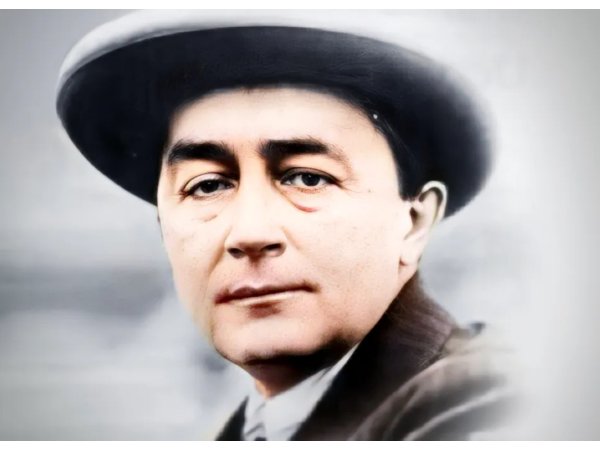
George Constantinescu, the Romanian inventor who created the theory of sonicity, has a street named after him in Bucharest
- Articles
- 18 MAR 26
The history of Romanian science hides remarkable figures whose influence went far beyond the country’s borders. Among them is George (Gogu) Constantinescu, one of the most original engineers of the 20th century, the creator of a revolutionary theory — sonicity. Although his name is better known in international technical circles than among the general public in Romania, his contributions changed the way energy can be transmitted and used.
From construction engineer to visionary researcher
Born on October 4, 1881, in Craiova, Constantinescu showed exceptional intelligence and extraordinary technical curiosity from an early age. His destiny would take him from the great Romanian construction sites of the early 20th century to research laboratories in London, where he would create one of the boldest theories in modern mechanics.
In 1904, George Constantinescu graduated as the top student of the prestigious National School of Bridges and Roads, one of the most important technical schools of the time. In the following years, he specialized in reinforced concrete, then in its early stages, contributing both to its theoretical development and practical application in construction.
Among his projects in Romania was the construction of the concrete vault of the former Chamber of Deputies building on Mitropolia Hill, a work that already demonstrated his ability to combine mathematical rigor with innovative engineering solutions. However, his ambitions went beyond civil constructions. Constantinescu was drawn to fundamental problems of physics and mechanics, seeking new principles that would allow the efficient transmission of energy.
Wanting to expand his research and work in a more advanced scientific environment, he decided to settle in Great Britain. This move marked the beginning of his most creative period.
The birth of the theory of sonicity
In 1918, George Constantinescu published the fundamental work The Theory of Sonics. A Treatise on Transmission of Power by Vibrations, in which he introduced a new branch of continuous media mechanics: sonicity. This theory studies the transmission of mechanical energy through vibrations in fluid or solid media, using pressure waves similar to sound waves.
The concept was revolutionary. Instead of classic mechanical transmissions — shafts, gears, or belts — Constantinescu proposed using controlled vibrations to transport power from a source to a receiver. Practically, energy could “flow” through liquids or elastic materials without direct mechanical contact.
Based on this theory, the Romanian scientist developed an entire family of new disciplines: electrosonicity, hydrosonicity, sonostereosonicity, and thermosonicity. Through these branches, he demonstrated that the principles of sonicity could be applied in various fields, from electrotechnics to thermodynamics.
Inventions that changed modern technology
George Constantinescu did not stop at theory. A practical-minded inventor, he designed numerous devices based on the principles of sonicity. These include sonic motors and pumps, sonic hammers and perforators, sonic injectors, sonic energy generators, and various systems for transmission without classic mechanical contact.
One of his most important achievements was the device known as G.C. Gear (Constantinesco Fire Control Gear). This allowed an aircraft machine gun to fire through the disc formed by the propeller blades, regardless of the engine’s rotation speed, without striking the propeller. The invention played a crucial role in military aviation during World War I and was used by British aircraft.
Impressed by the value of his research, the British government built him in 1918 a large laboratory in West Drayton, known as the Sonic Works. There, Constantinescu could develop industrial applications of his theory and collaborate with numerous engineers and researchers.
Another remarkable invention was the torque converter. By applying this system to an automobile, the Romanian scientist created in May 1923 the first vehicle with an automatic transmission in the world — long before this technology became standard in the automotive industry.
Research in later years and scientific legacy
In the last part of his life, George Constantinescu focused on fundamental energy problems. He studied the conversion of electrical energy into sonic energy, the transformation of mechanical energy into thermal energy, and the use of ultrasound in practical applications. These researches anticipated technologies that would be developed only decades later.
His scientific activity was recognized internationally, yet in Romania his name remained undervalued for a long time. Today, however, Constantinescu is considered one of the great inventors of the 20th century and a pioneer of technologies based on vibrations and pressure waves.
The scientist passed away on December 11, 1965, in London, far from his homeland, leaving behind an impressive technical legacy. His ideas continue to inspire research in fields such as applied acoustics, mechanical engineering, and energy technologies.
George Constantinescu Street in Bucharest
To honor his exceptional contributions, George Constantinescu’s name was given to a street in Bucharest. It is located in Sector 1, in the Aviation district, a modern and dynamic area of the capital, close to important business centers and aeronautical infrastructure — a symbolic detail for an inventor linked to aviation history.
Today, George Constantinescu Street is an active urban artery integrated into a neighborhood that reflects technological progress and the contemporary development of the city, quietly perpetuating the memory of a Romanian genius who changed the world with his ideas.
We also recommend: Dem. I. Dobrescu, the mayor who transformed the Capital into the Little Paris, has a street named after him in Bucharest