From the Ciclop Garage to the Parking App: The Story of Paid Parking in Bucharest
- Articles
- 16 SEP 26
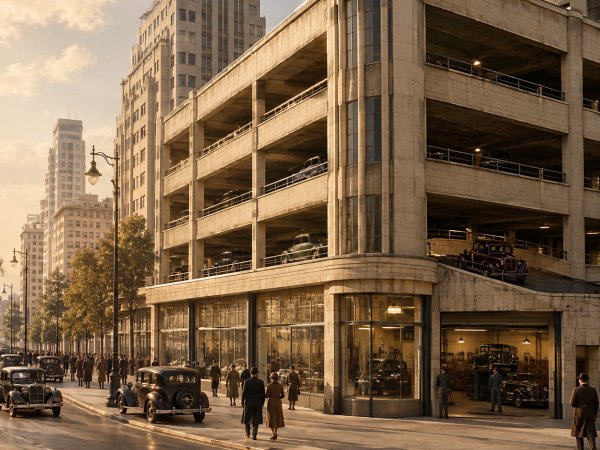
Magheru Boulevard was home, from 1930 onward, to one of interwar Bucharest's landmark buildings: the Ciclop garage, built on land that had belonged to industrialist Dumitru Marinescu Bragadiru, who died back in 1915. His heirs leased the land only in 1928 to a company set up specifically for the project. The building opened in April 1930, after a little over two years of construction, and combined parking spaces with an auto repair shop, retail space, and offices. Trade press often describes it as Romania's first multi-story parking garage, though the claim circulates mostly in journalistic accounts rather than being confirmed by any heritage institution directly. There's no institutional link between this private garage and today's street parking system, but it remains a symbolic precedent for a city that, even in the interwar years, was trying to keep pace with the West.
Decades of Attendants and Fragmented Administration
The modern system of paid street parking took shape far more slowly than the Ciclop garage, and without an easy date to pin on a calendar. The details of its administration before the 2010s are hard to reconstruct from public sources, but payment was made, at least until fairly recently, directly to a uniformed attendant who walked among the cars and handed out a ticket on the spot. On this front, Bucharest lagged years behind provincial cities, where automated parking meters had already become routine.
In 2017, through city council decision no. 97, Bucharest's city hall set up the Bucharest Municipal Parking Company, with the goal of centralizing management of the city's public parking. In 2019, the General Council reapproved the delegation of management to this company for 234 public parking lots and announced an investment of over 12 million euros, nearly half of which was earmarked for 300 solar-powered parking meters that would accept cards, coins, and banknotes. The announcement sounded promising, but the equipment stayed on paper for a long time.
The "Parking Revolution" and the First Real Meters
Real change came only in 2022, under mayor Nicușor Dan and deputy mayor Stelian Bujduveanu, through a program they called, quite literally, the "parking revolution." Sidewalks around city hall, occupied by cars for years, were cleared, and the spaces along the roadway were converted into paid parking, marked with blue lines painted over the old white ones. The tender for the city's first automated parking meters was launched in the fall of 2022, and the machines became operational in the early months of 2023, alongside video cameras mounted on specially equipped cars, capable of scanning license plates and catching drivers who hadn't paid.
Starting August 15, 2022, non-payment became punishable with a fine of 200 lei per day, and the car could be immobilized until the debt was settled. A year later, on March 1, 2023, the city moved to a unified tariff system with three zones based on proximity to the center: Zone 0 covers University Square, Romană Square, Unirii Square, and the Old Town, while Zones 1 and 2 extend toward the outskirts.
What the System Looks Like in 2026
Today, Bucharest has more than 300 parking meters, where you can pay by bank card with no surcharge, by phone via NFC, by smartwatch, or by QR code. The Parking București, AmParcat, and Qport apps allow advance payment, locating free spots on a map, and buying daily or monthly passes, while SMS payment is still available, updated as of November 2024 to the short code 7576. Fines for non-payment can be paid directly through the app, at a meter, or through the Ghișeul.ro platform, an option introduced in February 2024.
Free parking for electric and hybrid vehicles registered in Bucharest has existed since December 2022, under a General Council decision. Since 2025, though, it requires annual re-registration of the vehicle in the company's registry, after the city hall initially planned to limit the free-parking benefit for hybrids to the end of 2024 and later reversed that decision. At the district level, digitalization has gone further still: Sector 1 is currently testing IoT sensors that show real-time space availability, with plans to eventually integrate the system with STB (Bucharest's public transit operator) and the national eRomânia platform.
Old habits persist in some corners, of course. Cash is still accepted by attendants present at some lots, and street parking in residential neighborhoods on the outskirts largely remains free. The distance between the attendant with a ticket book and the sensor that pings your phone about an open spot looks vast at first glance, and the road to get there took considerably longer than it should have, with years of promises left on paper between announcement and actual implementation.
Also recommended Residential Parking, by Sectors, in Bucharest 2026: Steps, Documents, Costs, Common Mistakes