Famous names of boulevard: The great poet George Coșbuc lost his will to live after his son Alexandru died
- Articles
- 02 MAR 26
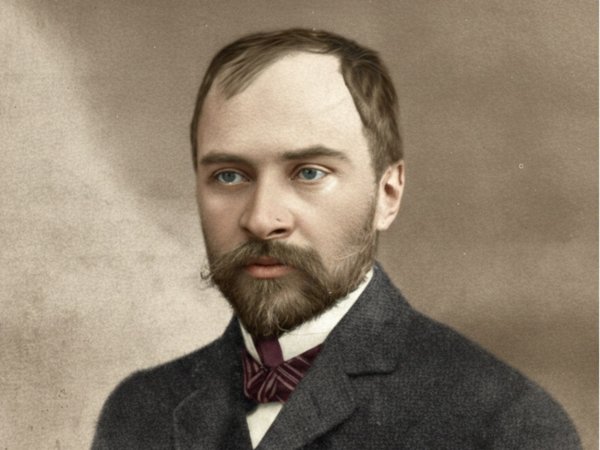
The destiny of George Coșbuc is one of the most impressive in Romanian literature. Beyond the image of the classical poet known from school textbooks, Coșbuc was a complex personality: a precocious spirit, a brilliant translator, and a researcher of folk traditions. His life was marked, however, by a personal tragedy that profoundly changed him — the death of his only son, Alexandru Coșbuc, an event that shattered his emotional balance and diminished his desire to live. In the poet’s memory, one of the important boulevards of Bucharest is today named after him, an artery that recalls both a brilliant artistic destiny and a deeply tragic one.
The child prodigy who became a poet
George Coșbuc distinguished himself from childhood through an unusual intelligence and sensitivity. It is said that before turning ten he had already composed approximately 160 poems, a remarkable performance even for a mature author. This intense activity was not the result of mere spontaneous talent, but also of a solid education.
At the Romanian gymnasium in Năsăud he thoroughly studied the classical languages, Latin and Greek, disciplines that formed a solid cultural foundation. This knowledge would later play an essential role in his activity as a translator and scholar. From adolescence, Coșbuc proved himself not only a talented poet, but also a rigorous intellectual.
His first important poem was published in the magazine “Familia” and bore a symbolic dedication addressed to the Hungarian poet Petöfi. Publication in this magazine represented the first step toward literary recognition. His talent was quickly noticed by established writers, and the publication of poems and poetic fairy tales in the magazine “Tribuna” brought him an increasing number of admirers.
Although he did not complete his university studies in Cluj, Coșbuc managed to establish himself in the cultural environment. Supported by friends and admirers, he was introduced into the important literary circles of the time. He collaborated on ambitious editorial projects and drew close to influential writers.
Literary consecration and the great volumes
Definitive consecration came in 1893, with the appearance of the volume Ballads and Idyls. The book impressed through the way it combined rural inspiration with refined poetic technique. The characters and scenes described possessed a rarely encountered vitality, and the language was clear and expressive.
Poems such as “At the Mirror,” “The Rivals,” “The Song of the Spindle,” or “Winter on the Street” quickly became well known and remain to this day among his most widely read creations. They present an idealized rural world, but one that is lively and authentic, populated by memorable characters.
After the success of this volume, the poet continued to publish. Threads of Yarn, which appeared in 1896, and The Journal of an Idler, published in 1902, marked a change in tone and a diversification of themes. Coșbuc partially moved away from the peasant universe that had made him famous, exploring new literary directions.
An important moment was represented by the appearance of the volume Songs of Heroism, in 1904. Inspired by the War of Independence, these poems demonstrate his strength in the heroic register. Critics often considered that in this field Coșbuc even surpassed Vasile Alecsandri.
His masterpiece remains Zamfira’s Wedding, a poem of folkloric inspiration that recreates the atmosphere of a fabulous wedding. In the same dramatic register is also included The Death of Fulger, a powerful creation through its emotional tension.
Alongside native themes, Coșbuc also adapted Western ballads, managing to give them an original Romanian form. This openness toward universal literature shows the cosmopolitan dimension of the author.
The translator of great masterpieces
An essential part of George Coșbuc’s activity was dedicated to literary translations. This work established him as one of the most important Romanian translators.
He produced the first translation into Romanian verse of Homer’s Odyssey, a monumental work that required not only knowledge of the original language, but also exceptional poetic sensitivity. Later, he also translated Vergil’s Aeneid, preserving the rhythm and grandeur of the Latin text.
Through the intermediary of the German language he brought into Romanian culture works from Sanskrit literature, such as Sakuntala by Kalidasa and a Sanskrit anthology. These works contributed to the widening of Romanian cultural horizons.
A decisive moment was the meeting with Ramiro Ortiz, who awakened his interest in The Divine Comedy. In order to accomplish the translation, Coșbuc taught himself the Italian language. After a period spent in Italy, he completed the first Romanian translation of Dante’s work.
His translations were not simple mechanical transpositions. They represented true artistic recreations, in which the original spirit was preserved, but the expression was adapted to the Romanian language. This ability brought him an exceptional reputation.
The poet and the researcher of traditions
George Coșbuc was also a passionate researcher of Romanian folklore. He studied proverbs, laments, and riddles, attempting to discover the spiritual structure of popular culture.
Influenced by the theories of Max Müller, Coșbuc regarded traditions as a form of expression of collective mentality. Through these concerns, some researchers considered him a precursor of modern studies on religion and mythology.
This erudite side completes the image of the poet. He was not only a creator of verses, but also an intellectual interested in the roots of Romanian culture.
The solemn image of the poet is contradicted, however, by certain episodes from his youth. One of the best known took place when he was about 12 years old. After attending a wedding where he had celebrated all night, Coșbuc went to school the next day tired and disoriented.
During the history lesson, the teacher asked him to speak about the Seven Years’ War, but the pupil began to talk about the party he had attended. Irritated, the teacher punished him, and Coșbuc reacted violently, throwing a chair toward him. The incident ended only after the intervention of his father, who saved him from expulsion.
This episode shows that behind the disciplined poet there stood an energetic and sometimes impulsive personality.
The tragedy that broke his life
In the last years of his life, Coșbuc experienced both official recognition and personal suffering. In 1916 he was elected a full member of the Romanian Academy, one of the greatest cultural distinctions.
A year earlier, however, his life had been shaken by a tragedy. In August 1915, his son Alexandru died in an automobile accident that took place near the locality of Bălești, in Gorj County.
The young man, born on August 23, 1895, had a promising future. He had studied at the Faculty of Philology and had distinguished himself through intellectual talent. He knew numerous foreign languages and was attracted to literature and art.
He was a good musician, played the violin, and had talent for drawing. He had studied Latin, modern Greek, Sanskrit, Hebrew, Arabic, and the Slavic languages. His professors considered him an exceptional student.
In the automobile accident, the car in which he was traveling overturned because of speed and a technical defect. Alexandru was seriously injured and died on the way to the city. The funeral took place at Bellu Cemetery on August 30, 1915, in an atmosphere of profound emotion.
The writer Liviu Rebreanu visited Coșbuc after the tragedy and later recounted that the poet was devastated. The loss of his son overwhelmed him and destroyed his inner balance. Contemporaries said that the poet died of a “broken heart,” an expression suggesting deep moral suffering. After Alexandru’s death, Coșbuc withdrew from public life and became increasingly isolated.
His pain was felt not only by his family, but also by friends and collaborators. Alexandru’s death was considered a loss for the entire Romanian culture.
George Coșbuc Boulevard in Bucharest
Today, the poet’s name is borne by George Coșbuc Boulevard, an important artery located in the central-southern area of Bucharest. The boulevard lies mainly in Sector 5 and connects Regina Maria Square with the Rahova area.
The artery crosses historic neighborhoods of the city and represents a link between the old center and the southern areas of the capital. Along the boulevard there are buildings from the late nineteenth century and early twentieth century, but also newer constructions that reflect the transformations of the city.
The boulevard’s name recalls one of the most important Romanian poets, but also his profoundly human destiny. In this way, George Coșbuc remains present in the memory of the city not only through his books, but also through the geography of Bucharest, where his name continues to be spoken daily by thousands of people.
We also recommend: Famous boulevard names: King Michael I and the century of the sovereign exiled from his much-loved Romania