Famous Boulevard Names: Marshal Constantin Prezan, One of the Heroes of the First World War
- Articles
- 26 FEB 26
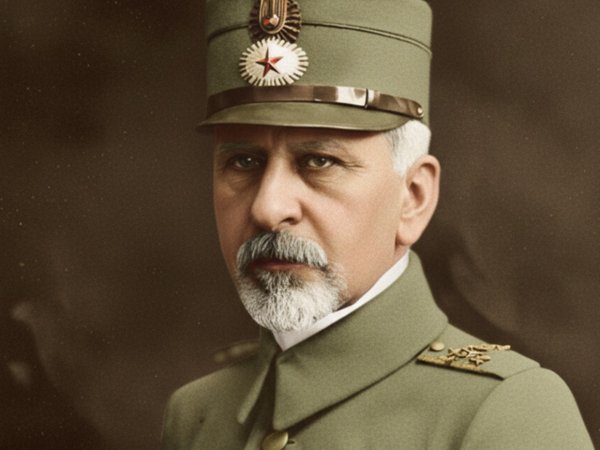
The figure of Marshal Constantin Prezan occupies a leading place in the military history of modern Romania. A prominent personality of the War of National Unification, Prezan was one of the main architects of the reorganization of the Romanian army and of the military successes that made it possible to preserve the Romanian state during the most difficult moments of the First World War. His name is today borne by streets and boulevards in numerous cities of the country, as a sign of respect for his contribution to the creation of Greater Romania. His life represents the classic model of the Romanian officer formed through work, discipline, and devotion to the country. From modest beginnings to the highest military rank, his destiny was intertwined with the great events of national history.
The Formation of an Elite Officer
Constantin Prezan was born on January 27, 1861, in the village of Sterianul de Mijloc, in the commune of Butimanu, Ilfov County, into a modest family. He attended primary school in his native locality, after which he was enrolled at the Sons of Soldiers School in Iași, choosing the military career from an early age.
After graduating from this institution in 1878, he attended the infantry officers’ school, and on July 1, 1880, he was appointed second lieutenant in the 7th Line Regiment. Shortly afterward, he was assigned to the 2nd Engineer Battalion in Bucharest, a branch that required complex technical training and special skills. In order to become a specialist, between 1881 and 1883 he attended the courses of the special engineer school, being promoted to lieutenant.
His exceptional qualities determined the army leadership to send him to studies in France. He attended the courses of the Artillery and Engineer Application School in Fontainebleau, where he obtained excellent results and the brevet of staff officer. During his studies he met the future politician Ion I. C. Brătianu, who was studying in the French capital.
Graduation with the qualification “very good” in 1886 confirmed the value of the young officer, who was to become one of the most important figures of the Romanian army.
Military Rise and Closeness to the Royal House
After returning to the country, Prezan distinguished himself through his involvement in the realization of one of the most important military projects of the era: the system of fortifications around Bucharest, known as the “Bucharest Fortress.” In 1896, having reached the rank of lieutenant colonel, he was appointed for several months commander of this important defensive complex.
The same year marked a decisive turning point in his career. On November 16, 1896, he was appointed royal aide-de-camp and attached to Crown Prince Ferdinand. This appointment reflected the trust he enjoyed in the circles close to the monarchy.
Prezan accompanied the prince on numerous trips and official activities, contributing to his preparation for the role of future supreme commander of the army. At the same time, his wife Olga became lady-in-waiting to Princess Maria. The years spent in the service of the Royal House strengthened the relationship of trust between Prezan and the future king, a relationship that was to be essential during the war.
Later, Prezan held positions as regimental commander and divisional commander. He distinguished himself in the campaign south of the Danube in 1913, and in 1914 he was promoted to the rank of divisional general and appointed commander of the 4th Army Corps, headquartered in Iași.
Romania Before the Great War
The outbreak of the First World War in 1914 placed Romania in a difficult situation. After the death of King Carol I, the throne was occupied by Ferdinand, and the political leadership remained in the hands of Prime Minister Ionel Brătianu.
During this period of armed neutrality, Prezan was offered the position of Chief of the General Staff, with the mission of preparing the army for war. He refused, preferring to remain at the command of the 4th Army Corps. The position was given to General Dumitru Iliescu, a choice that later proved unfortunate.
Prezan’s decision showed his modesty and practical spirit, preferring direct command of troops instead of an administrative position.
The 1916 Campaign and the Fighting in the Carpathians
Romania’s entry into the war on August 14/27, 1916 had as its objective the realization of national unity. General Prezan received command of the 4th Army, which had the mission of crossing the Eastern Carpathians.
The operation was initially carried out successfully. The troops commanded by Prezan advanced about 130 kilometers into enemy territory by the end of September. Later, the offensive of the Central Powers forced the Romanian army to retreat.
The retreat was carried out in order, without major losses of organization, demonstrating the general’s qualities as a commander. The 4th Army defended fiercely the passes of the Eastern Carpathians and especially the Oituz Pass.
In these battles General Eremia Grigorescu distinguished himself, whose troops repelled enemy attacks and prevented the separation of Moldavia from the rest of the country.
The Battle for Bucharest
The general situation of the Romanian army deteriorated in the autumn of 1916, and Bucharest was threatened by the offensive of the Central Powers.
The Romanian command organized the battle on the Argeș and Neajlov rivers, entrusting command of the army group to General Prezan. He conceived a bold plan to destroy in succession the enemy troops advancing toward the capital.
The plan did not succeed, however, because of the enemy’s numerical superiority and the lack of cooperation from the Russian army. On December 6, 1916, Bucharest was occupied by the enemy. Although the operation failed, Prezan remained one of the most capable commanders of the Romanian army.
The Reorganization of the Romanian Army
In December 1916, Prezan was promoted to general of army corps and appointed Chief of the Great Headquarters. His mission was extremely difficult: the withdrawal of the army into Moldavia and its reorganization for the continuation of the struggle.
The reorganization of the army was carried out in collaboration with the French military mission led by General Berthelot.
Under dramatic conditions — reduced territory, numerous refugees, and epidemics — the Romanian army managed to reorganize. Prezan coordinated the transformation of a defeated army into a force capable of resistance.
The Great Battles of 1917
Under Prezan’s leadership, the Great Headquarters organized the campaign of the bloody summer of 1917. The operations included the offensive at Mărăști, led by General Averescu, and the defensive battles of Mărășești and Oituz.
These confrontations represented decisive moments of the war for Romania. The Romanian army succeeded in stopping the offensive of the Central Powers and in maintaining the existence of the Romanian state. The defensive victories demonstrated the effectiveness of the reorganization carried out under Prezan’s leadership.
From Forced Peace to the Great Union
The Bolshevik Revolution in Russia radically changed the strategic situation. Russia concluded a separate peace with the Central Powers, forcing Romania as well to accept the armistice.
In 1918, the Romanian army intervened in Bessarabia in order to ensure stability and to allow the realization of union with Romania. In April 1918, Prezan was placed in reserve in the context of the peace imposed on Romania. King Ferdinand did not ratify the treaty, however.
The situation changed radically in the autumn of 1918, when Romania reentered the war. Prezan returned to the leadership of the Great Headquarters and coordinated the military actions that ensured the defense of the new Greater Romania. The union of Bukovina and Transylvania consecrated the fulfillment of the national ideal.
The Campaigns of 1919 and the Final Victory
After the war, the Romanian army had to face the danger represented by the Bolshevik regime in Hungary. Romanian troops pushed back the Hungarian army to the Tisza River, and in July 1919 they crossed the river and occupied Budapest.
General Prezan, although the architect of this victory, refused to enter the Hungarian capital at the head of the troops, leaving this honor to General Gheorghe Mărdărescu. His gesture demonstrated the modesty and team spirit that characterized him.
Honors and Recognition
After the war, Constantin Prezan retired from activity following the dissolution of the Great Headquarters in 1920. His merits were officially recognized. In 1923 he was appointed honorary member of the Romanian Academy, a rare distinction for a military officer.
In the same year, Parliament granted him the right to wear the military uniform for life and to benefit from the honors granted during wartime. The most important recognition came in 1930, when King Carol II instituted the rank of Marshal of Romania. Prezan was among the first officers to receive this distinction.
Although he was invited several times to form governments of national union, Prezan constantly refused direct political involvement.
The Final Years and the Legacy
In the last years of his life, Marshal Prezan witnessed with sadness the crisis of Greater Romania in 1940. During that period he guaranteed the loyalty to Germany of General Ion Antonescu, his former subordinate.
Constantin Prezan died on August 27, 1943, at his manor in Schinetea, Vaslui County, shortly after the death of his wife.
His state funeral was honored by King Mihai and the leadership of the state, as a sign of recognition for one of the greatest Romanian military commanders.
Marshal Constantin Prezan remains one of the fundamental personalities of the era in which national unity was achieved. Through professionalism, modesty, and devotion, he became a model for generations of soldiers.
His name, borne by streets and boulevards in Romania, permanently recalls the essential role he played in the defense and unification of the Romanian state. His destiny illustrates the way in which a dedicated individual can decisively influence the course of a nation’s history.
We also recommend: Major Ion Coravu, the Romanian hero of Mărăști in the First World War, has a street named after him in Bucharest