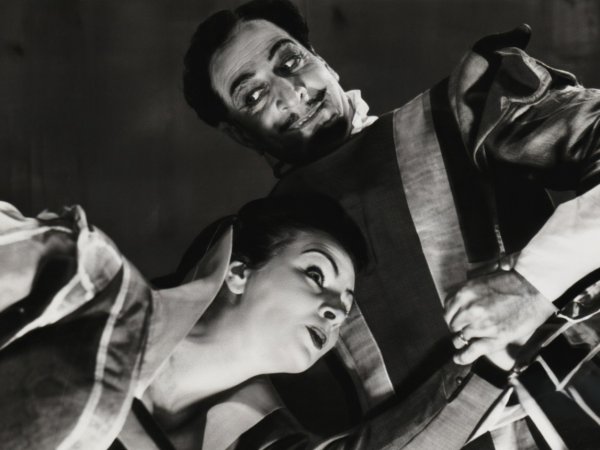
“Don’t You Feel Sorry for Me?” Bucharest-born George Demetru, Emeritus Artist of the People, the Greatest Chiriac in Romanian Drama
- Articles
- 21 SEP 26
In the history of Romanian cinema, there are characters who have become inseparable from the actors who played them. Chiriac, Jupân Dumitrache’s trusted man and Veta’s secret lover from “A Stormy Night,” is one of these characters. In the film made by Jean Georgescu and released in 1943, George Demetru managed to give him a distinctive expressiveness, turning him into one of the most memorable presences in the screen adaptation of I.L. Caragiale. Born in Bucharest on December 9, 1905, under his real name Dumitru Georgescu, George Demetru belonged to a generation of actors who created the link between interwar Romanian theater and the cinema that developed during the following decades. He died in Bucharest on February 27, 1984, after a career spanning more than half a century. Biographical sources record him as a theater and film actor, while his artistic career was crowned with the title of Emeritus Artist and, in 1967, with the Order of Cultural Merit, 2nd Class, for outstanding merits in the field of dramatic art.
An actor trained at Lucia Sturdza-Bulandra’s school
George Demetru trained under the guidance of one of the great personalities of Romanian theater, Lucia Sturdza-Bulandra. An obituary published in the magazine “Teatrul” in April 1984 mentions that Demetru was her student and that, later, his talent took him to Paris, where he studied as a scholarship holder in the class of the famous Charles Dullin.
This training partly explains the rigor with which the actor built his characters. At a time when Romanian theater was undergoing important transformations, Demetru benefited from the influence of a solid theatrical school, as well as from contact with European experience. In the memorial published after his death, Alecu Popovici described him as an actor with “a completely personal voice,” destined to interpret “the men” of the Romanian stage, strong and vigorous characters, which he portrayed with discretion and sobriety.
His theatrical repertoire included characters from important works of Romanian and universal drama. He acted in “The Lost Letter,” “Răzvan and Vidra,” “String Yourself Up, Pearls,” “The Muscata at the Window,” “The Woman, Caesar of Him,” “Monna Vanna,” “Carnival Scenes,” “The Red Roses,” “The Winter’s Tale,” and “Titanic Waltz.” He was also present in performances such as “The Great Day,” “Arma Christi,” “The Power of Darkness,” “A Doll’s House,” and “The Last Ones.”
An important stage of his career took place at the Nottara Theatre, to which, according to the recollection published in “Teatrul,” he dedicated the last decades of his artistic life. There he played, among others, characters in “The Fountain of the Herds,” “The Taming of the Shrew,” “Cyrano,” “The Moon of the Disinherited,” “Passions,” “Master Manole,” “The Taming of the Shrew,” “A Real Man,” and “The Fountain of Blanduzia.”
Chiriac, the character who fixed his face in the memory of cinema
For Romanian cinema, however, the essential moment of George Demetru’s career remains “A Stormy Night.” Jean Georgescu’s film, made during the war and released on March 22, 1943, is one of the first major screen adaptations of I.L. Caragiale’s universe. The film was produced by the National Cinematography Office, and filming took place in 1942.
The cast brought together actors such as Alexandru Giugaru as Jupân Dumitrache, Maria Maximilian as Veta, Ștefan Iordănescu-Bruno as Nae Ipingescu, and Radu Beligan as Rică Venturiano. For Radu Beligan, the film represented his cinematic debut. George Demetru was given the role of Chiriac, Dumitrache’s clerk and trusted man, but also a sergeant in the Civic Guard.
Chiriac is one of the most interesting characters in the play precisely because he constantly lives between two identities. In front of Dumitrache, he is the loyal employee, the man who protects the family man’s honor and who seems ready to do anything for his master. In reality, he is the very man who maintains the clandestine relationship with Veta, Dumitrache’s wife. The film exploits this contradiction, and Demetru transforms it into a permanent source of tension and comedy.
The actor does not play Chiriac as a simple comic character. There is also a certain gravity in his interpretation. Chiriac is jealous, proud, impulsive, and vulnerable, while the moments when he loses control show that, beyond the appearance of an authoritarian man, there is a person dominated by passion.
“Don’t You Feel Sorry for Me?” – the moment when comedy becomes drama
The line in the title belongs to one of the most intense scenes in Caragiale’s play. The relationship between Veta and Chiriac reaches a critical point, and Chiriac threatens to take his own life. Veta tries to stop him, and her despair explodes in the question: “Don’t you feel sorry for me? You have forgotten everything, everything, in one day, after more than a year?”
It is a scene that shows how much “A Stormy Night” goes beyond a simple comedy of manners. Caragiale creates here a situation in which jealousy, love, fear, and ridicule coexist. Chiriac is no longer merely the clerk who accompanies Dumitrache and protects his honor, but a man in love, wounded and convinced that he has lost the woman he loves.
This very change in register gave George Demetru the opportunity to demonstrate that he was more than a comedy actor. Chiriac has moments of anger, tenderness, jealousy, and despair, and the interpretation must preserve at the same time the comic dimension of the situation. Demetru manages to make this contradiction visible without turning the character into a caricature.
Another memorable moment appears when Chiriac justifies his despair through his love for Veta. “If there is nothing left between us,” he says, “how am I supposed to go on living?” In this scene, the character becomes almost tragic for a few moments, before Caragiale’s absurd universe brings everything back into the realm of comedy.
From Chiriac to the great characters of stage and screen
George Demetru’s success in “A Stormy Night” did not mean that the actor remained a prisoner of a single role. On the contrary, his filmography stretches across several decades and includes very different productions. He appeared in “A Winter’s Night Dream” (1946), “The Development” (1954), “Our Director” (1955), “The Lying Little Girl” (1956), “The Devil’s Ravine” and “The Storm Bird” (1957).
In the following years, he acted in “He Was My Friend,” “Vacation at the Seaside,” “Steps Toward the Moon,” “The Stranger,” “If I Were... Harap Alb,” “Beautiful Vacations,” “The Leatherstocking Tales,” “Michael the Brave,” “Power and Truth,” and “Because They Love Each Other.” In “If I Were... Harap Alb,” for example, he played Emperor Alb, while in “Because They Love Each Other” he appeared in the cast of the 1972 film.
This filmography shows the breadth of his career. Demetru moved from the comedy inspired by Caragiale to historical films, literary productions, and dramas, without being defined exclusively by his role as Chiriac. In “Michael the Brave,” one of the great Romanian cinematic productions of the early 1970s, he was part of a large ensemble cast, while in “Power and Truth” and “Because They Love Each Other” he continued to appear on screen during a period when his generation of actors had reached artistic maturity.
Emeritus Artist and one of the strong figures of the Romanian stage
Official recognition came during a career that was already well established. George Demetru received the title of Emeritus Artist before 1964, and in 1967 he was awarded the Order of Cultural Merit, 2nd Class, for outstanding merits in the field of dramatic art. These distinctions confirm the status he had acquired in Romanian theater after decades of activity.
What is important, however, is that George Demetru was not merely an actor of his generation, nor simply the face of Chiriac in a famous screen adaptation. The recollection published after his death in the magazine “Teatrul” emphasizes his artistic diversity and the fact that he dedicated the last decades of his life to the stage of the Nottara Theatre. The portrait created by Alecu Popovici presents him as an actor capable of moving from romantic characters to heroes, defeated men, historical figures, or characters of great stage force.
George Demetru died in Bucharest on February 27, 1984, at the age of 78. In the obituary published in “Teatrul,” his cinematic memory was naturally associated with Chiriac, alongside other roles in “A Winter’s Night Dream,” “The Development,” “If I Were Harap Alb,” and “Beautiful Vacations.”
Today, when “A Stormy Night” is watched again, George Demetru’s face remains one of the elements that give the film its special strength. His Chiriac is not merely the man who protects Dumitrache’s “family man’s honor,” but also the man who, behind closed doors, loses his confidence, becomes jealous, and fears that he will lose Veta’s love. It is precisely this double identity that explains why his performance has remained memorable.
The line “Don’t you feel sorry for me?” encapsulates, in fact, the entire contradiction of the character. In a single scene, Chiriac is both the authoritarian man of the neighborhood and the vulnerable lover, both the comic character and the man overcome by despair. And George Demetru knew how to play all these nuances, transforming Chiriac into one of the roles that continue to connect the actor’s name with the memory of I.L. Caragiale and with the history of Romanian cinema.
We also recommend: The story of Dumitru Georgescu Kiriac, the Bucharest composer who brought authentic Romanian folklore into classical music